With a focus on conservation, allocation and restoration, water conservancy initiatives have been breathing life back into rivers and rejuvenating entire watersheds, said Minister of Water Resources Li Guoying in Beijing on Saturday.
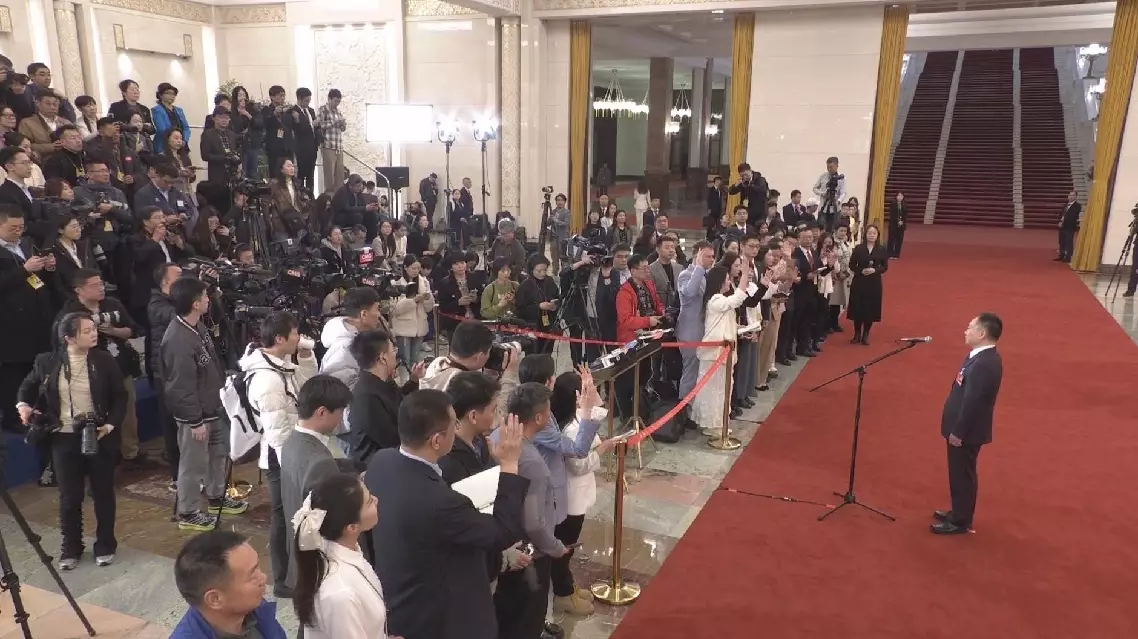
Li, also a deputy to the 14th National People's Congress (NPC), introduced the efforts the Ministry of Water Resources has made in improving the ecological environment in a group interview after the second plenary meeting of the third session of the 14th NPC.
China's per capita water availability is only 35 percent of the global average, and problems such as over-extraction and water wastage persist, making it an urgent need for efficient water management. To address this, the government has strengthened restrictions on water use and adopted a strategy of development tailored to local water availability. Measures included enforcing the Water Conservation Regulation, launching a nationwide water-saving campaign, and creating policies to improve water efficiency in agriculture, industry, and cities. These efforts have kept water use within the limits of what rivers and lakes can sustain, allowing more water to flow back into natural ecosystems.
"Over the past decade, our GDP has nearly doubled, yet total water consumption nationwide has registered zero growth," he pointed out, showcasing the effectiveness of these measures.
China's fundamental water challenge lies in its uneven distribution: abundant in the south but scarce in the north, with seasonal disparities exacerbating the issue. To tackle these issues, the ministry has prioritized the construction of a national water network, integrating provincial, municipal, and county-level systems to optimize the allocation of water resources.
"As the main skeleton and artery of the national water grid, the first phase of the east and central routes of the South-North Water Diversion Project has diverted 78.8 billion cubic meters of water to northern regions, benefiting more than 185 million people. They have served as a lifeline for optimizing water resource allocation, ensuring people's drinking water safety, restoring the ecological environment of rivers and lakes, and facilitating the economic circulation between the north and the south," said the minister.
China have emphasized the ecological restoration of rivers and lakes. Efforts have been made to manage entire river basins as a whole, considering upstream and downstream areas, both banks, main rivers and tributaries, as well as surface and underground water. Specific plans have been created for each river and lake, with consistent and coordinated actions. Key measures included strengthening the River and Lake Chief System, restoring the ecology of rivers and lakes, tackling groundwater overuse, and improving soil and water conservation. Notably, the Mother River Revitalization Campaign, which aims to maintain ecological flow in rivers and lakes, has seen great progress.
"The Beijing-Hangzhou Grand Canal, which had been dry for 100 years, has now achieved full connectivity for three consecutive years. The Yongding River, which hadn't flowed for 26 years, has now been fully restored for four consecutive years. And the Haihe River Basin, once plagued by 'dry rivers and polluted waters,' has seen a complete turnaround," according to Li.
China's water management efforts underscore that "there is no endpoint to safeguarding the health of rivers and lakes," as Li emphasized. The ministry will persevere in its mission to restore the vitality of rivers and lakes, allowing watersheds to thrive once again and ensuring that more rivers and lakes become sources of happiness and wellbeing for the people, Li said.
China's water conservancy initiatives revive arid rivers, ecosystems: minister