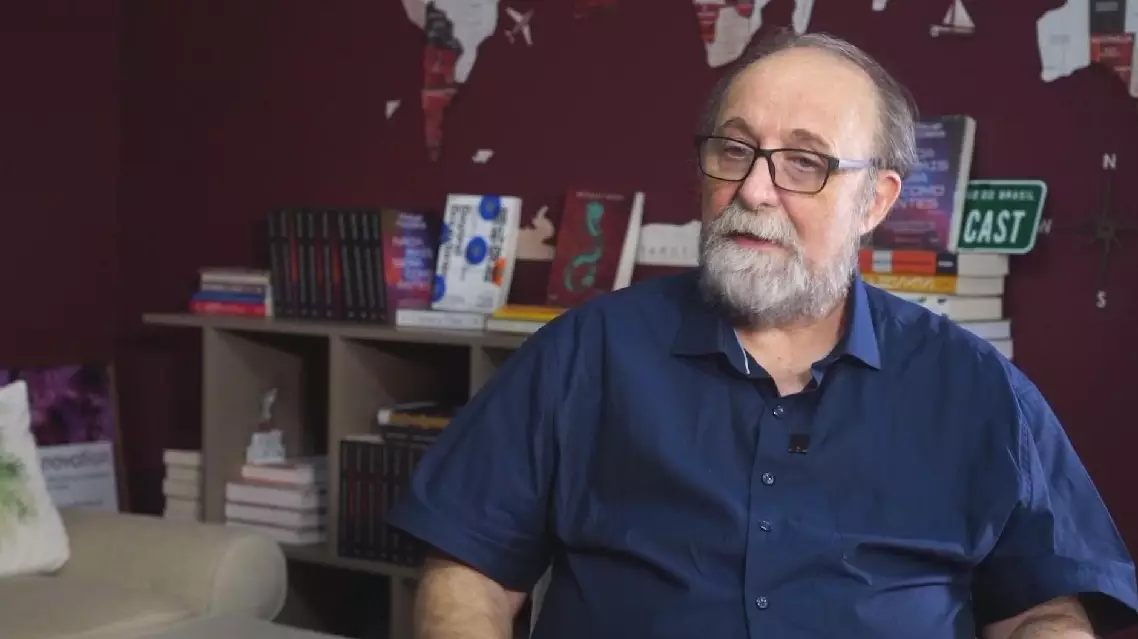
Brazilian neuroscientist Miguel Nicolelis, a recipient of the Chinese Government's Friendship Awards, discussed his groundbreaking work and the significance of its recognition in China in a recent, exclusive interview with China Global Television Network (CGTN).
Nicolelis is regarded as one of the world's leading experts in the field of brain-machine interfaces, a technology that enables individuals to control machines using only their minds.
His pioneering Walk Again project uses this technology to assist individuals with severe disabilities, such as quadriplegia, in regaining mobility through the use of exoskeletons.
Several years ago, Nicolelis was invited to collaborate with brain injury patients at Capital Medical University in Beijing, China, to further his research. The initial results of this collaboration were recently published.
"The trial was concluded, and the results are mind boggling. They didn't even need the exoskeleton because they had recovered partially the ability to control their muscles, their leg muscles. Because some of them, particularly one young lady, the improvement was so tremendous that she was able to walk on the streets of Beijing with no exo, just with a little, one of these carts that we use, elderly people use to walk," he said.
Nicolelis expressed his gratitude for the award, and highlighted the successful transfer of technology and the positive impact on patients, noting the importance of science in Chinese society and government.
"I think what I was told is that the rationale behind this award for me was because of this successful transfer of technology and collaboration for many years, and the fact that the patients are benefiting. I was very touched to see how relevant science is for the Chinese society and the government, of course," said Nicolelis.
He also shared a story from his meeting with Chinese Premier Li Qiang and the Minister of Foreign Affairs Wang Yi.
"There was another major surprise because, I was telling your friends here, I got to the banquet, and there was the central table for the authorities. So I sat there. And suddenly the Premier gets there and he introduces himself. Mr. Wang introduced himself. I said, 'No, I know you. I saw you on TV many times'. And he laughed. And then the Premier looked at me and said through the translator, of course, 'What do you think is the future of brain-machine interface, its going to be invasive or non-invasive?' The Premier was asking me a very focused, precise scientific question. I said 'Well I think its non-invasive'. There are 3.4 billion people suffering from some sort of brain disorder. That's 43 percent of humanity. There's no way you can implant brain chips in 3.4 billion people. You need techniques that are affordable, safe and can scale," he said.
Friendship Award recipient delighted that research could benefit China