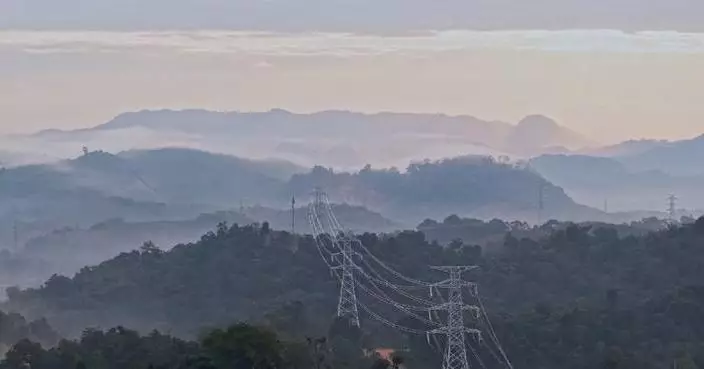
A series of tree-planting activities were held across China as the country marked its 47th Arbor Day, or Tree-Planting Day, on Wednesday, with the aim of improving plant coverage and combating soil erosion and desertification.
The Tree-Planting Day is a time to embrace nature and sow hope for a greener future, and tree-planting activities were in full swing along the banks of the Yangtze River that runs through Jingzhou City, in central China's Hubei Province. Hundreds of volunteers worked in high spirit with tools in hand, digging holes, planting trees, and watering the new saplings. Over 500 trees have been planted in a short period of time.
This initiative will continue beyond the Tree-Planting Day, with an annual goal of planting trees across an area of approximately 2,000 hectares along the riverbank.
Meanwhile, in east China's Fujian Province, efforts to improve forest landscapes were made in scenic areas, including the Wuyi Mountain, a place of great natural beauty that was designated as a UNESCO World Heritage site for both cultural and natural heritage protection in 1999. Around 20,000 flowering trees have been planted in the scenic area.
In Changting County of Fujian Province, staff from the local soil and water conservation center were busy replanting tree species that can capture carbon effectively.
"Today we are replanting Chinese Sweet Gum and Chinese guger trees, which are the native broad-leaved tree species that can capture carbon effectively. We have reached our goal of forestation coverage and soil erosion prevention thanks to measures taken before," said Yue Hui, director of Changting County Soil and Water Conservation Center.
Changting was once among the counties with the most serious soil erosion in southeastern China's red soil region.
Data shows that since 2012, Changting County has taken comprehensive measures to control soil erosion in an area of over 97,800 hectares, and the soil erosion area dropped from nearly 31,800 hectares at the end of 2011 to just over 21,000 hectares at the end of 2020, with soil erosion rate dropping to 6.78 percent, which is lower than the provincial average.
Fujian Province has completed around 31,200 hectares of tree planting and afforestation work so far the last year. The province's forest coverage rate has exceeded 65 percent, and has ranked first in the country for several consecutive years.
In Ordos City of north China's Inner Mongolia Autonomous Region, tree-planting robots and semi-automatic planting trucks are working to combat desertification with greater efficiency and lower labor costs.
The tree-planting robots can move steadily across the sandy land, precisely inserting one-meter-long willow branches. It took just 19 minutes for these robots to complete the planting of drought-resistant plants in an area of around 700 square meters.
As the frontline in China's battle against desertification and sandstorms, Inner Mongolia shoulders 60 percent of the country's Three-North Shelterbelt Forest Program in combating sandy land degradation.
According to the Inner Mongolia Autonomous Region Forestry and Grassland Bureau, the region planted over 43 million trees through public participation in 2024.
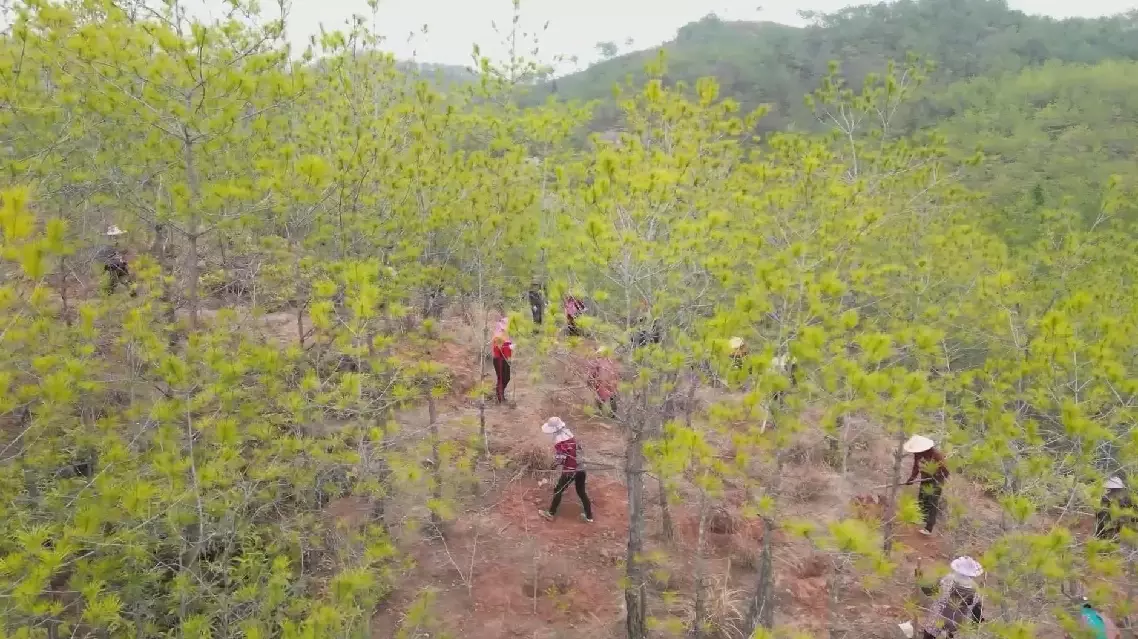
Tree-planting activities held across China in bid to build greener future