China's policy of extending zero-tariff treatment to the least developed countries (LDCs) with which it has established diplomatic relations has significantly boosted trade liberalization, fostering a new era of shared benefits and mutual development.
March 10 marked 100 days since the entry into effect of China's zero-tariff treatment for all products from the least developed countries (LDCs) maintaining diplomatic ties with China.
Over the past three months, trade between China and these nations, including 33 African countries, has seen significant growth, creating new opportunities for economic development and cooperation.
Recently, a batch of natural rubber imported from Laos cleared customs in Qingdao City of east China's Shandong Province and entered a local tire production line, benefiting from the tariff exemption.
"With the preferential certificate of origin, this shipment enjoyed the exemption of 660,000 yuan (about 91,246 U.S. dollars) in import duties," said Sun Yunhua, operator of a foreign trade company.
Implementing preferential tariff rates for the least developed countries not only reduces tariff costs for Chinese importers but also enhances the competitiveness of export products from these nations, significantly boosting bilateral trade.
To ensure that enterprises will fully utilize the policy, Chinese customs authorities leverage big data analysis to match import declarations with the zero-tariff list, providing targeted guidance.
"For goods from landlocked countries like Mali, Niger and Zambia that must be transshipped through a third-country port to reach China, as long as they remain in container transport without changes to the seal identification code, the requirement for a third-country official non-processing certificate is waived. This allows these goods to directly enjoy zero-tariff benefits, further enhancing the efficiency and convenience of preferential tariff access for businesses," said Wang Zhiwei, deputy director of the Tariff Department of Qingdao Customs.

Zero-tariff treatment for least developed countries significantly boosts trade liberalization
The U.S. Central Command (CENTCOM) said on Monday that its ongoing maritime blockade against Iran has redirected 44 commercial vessels, while a top Iranian military advisor warned that Iran will not tolerate any U.S. attempt to establish shipping lanes other than those designated by Iran in the Strait of Hormuz.
In a post on social media platform X, the command said that U.S. forces continue to strictly enforce the U.S. blockade against Iran. As of Monday, CENTCOM has redirected 44 commercial vessels, disabled two, and boarded two, it said.
On the same day, Mohsen Rezaei, military advisor to Iran's Supreme Leader, issued a firm warning over U.S. actions in the key shipping chokepoint.
Rezaei told media that Iran will never allow the United States to establish shipping routes outside those designated by Iran in the Strait of Hormuz. He warned that even U.S. warships deployed along such routes would be treated as targets.
Rezaei stressed that while Iran does not seek war, its armed forces are fully prepared and ready to fight for the country. He called on the United States to change its behavior and comply with the terms of the memorandum of understanding (MoU) signed between the two countries in June, cautioning that otherwise U.S. warships would face serious danger and Iran's armed forces would not stand by.
Separately, Rezaei revealed that Iran had previously prepared to carry out strikes on three locations in Ukraine but called off the plan after Ukraine issued an apology.
The planned retaliation followed a Ukrainian strike on an Iranian commercial vessel in the Caspian Sea on July 25, which killed one sailor and wounded three others.
On June 18, Iran and the United States signed the MoU, under which the two countries were scheduled to hold negotiations within a 60-day period to reach a final agreement. However, the talks' fate is hanging in the balance due to the recent escalation between the two sides.
The U.S. military launched multiple waves of strikes against Iranian targets last month, saying they were in response to Iranian attacks on vessels in the Strait of Hormuz and aimed at "degrading Iran's ability to threaten commercial shipping." Iran responded with missile and drone attacks targeting U.S. military bases and facilities in the region.
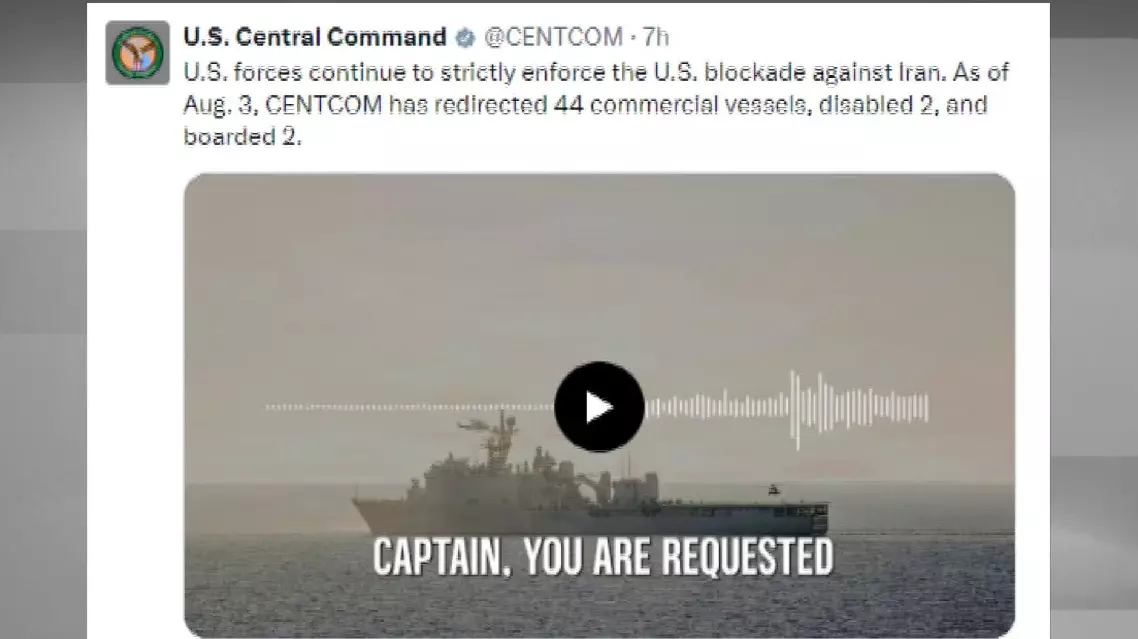
U.S. says 44 commercial ships redirected under blockade, Iran warns on Hormuz routes