Chinese scientists announced on Thursday that they have achieved the world's first real-time quantum key distribution (QKD) between a micro-nano quantum satellite and a small, mobile ground station, making an important step toward the establishment of extensive quantum messaging networks.
The milestone, published in the prestigious science journal Nature, offers a new pathway for the global deployment of the quantum internet.
Quantum secure communication, widely regarded as the only risk-free method of information transmission, is expected to significantly enhance the security of existing communication systems. However, building an efficient, practical, and global quantum communication network requires the deployment of multiple low-cost microsatellites operating in a coordinated network.
To address this challenge, a research team led by the University of Science and Technology of China (USTC), in collaboration with several domestic institutions, successfully developed the world's first quantum micro-nano satellite known as Jinan-1. Weighing only 23 kilograms, the satellite's payload is about 10 times lighter than that of Micius, the world's first quantum science experimental satellite launched by China in 2016.
Building on this breakthrough, the research team has furthered developed a lightweight and highly portable ground station system. Weighing just about 100 kilograms, the system can be deployed in diverse environments including cities, mountains, and plateaus, making it possible for flexible quantum communication.
"By making [the system] more integrated and compact, we can expand its application scope after launching more satellites and developing more ground stations. This lays a solid foundation for the future construction of a [quantum satellite] constellation, and provides a critical technological solution for the global quantum internet," said Professor Liao Shengkai from the USTC.
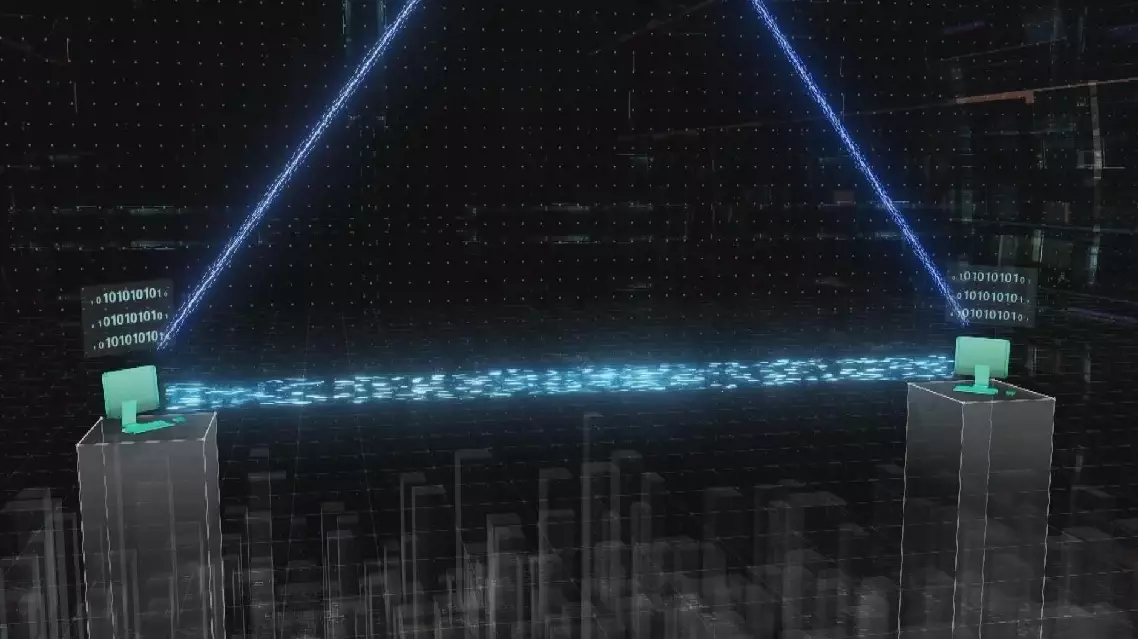
During the experiment, Jinan-1 successfully established optical links with ground stations in Beijing, Shanghai, Hefei, and Jinan, achieving real-time satellite-to-Earth QKD.
The team also used a relay satellite to create a quantum key between China and South Africa which spans a distance of over 12,900 kilometers, enabling quantum-secured transmission of image data using a "one-time pad" encryption method.
"The first [goal] is to ensure the security of information transmission. As we all know, in today's realm of information security, people don't want their messages to be eavesdropped. To achieve this, we encrypt the information, similar to locking it inside a box before sending it out. What we have developed is essentially this 'lock', and its security is guaranteed by the principles of quantum mechanics. This means that even the most powerful computers cannot decipher this system," said Professor Liao.
China achieves key breakthrough in space-to-ground quantum secure communication