Skip to Content Facebook Feature Image

China expands presence in humanoid robotics amid industry boom

China

China

China

China expands presence in humanoid robotics amid industry boom

2025-03-20 20:01 Last Updated At:03-21 00:07

China's robotics sector is rapidly ascending as a global powerhouse, driven by cutting-edge technologies and booming market demand, according to a new industry analysis by leading global financial services firm Morgan Stanley.

The report "The Humanoid 100: Mapping the Humanoid Robot Value Chain" highlights China's dominance in humanoid robotics, with 37 of the world's top 100 listed companies in the field hailing from the country -- seven based in southern city of Shenzhen alone.

The report reveals that 56 percent of companies involved in humanoid robotics and 45 percent of integrators worldwide are from China. Market projections suggest that by 2050, China's humanoid robotics market could reach a staggering 6 trillion yuan (840 billion U.S. dollars), with an estimated 59 million units in operation.

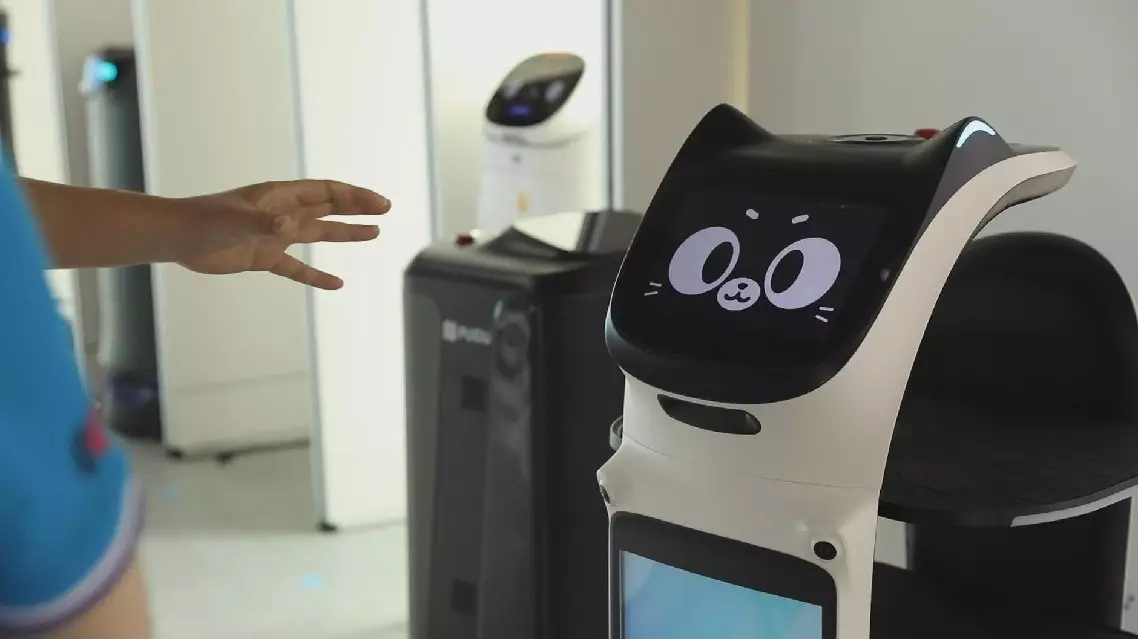
At the forefront is Shenzhen's Pudu Robotics, a leader in commercial service robots. Its cat-faced delivery bots, equipped with playful interactions and an "AI brain" powered by DeepSeek's large language model (LLM), have captivated buyers across 60 countries and regions, securing 23 percent of the global market share.

The standout creation has gained popularity worldwide, even inspiring a dedicated social media following.

"So far this year, our orders are up by 300 percent year on year," said Zhang Tao, founder and CEO of Pudu Robotics.

"We offer our clients two kinds of values. The first is functional as it can help them fix some problems. The second aspect is emotional. When consumers see these robots, they will feel it's funny," said Guo Cong, chief technology officer (CTO) of Pudu Robotics.

This robot is still iterating, and has been upgraded to serve as a shopping assistant.

"Last week, we also connected DeepSeek to this robot, which means to equip it with an AI brain, and enable it to do a lot of things," said Zhang.

Shenzhen's technology-oriented ecosystem continues to break barriers. A viral video recently showcased hikers using lightweight exoskeletons from Conchin Technology Co. Ltd. to carry 15 kilograms loads effortlessly -- a feat achieved by an exoskeleton robot weighing just 1.5 kilograms.

"We made the world's first large-scale application of exoskeletons in mountaineering. In the past, you can see that our old exoskeletons were very bulky, but after 10 years of hard work, we have now made them light, smart, and even fashionable," said Yu Yunbo, general manager of Conchin Technology.

The company's ability to quickly deliver customized products, thanks to a robust local supply chain, has given it a competitive edge. From precision gears to custom straps, suppliers are just one hour away.

Kenqing has already partnered with several overseas tourist sites and plans to integrate visual and tactile technologies for future customizations.

China's robotics industry is thriving, with data from the State Administration for Market Regulation showing that the number of smart robotics enterprises reached 451,700 by the end of 2024, a 206.73 percent increase from 2020. The sector's total registered capital hit 6.44 trillion yuan (890 billion U.S. dollars), reflecting its robust growth.

"Robot, it is not only itself, but an aggregate of Internet of Things (IoT), sensors, as well as AI-driven Machine Vision. The content of technology is relatively high. Our country's industrial chain is still quite complete (in high-tech equipment)," said Wang Xiwen, president of the Beijing Huaxia Industrial Internet Intelligent Technology Research Institute.
China expands presence in humanoid robotics amid industry boom
China expands presence in humanoid robotics amid industry boom
The 36th extraordinary session of the Council of the International Maritime Organization (IMO) concluded on Thursday in London, with member states split over who should be held accountable for the closure of the Hormuz Strait.

As a specialized UN agency, the IMO's responsibility is to safeguard global shipping safety and the rights and interests of seafarers. At the meeting, all parties had obvious differences regarding the root causes of the situation and the wording of the documents.

According to data provided by the IMO, since the outbreak of the conflict involving the United States, Israel and Iran, at least seven seafarers have been killed in attacks on merchant vessels in the Strait of Hormuz area, with several others seriously injured. Around 20,000 seafarers remain stranded aboard ships in the region.

Some countries urged condemning the actions of certain country that led to the blockade, while others believe that the root cause of the current maritime tensions in the Middle East lies in the military action launched by the United States and Israel against Iran, and that unilaterally blaming one country is neither objective nor comprehensive.

Multiple representatives emphasized that the IMO should not serve as a platform for political confrontation. They called for balanced, neutral language in resolutions and urged the organization to focus on pragmatic measures within the framework of IMO regulations to safeguard maritime corridors.

Iran's delegate pointed out that the IMO must not become a tool for political pressure, and any coordination on navigation security must involve Iran.

The Russian delegate warned that current international maritime declarations appear biased and one-sided, which hinders efforts to ease the crisis. He called on the IMO to adopt a more balanced stance.

China's delegate echoed the need for inclusive and impartial language, proposing that the resolutions reflect a constructive consensus rather than unilateral accusations. The Chinese side also suggested that language condemning or opposing military actions that lead to the escalation of tensions in the Strait should be added to proposal.

The IMO Council highlighted the urgent need to address the peril faced by numerous stranded commercial ships. It encouraged exploring frameworks, such as maritime safety corridors, as an emergency humanitarian measure to facilitate the voluntary evacuation of ships from high-risk zones to safer waters.

Regarding the U.S. proposal to provide naval escort operations, IMO Secretary-General Arsenio Dominguez said that naval escorts are not a long-term sustainable solution to the current crisis in the Strait of Hormuz, and only an end to the conflict can prevent shipping from becoming collateral damage.

While acknowledging that the root causes of the crisis lie beyond the IMO's mandate, he said he would continue to work with countries engaged in diplomatic efforts to address the situation.

Over the past few days, U.S. President Donald Trump has urged European countries and other allies to join naval escort operations in the Strait of Hormuz. However, European powers have largely rebuffed the request, citing concerns that direct military involvement would escalate regional tensions and risk drawing them into a wider conflict.

IMO members divided over accountability for closure of Hormuz Strait

IMO members divided over accountability for closure of Hormuz Strait

Recommended Articles