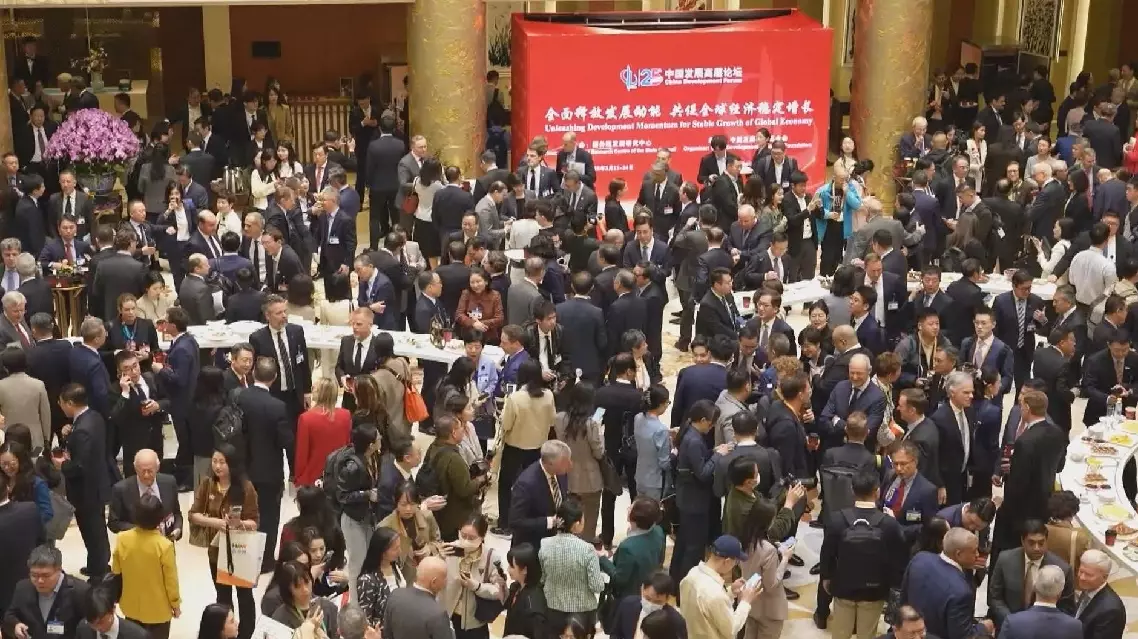
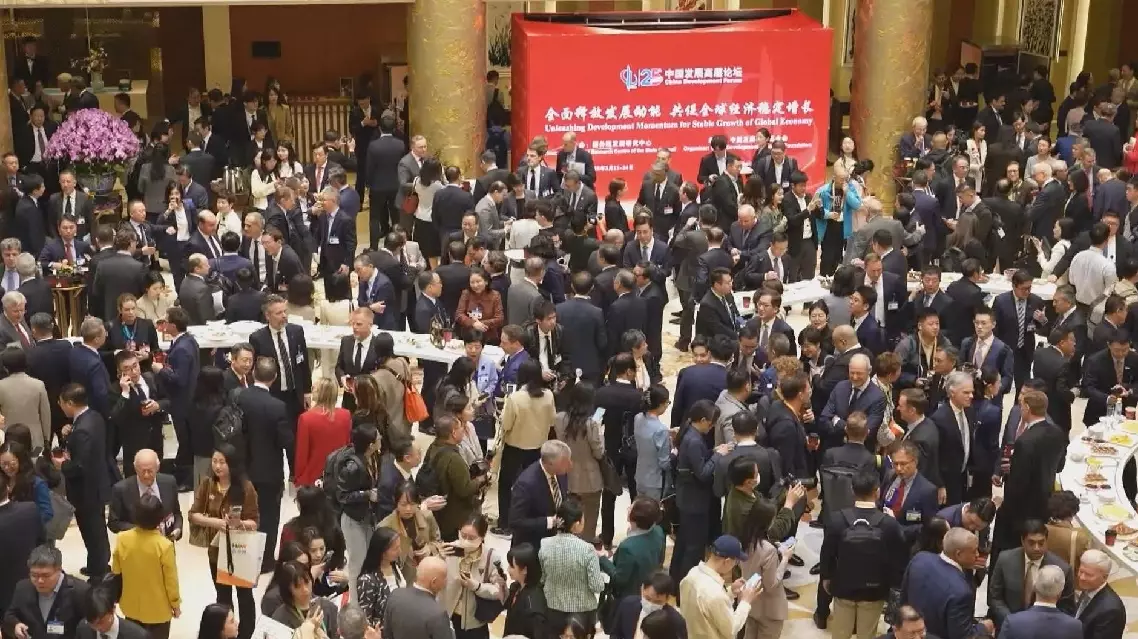
Global business leaders expressed their enthusiasm for expanding research and increasing investment in China at the China Development Forum 2025.
Themed "Unleashing Development Momentum for Stable Growth of Global Economy", the two-day forum, which brought together 86 official delegates from multinational companies from 21 countries, concluded on Monday in Beijing.
The executives attending the forum are keenly interested in China's economic dynamics and development strategies, with many arriving early to gain deeper insights into China's economic policies and technological progress.
During interviews with China Central Television (CCTV), the business leaders highlighted the buzzwords in China's development.
"That's a trade-in program, and I think that's a good sponsorship for consumption," said Stefan Hartung, chairman of the board of management of Robert Bosch GmbH, a German multinational engineering and technology company.
"We actually have strong partnerships with DeepSeek," said Michael Nelson, president and CEO of Amway, an American company that sells health, beauty and home care products.
"New quality productive forces are really the future of China," said Jean-Pascal Tricoire, CEO and chairman of the multinational electricity company Schneider Electric.
As the business leaders seek to increase presence in the country's vast market, they specified the regions where they aim to boost their investment in China.
"For us the opportunity is to penetrate all the cities," said Anil Wadhwani, CEO of Prudential plc, a British-domiciled multinational insurance and asset management company.
"We are opening up an organic farm in Sichuan Province, and so we will have a groundbreaking of that in the next several months," said Nelson.
"The places where we invest are the places where we do R and D, where we do manufacturing," said Tricoire.
"We need icy conditions for driving on ice, so we have to be in the north, right? Wuxi businesses, in Taicang, Suzhou, in Chongqing, in many areas we build up new businesses," said Hartung.
The business leaders also expressed their aspirations to diversify their portfolio in China, actively seeking out new avenues for growth and opportunity.
"And China needs more consumption. We are increasing our lineup for the home appliances," said Hartung.
"We continue to look at anti-aging products, we continue to invest into research and development capabilities," said Nelson. "We are developing with China green hydrogen. We want to develop the supply chain of desalination in China," said Mohammed Abunayyan, chairman of the board of ACWA Power, a Saudi Arabian company on power generation and desalinated water production.
Global business leaders eager to expand research, increase investment in China
China's commitment to its path of opening up will continue as a long-term national strategy and should increasingly be defined by inclusiveness, a national political advisor said Friday.
Zhou Hanmin, a member of the Standing Committee of the National Committee of the 14th Chinese People's Political Consultative Conference (CPPCC) and president of the Shanghai Public Diplomacy Association, made the remarks in an interview with China Media Group (CMG) during the annual political "two sessions" underway in Beijing.
"Opening-up is and has been a long-term national policy and a strategy ever since China opened itself up (to the world) some 48 years ago. Ever since China joined WTO (World Trade Organization), you could see it has fundamentally changed the formats of economic movements. So opening-up is a reference and also a driving force," he said.
Zhou stressed China must also invite less privileged nations to share in the prosperity of a more open world.
"Inclusiveness is one word that should be used to modify China's opening-up. I (previously) submitted a bill in CPPCC for the zero tariff for those least developed nations' exportation to China. Because for each and every China International Import Expo, you can see quite a large number of exhibitors coming from the least developed countries. We need to give them very genuine help. We are just in the situation of that. We just try to do not only with developed nations, but the Global South and rest of the countries, all together," he said.
Zhou's comments come amid the ongoing "two sessions", the annual meetings of China's top legislature, the National People's Congress (NPC), and the top political advisory body, the National Committee of the CPPCC. Both bodies serve a five-year term and hold a plenary session each year, generally in March.
The fourth session of the 14th NPC and the fourth session of the 14th National Committee of the CPPCC kicked off in Beijing on Thursday and Wednesday, respectively. A main focus is the adoption of the country's 15th Five-Year Plan (2026-2030), a key blueprint guiding China's drive toward modernization. When asked about key signals from the plan that the international community should closely watch, Zhou outlined several key issues.
"We are now carrying on this Five-Year Plan in the most crucial period of time. We are going to generally modernize the country (in) another 10 years. In this five-year period of time, we need to focus more on creation. Creation not necessarily in the field of technology. Creation means the modernization of the governance, create lots of new things in the system and methods of governance. This is also important," Zhou said.
"The modernization of industrial systems, the further expansion of the ability of consumption, and we try to know very well the longevity, whatever solves people's daily needs. The last but not least, we try to understand fully international collaboration. Opening-up is still a driving force," he said.
China's opening-up should continue path of inclusiveness: political advisor