Pascal Soriot, the Chief Executive Officer of biopharmaceutical company AstraZeneca, has commended China for fostering a supportive business environment, and emphasized the revolutionary role of artificial intelligence (AI) in the healthcare industry, during a recent interview.
Speaking to China Global Television Network (CGTN) ahead of the Boao Forum for Asia (BFA) Annual Conference 2025, Soriot expressed confidence in China’s five-percent economic growth target, highlighting robust policy support and consumer demand as key factors driving the company’s continued growth.
"In Beijing, we are setting up this new research and development center. We are going to invest 20 billion RMB in this center in doing research and development, AI, and new biology in Beijing. The government of Beijing has been incredibly supportive, better than what we could hope for anywhere in the world. So, you've got a commitment by the government, you have a strategy, you have science, you have the talent. So, I think it will happen. There are an enormous number of people in China that are still aiming to do better in life. They want to access a better life, they want to access this common prosperity and common health. So, all of those factors give me really hope and confidence that the economy will continue to grow," he said.
According to Soriot, artificial intelligence holds significant promise in advancing health innovation.
"On the innovation side, it is actually helping us discover new targets, new medicines much faster. It is helping us optimize those molecules, because you discover a target, you have a first scaffold of a molecule and then you have to optimize the molecule. In the past it would take six months, now it takes a week. It's helping us accelerate our clinical trials. So it really has a tremendous impact on the innovation side of healthcare, coming up with new medicines, bringing them to patients. And suddenly biotech companies in China are leveraging this to the full extent because there are a lot of very good AI engineers in China as we all know from hearing about DeepSeek," he said.
Soriot pointed out that AI can transform disease detection and treatment, while enhancing access to timely, high-quality healthcare services.
"An example of where AI can help is we're using a technology developed by a company called Qure AI. And it's an AI technology that scans traditional X-rays, chest X-rays that people are taking for chest infection or whatever other reasons. And we use this to actually diagnose early forms of lung cancer where people can be cured, because surgery would just remove the tumor and they are cured. Early diagnosis of lung cancer is done typically with CT scan. It's expensive, it takes time, so people don't do it. Scanning those traditional X-rays is actually a fantastic way to diagnose patients early. So I think technologies can also help in this area of early diagnosis and treatment of people," he said.
The Boao Forum for Asia (BFA) Annual Conference 2025 opened on Thursday in Boao, south China's Hainan Province.
Founded in 2001, the BFA is a non-governmental and non-profit international organization committed to promoting regional economic integration and bringing Asian countries closer to their development goals. Running from March 25 to 28, this year's conference is themed "Asia in the Changing World: Towards a Shared Future."
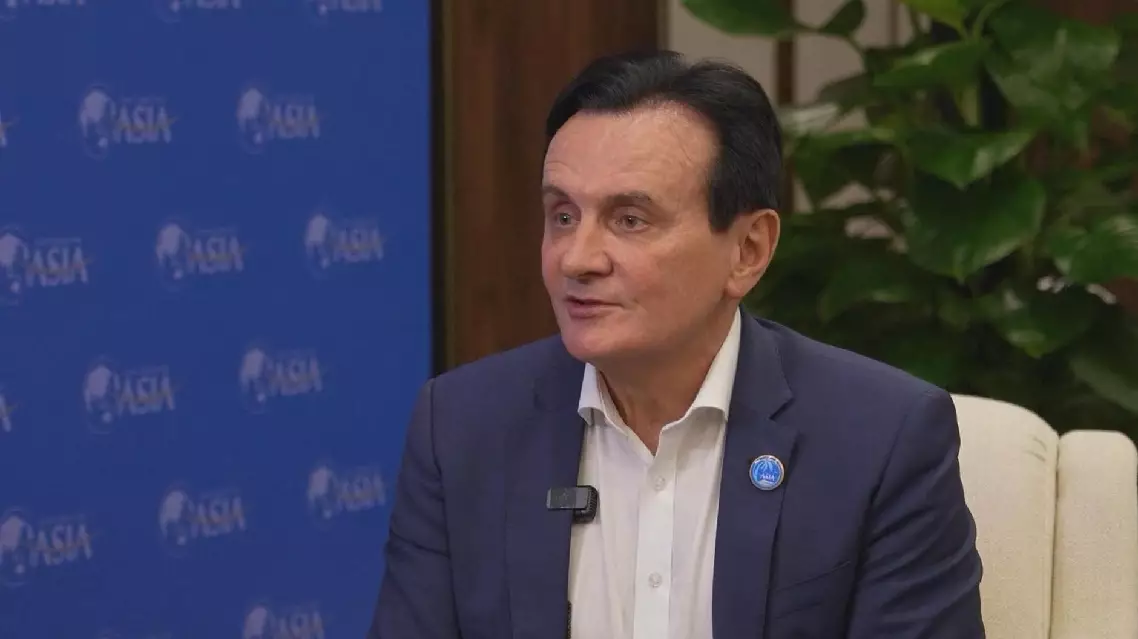
AstraZeneca CEO offers insights on China’s economy, AI-driven healthcare innovation