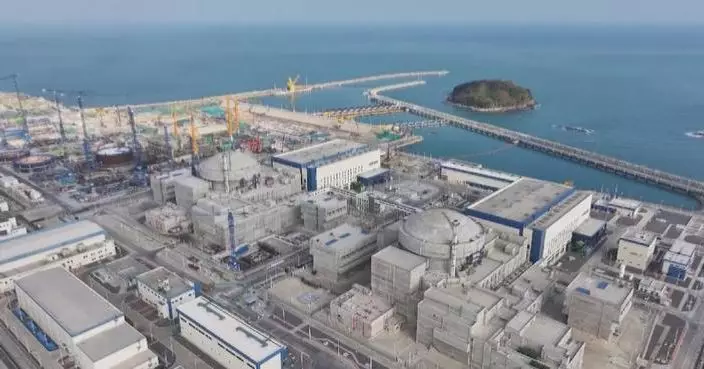
China's nuclear fusion reactor, dubbed the "artificial sun," has achieved a new technological milestone with temperatures exceeding 100 million Celsius for both atomic nuclei and electrons for the first time, taking another step forward on the road toward near-limitless clean energy.
The "Huanliu-3" is a large-scale scientific device for controlled nuclear fusion, independently developed by China. Its energy generation principle is similar to the way the sun produces light and heat, which is why it is dubbed the new-generation artificial sun.
Latest experimental data shows that the device has, for the first time, reached a nuclear temperature of 117 million degrees Celsius and an electron temperature of 160 million Celsius, according to China National Nuclear Corporation (CNNC).
"Today, we achieved the 'double 100 million degrees Celsius temperature' targets in our experiment, with the comprehensive parameters showing significant improvement. It means that our country's nuclear fusion research has now entered the burning plasma experiment stage. Our self-developed heating, control, and diagnostic equipment and systems have been put into operation for the first time, with the relevant technical indicators now reaching the forefront of the world, setting new records in our country's nuclear fusion research," said Zhong Wulyu, deputy director of the Center for Fusion Science under the Southwestern Institute of Physics of the CNNC and head of the Huanliu-3 experiment.
Experts noted that the fusion reaction of the artificial sun releases tremendous energy, draws on abundant fusion resources, and produces clean and safe byproducts, making it known as "the ideal energy source for humanity's future."
Entering the burning plasma experiment phase signifies that controlled nuclear fusion has reached a core stage toward practical application. Moving forward, researchers will further upgrade the capabilities of "Huanliu-3" to obtain key core data necessary for controlled nuclear fusion reactions.
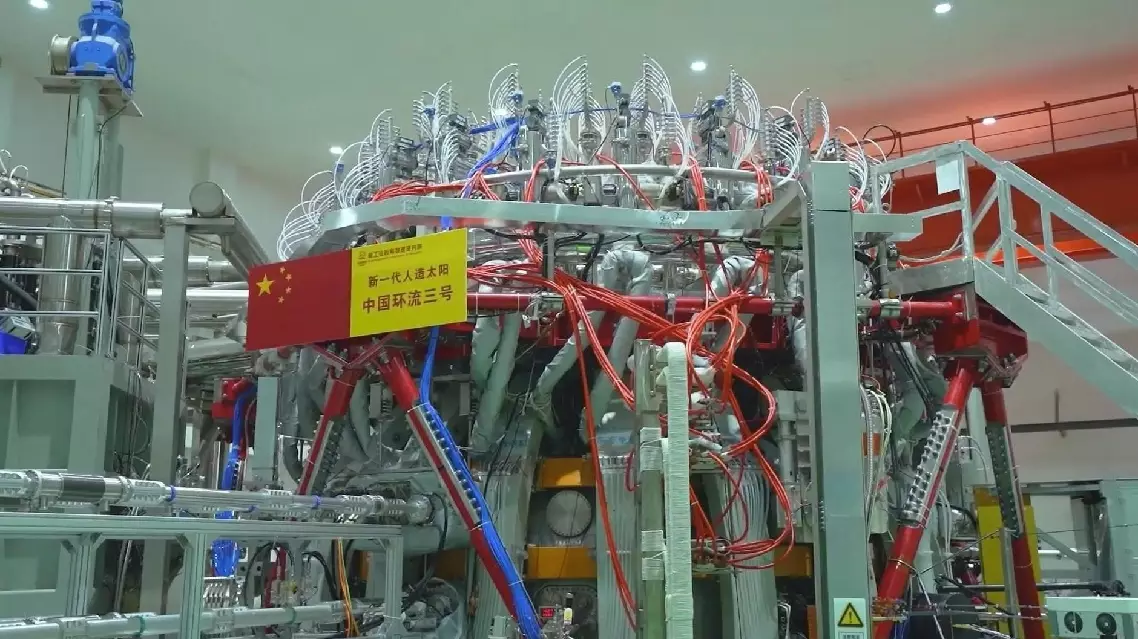
China's "artificial sun" achieves new milestone on path toward near-limitless clean energy

Yemen's temporary capital Aden is showing resilience and stability in economy, with market operations and public services running smoothly despite a recent escalation in the region's volatile military and political situation.
Currently, various essential supplies, including grain, oil, food and everyday items, are consistently available on the markets.
Public services such as water, electricity and communications are also functioning normally, and shops in multiple commercial districts remain open.
"We went out to buy household items today. The prices were the same. There was no rise in prices," said Mohamed Naguib, a resident.
The current market stability is attributed to the efficient functioning of the transportation and logistics systems, as well as the government's ongoing efforts to enhance market oversight and regulate prices, which have helped reduce market volatility, according to analysts.
"Although there are some rumors about rising tensions, the overall situation in Aden remains stable. The industry and commerce department has continued to monitor the market and rigorously control prices to prevent increases in commodity and food costs," said Amjad Al-Husseini, director of the Aden Governor's Office.
The city's monetary circulation system has also largely maintained balance, with the exchange rate of the local currency against major foreign currencies remaining relatively stable.
Aden has long been a flashpoint in the country's civil war, which erupted in 2014 when Houthi forces seized much of the north, prompting a Saudi-led military intervention in the following year. Tensions in the south have persisted despite repeated power-sharing deals.
The tensions further escalated last month after the United Arab Emirates-backed Southern Transitional Council (STC) seized large swathes of Yemen's oil-rich Hadramout province and the eastern province of Al-Mahrah. Riyadh considers these areas as a "red line" due to their proximity to the Saudi border and their concentration of Yemen's remaining energy reserves.
Last week, airstrikes and ground operations by the Saudi-led coalition forced the STC forces to withdraw from the two provinces.
Formed in 2017, the STC seeks autonomy and eventual independence for southern Yemen. Although it joined the Saudi-led coalition and became part of the Yemen's Presidential Leadership Council in 2022, the group's push for southern self-rule has continued to fuel disputes over power-sharing and control of territory and resources.
Economy, market remain stable in Yemen's Aden despite escalating violence