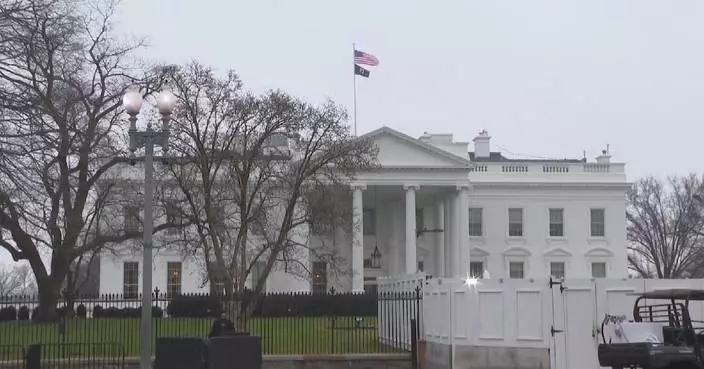
The U.S. President Donald Trump's tariff measures will only depress investment and create more uncertainty, an American political and economic affairs expert said in Beijing.
On Friday, Trump said he is open to negotiating with countries seeking to avoid U.S. tariffs but emphasized that talks will only begin after April 2, possibly after the announcement of additional tariffs.
Einar Tangen, a senior fellow at the Beijing-based think tank Taihe Institute, pointed out that Trump is using tariffs as bargaining chips to threaten other countries, in a Skype interview with China Global Television Network (CGTN) on Sunday.
"How many years have we heard the narrative that you cannot depend on China? That they'll use their economic heft to somehow corner you. Now it appears it's the U.S. that is the real danger,” said Tangen. “Trump's tactics have remained the same, but the world has changed. Trump is playing poker collectively, and his opponents have better cards. If they call his bluff, it's going to be over for him. Taking on the entire world was a mistake. Bullies usually focus on weaker opponents, using them as examples to frighten others."
Starting with steel, aluminum, and cars, and potentially extending to pharmaceuticals and wines, Trump claims he will secure all possible trade advantages for the U.S. The president argued that these tariffs would encourage more production to relocate to the U.S., generate new government revenue, and help reduce the national debt.
Tangen believes Trump's trade actions are a form of bluffing and will ultimately harm the U.S. economy and increase global uncertainty.
"He is bluffing. What he's doing is taking money out of American consumers' pockets, and he thinks he can dole it back to them, and they'll be somehow thankful. The U.S. has vulnerabilities in terms of inflation and collective tariff retaliation. Trump is taking money from one side, his own taxpayers, and then he thinks he can give it back to them as tariffs and that this will somehow be welcome. His effort to control the economy and reindustrialize America will only depress investment and create more uncertainty," said the senior fellow.
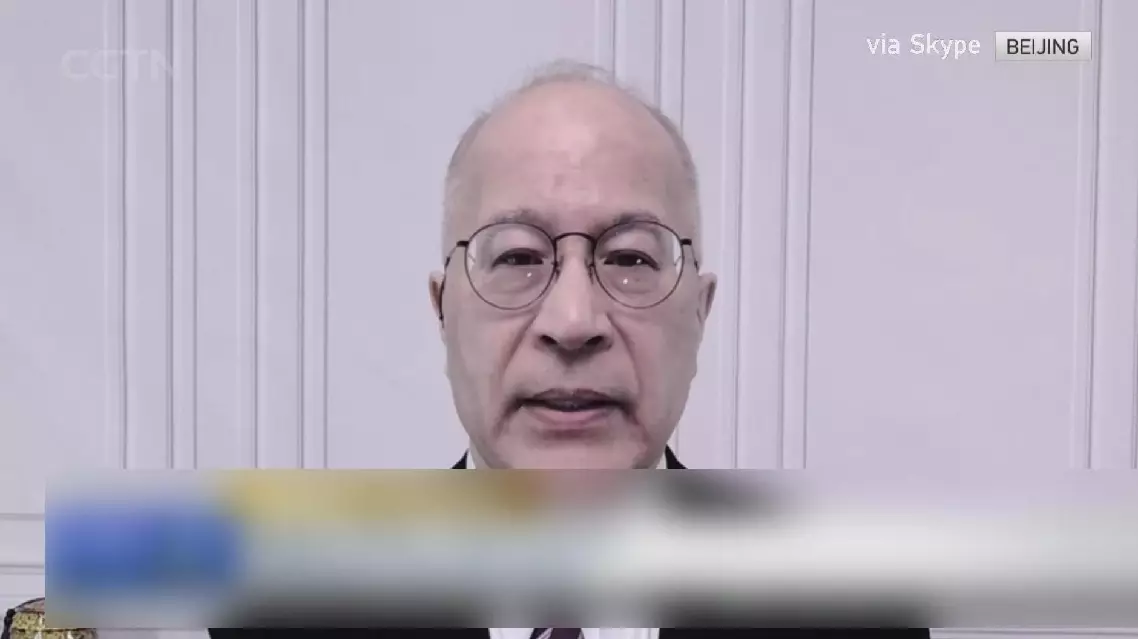
Trump's tariff measures will depress investment, increase uncertainty: expert
Carolyn Rodrigues Birkett, Guyana's permanent representative to the United Nations (UN), emerged as the top candidate in the second informal straw poll for the next UN secretary-general, held Friday by the Security Council.
Rodrigues Birkett received eight "encourage" votes, edging ahead of Costa Rica's Rebeca Grynspan, according to sources familiar with the closed-door vote.
"The second round of straw polls has taken place," said Christina Markus Lassen, the UN ambassador of Denmark, whose country holds the rotating presidency of the Security Council for the month of August.
Lassen told reporters after the secret vote that "the candidates will be informed of the results through the respective permanent representatives of nominating member states. The President of the General Assembly will also be informed that the straw poll has been concluded."
Through straw polls, the Security Council selects a candidate to recommend to the General Assembly for appointment as the next UN secretary-general.
Security Council straw polls on secretary-general candidates are informal closed-door ballots used to gauge support for the candidates. Their results are not officially released.
Article 97 of the UN Charter states that the secretary-general shall be appointed by the General Assembly upon the recommendation of the Security Council.
Lassen did not provide any details of Friday's vote. However, it is believed that all eight candidates were on the ballot.
The eight candidates currently in the race are: Ivonne A-Baki, former Ecuadorian minister and diplomat; Michelle Bachelet, former Chilean president and former UN high commissioner for human rights; Maria Fernanda Espinosa, former UN General Assembly president and former foreign minister and defense minister of Ecuador; Rafael Grossi of Argentina, current director general of the International Atomic Energy Agency; Rebeca Grynspan, former vice president of Costa Rica and current secretary-general of the UN Conference on Trade and Development; Olara Otunnu of Uganda, former UN under-secretary-general; Carolyn Rodrigues Birkett, Guyana's permanent representative to the United Nations; and Macky Sall, former president of Senegal.
Security Council members were believed to have received one ballot per candidate, containing the candidate's name followed by three options: "encouraged," "discouraged," and "no opinion expressed," according to What's in Blue, which provides insights into evolving Security Council actions.
The term of current UN Secretary-General Antonio Guterres will end on December 31.
Guyana's UN envoy leads in second straw poll for next secretary-general