No scientific connection can be drawn between the spate of major earthquakes which have been recently observed around the globe, a seismologist said on Monday, while stressing that experts are still unable to make truly accurate predictions on when and where the next major quake will strike.
Public concerns have been raised in recent times following the occurrence of several large seismic events, with the 7.9-magnitude earthquake which struck Myanmar on Friday, resulting in over 2,700 fatalities and thousands of injuries, being followed by a 7.0-magnitude tremor in Tonga on Sunday.
Earlier this year, southwest China's Xizang Autonomous Region was hit by a 6.8-magnitude quake which left 126 people dead, hundreds of others injured, and caused widespread damage.
Despite fears over the regularity of these disasters happening in relatively quick succession in the Asia-Pacific, Robert J. Geller, a seismologist and professor emeritus at the University of Tokyo, told the China Global Television Network (CGTN) that there is no evidence of any causal relationship between these seismic activities.
"The occurrence of large earthquakes is a kind of matter of probability rather than definite connections. Just like you have aftershocks right near the epicenter, you also have earthquakes that can be triggered at a long distance. So, there is some connection between all of the earthquakes in the Earth's crust. But it's not so simple as to say that earthquake A triggered earthquake B which triggered earthquake C. Any large earthquakes make some instability in the crust on a global scale, and it makes slightly more probability than normal for other large earthquakes," he said.
As it is still not yet possible for the scientific community to make precise forecasts on future earthquakes, Geller stressed the most effective approach to remaining resilient in the face of such natural disasters is through thorough preparation.
"The science of seismology is not able to make reliable and accurate predictions on a time and space scale to be useful to human beings. Maybe in 100 years that will change, although efforts to predict earthquakes reliably and accurately have been going on for more than 100 years with not only no progress, but the more people try it, the more we realize how difficult it is," he said.
"So, the most important thing is to have safe buildings that will withstand shaking. A large earthquake can happen at any time, anywhere, and without any advance warning. So, we have to do the best we can to prepare for earthquake resistance and earthquake resilience in advance," he said.
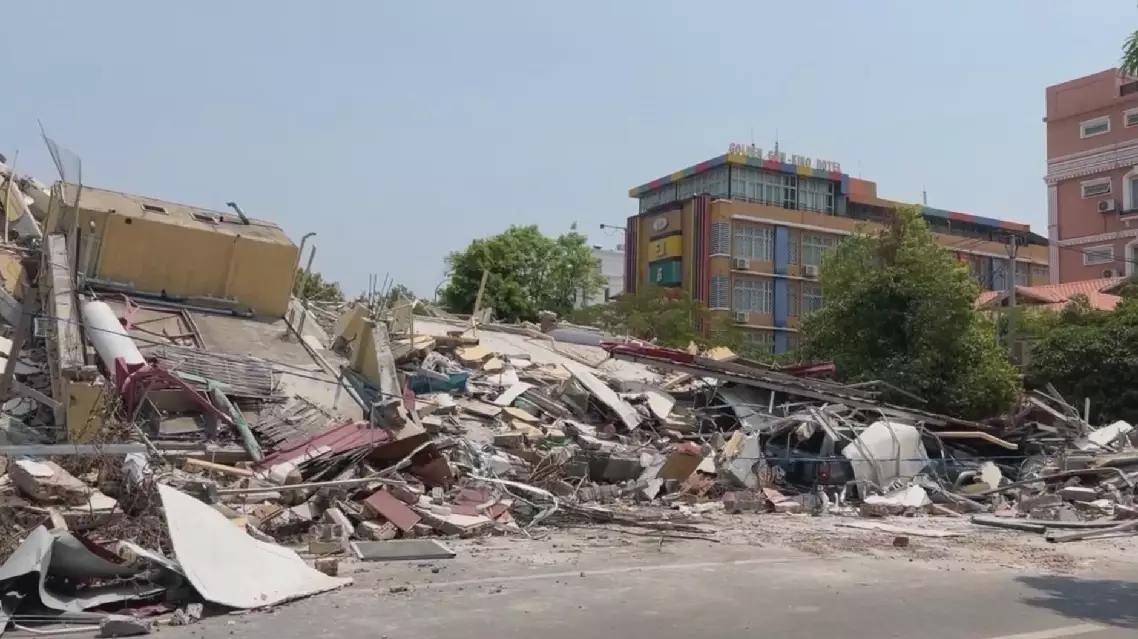
Recent occurrence of major earthquakes share no detectable connection: seismologist
A civil group in Japan held a study session on Saturday to tell the historical truth about the Nanjing Massacre and called on the Japanese government and society to reflect on history and avoid repeating the tragedy of war of aggression.
Saturday marks China's 12th National Memorial Day for the Victims of the Nanjing Massacre which took place when Japanese troops occupied the then-Chinese capital on Dec 13, 1937, killing approximately 300,000 Chinese civilians and unarmed soldiers in one of the most barbaric episodes of WWII over the course of six weeks.
"Japan's army committed a brutal atrocity -- the Nanjing Massacre 88 years ago in 1937. Today, on this important day, let us observe a moment of silence for 30 seconds for the victims," said an organizer of the study session.
This study session was led by Jomaru Yoichi, a former journalist with the Asahi Shimbun, a Japanese daily newspaper. Yoichi compiled numerous articles published in Japanese newspapers after the Nanjing Massacre. Among them, an article published on December 24, 1937 detailed the atrocities committed by the invading Japanese army in China.
"Around 08:00, about 400-500 defeated Chinese soldiers fled. The Japanese soldiers drove them into houses and bamboo groves, setting fires on all sides. Many of them were driven out by thick smokes. The Japanese soldiers killed them one by one with rifles and bayonets. The Japanese soldiers lost track of how many they had stabbed and killed all of them by 16:00," Yoichi recounted.
Many Japanese citizens said the Japanese government and society must confront the truth of history, and it's important to disseminate accurate historical information in contemporary Japan.
"The Nanjing Massacre is a real incident. The remarks that 'The Nanjing Massacre didn't exist' or 'The Japanese army was powerful and righteous' ignore historical evidence and deny the facts outright. I believe these are all attempts to hide the truth of history. I think these are all wrong. Facts are facts, and we must face history squarely," said a participant at the study session.
"I used to teach history in high school. In 1988, I spent two weeks in China and visited for the first time the site documenting the war crimes of the invading Japanese army. On the 80th anniversary of the end of World War II, the social atmosphere in Japan is gradually becoming strange. We must seriously examine Japan's past history, and disseminating accurate history has become even more important," said another participant.
Some expressed their concern that the Japanese government's historical revisionism, its attempt to cover up the truth of history, and its path towards military expansion will prevent Japan from facing the future.
"The fact that the Japanese army's war of aggression is not taught in social studies or history courses. I have no choice but to learn this myself even now at my age. The idea of upholding the pacifist constitution is becoming increasingly strong. Current Japanese politicians are pursuing a military expansion strategy, which I find incomprehensible," said another participant.
In 2014, China's top legislature designated December 13 as a national memorial day for the massacre victims.
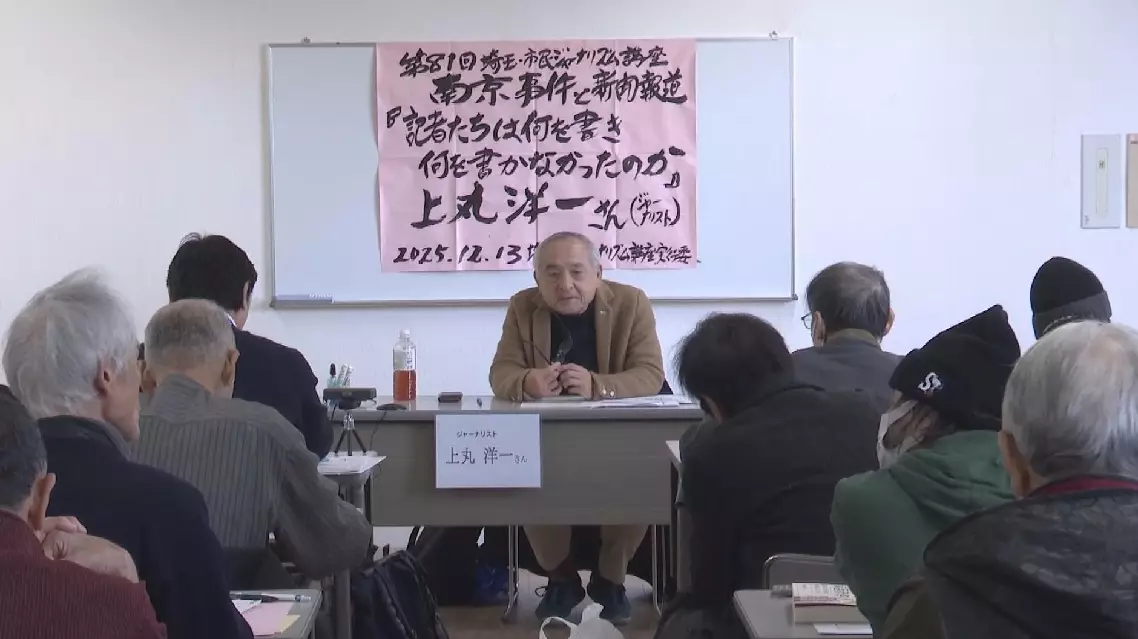
Japanese civil group calls for remembrance of Nanjing Massacre victims