China Railway Kunming Group Co., Ltd. announced on Sunday the extension of an international train service on a section of the China-Laos Railway, with more stations added to provide increased travel solutions for international passengers.
In addition to the train service linking the terminal stations of Kunming, capital of southwest China's Yunnan Province, and the Laotian capital Vientiane, there is also a shuttle train service section on the China-Laos Railway connecting Xishuangbanna of Yunnan with Luang Prabang in Laos.
From Sunday, this shuttle-service section will offer a 94-kilomenter extension to Pu'er in Yunnan, a city famous for its tea and coffee production.
The extension also features a stop at Nateuy of Laos.
As of Sunday, the section of Xishuangbanna-Luang Prabang international passenger train service on the China-Laos Railway had transported a total of 220,000 passengers, including 81,000 cross-border passengers, since its launch a year ago.
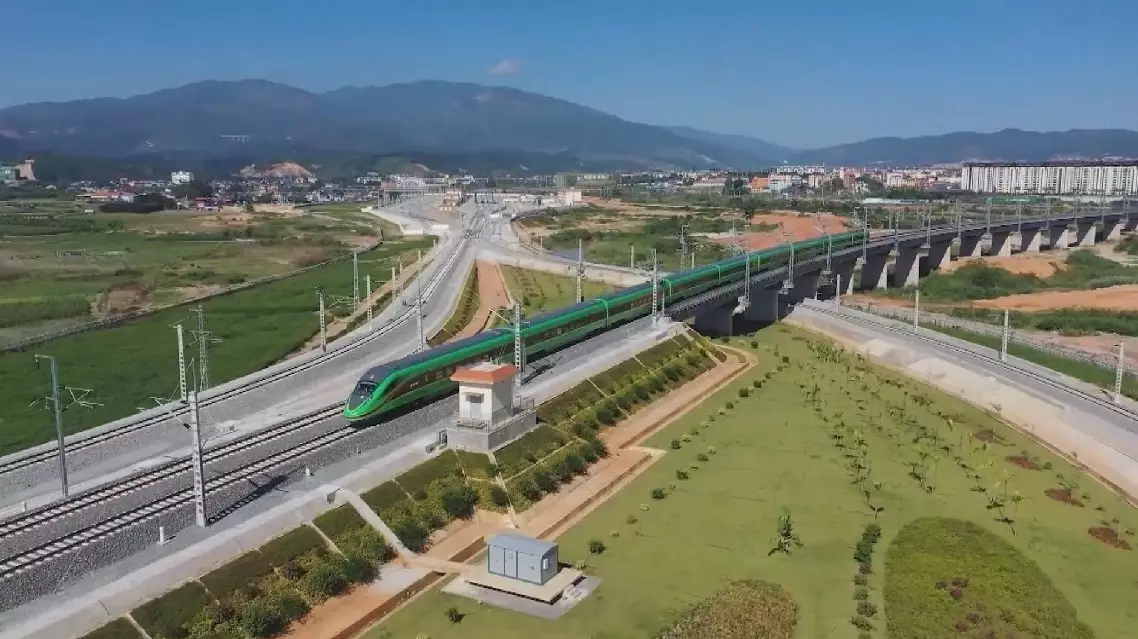
China-Laos Railway extended in shuttle-service section
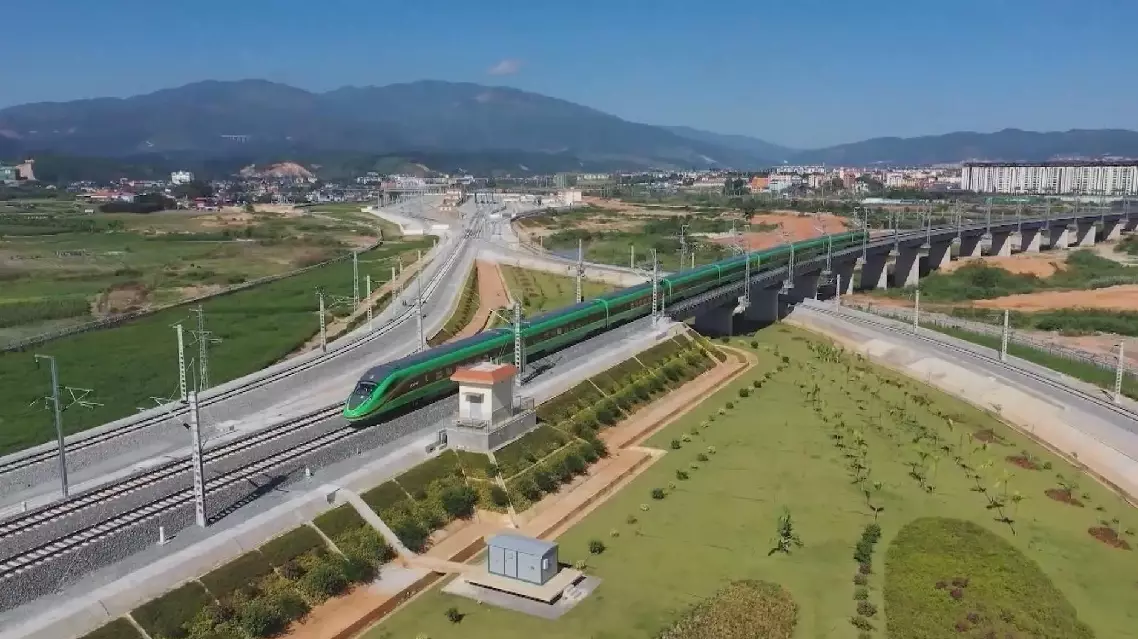
China-Laos Railway extended in shuttle-service section
China attaches great importance to the development of China-Singapore relations, and is willing to maintain the momentum of high-level exchanges, promote practical cooperation in various fields, and enhance people-to-people exchanges with Singapore, Chinese Foreign Minister Wang Yi said on Monday.
Wang, also a member of the Political Bureau of the Communist Party of China Central Committee, made the remarks when holding talks with Singaporean Foreign Minister Vivian Balakrishnan in Beijing.
Noting that over the past year, under the strategic guidance of leaders of the two countries and joint efforts of both sides, the all-round high-quality and future-oriented partnership between China and Singapore has maintained a good momentum, Wang urged the two countries to continue to enhance strategic communication, increase mutual trust, jointly address the ever-emerging global challenges at present, and safeguard the overall situation of regional peace and stability.
Wang said that maintaining the security of global industrial and supply chains and the smooth flow of maritime navigation is in the common interests of the international community, and China is willing to continue to make efforts to this end.
Noting that Singapore is an important ASEAN member and will assume ASEAN's rotating presidency next year, Wang said China expects the Singaporean side to continue playing an active role in promoting China-ASEAN cooperation.
Balakrishnan said Singapore highly values its relations with China, adheres to the one-China policy, and firmly opposes "Taiwan independence."
Singapore is willing to maintain close high-level exchanges with China, promote practical cooperation in various fields, carry out key cooperation projects of both sides, and promote regional connectivity, he said.
Singapore is ready to promote greater progress in ASEAN-China comprehensive strategic partnership, support the Global Development Initiative, and uphold multilateralism and free trade, and is willing to work with China to make joint efforts in promoting world peace, development and prosperity, he added.
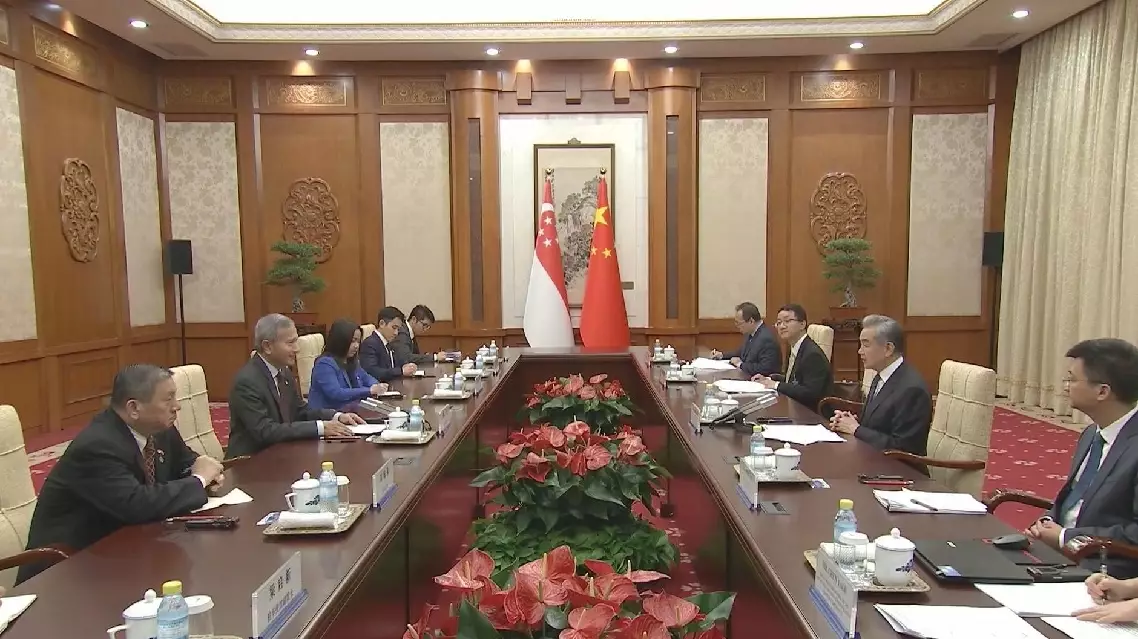
China ready to promote practical cooperation with Singapore: Chinese FM