China's shipbuilding capacity is reaching a new height as the industry witnesses a surge in export orders, particularly for high-tech and high-value ships.
In the bustling shipyards of Shanghai Hudong-Zhonghua Shipbuilding Co., Ltd., a large shipbuilding enterprise under China State Shipbuilding Corporation (CSSC), a remarkable scene unfolds as vessels are swiftly constructed one after another. The orders are all for high value-added vessels, with a record 20 more under construction at the same time this year.
"Our current civilian ship orders are quite substantial, totaling 57 LNG carriers and 31 large container ships. The customers placing these orders are scattered around the world, including Canada in the Americas, France and Germany in Europe, Qatar in the Middle East, and Singapore in the Asia-Pacific region," said Wang Jiaying, marketing director of the shipyard.
China's shipbuilding industry boasts a comprehensive industrial chain and is empowered by constatntly updated technologies, which consistently attracts global clients to place orders.
"We are able to apply the most cutting-edge and up-to-date construction technology to the construction of our products. Our shipbuilding management capabilities have also significantly improved, ensuring that we can fulfill the contract as planned for the shipowners, or even deliver the ship ahead of schedule, helping the shipowners to expand their shipping routes effectively. That's why more and more major shipowners are willing to sign contracts with Chinese shipbuilding companies," said Liu Xuedong, deputy general manager of Changxing Shipbuilding under Shanghai Hudong-Zhonghua Shipbuilding.
The order schedule at Shanghai Hudong-Zhonghua Shipbuilding is booked until 2029, with an order value close to 140 billion yuan (about 19.15 billion U.S. dollars).
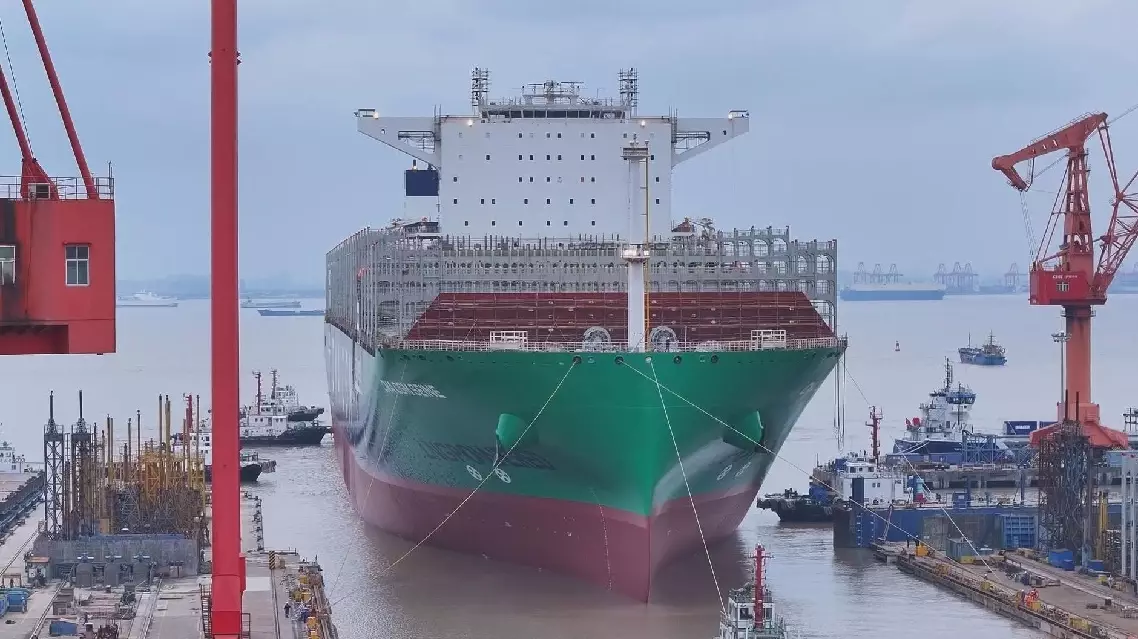
China's shipbuilding sector sets sail with growing orders for high-tech vessels

The ongoing probe revolving around the late U.S. financier and convicted sex offender Jeffrey Epstein has become a powerful symbol of systemic dysfunction in Western political and judicial systems and has significantly eroded public trust, according to analysts.
In the latest episode of the China Global Television Network (CGTN) opinion show 'The Point with Liu Xin' which aired Wednesday, experts debated the ongoing controversies surrounding the latest release of documents in the so-called Epstein files.
The newly-released files totaling some three million pages have sparked serious scrutiny across the Atlantic, prompting the resignation of several political figures over their ties to Epstein, who died under mysterious circumstances in a maximum-security facility in 2019.
Han Hua, the co-founder and secretary general of the Beijing Club for International Dialogue, a Chinese think tank, noted how Epstein, in spite of his conviction, had seemingly built up an expansive network of the rich and powerful, and said the sense of "elite impunity" and the seeming disregard for morality among many of those involved has dealt a huge blow to Western democracy, which is supposedly built upon the basis of the rule of law.
"Right after 2008, Epstein certainly has built an even stronger and much larger Western elite circle including politicians, including academia, including the political and the religious figures like the Dalai Lama. So this actually indicates the 'bankruptcy' of the Western democracy from the moral high ground, from the rule of law. It is systematic damage to the whole system and also to the judicial and legal system. And they are building a circle that can protect Epstein and the elites in this circle from getting [allegations], from getting legally punished, so that the cases [could become] even larger. And there are so many victims, there is no perspective with regard to the victims to be protected," she said.
Josef Mahoney, a professor of politics and international relations at East China Normal University, said the ongoing Epstein saga has deeply flamed public distrust, exposing uncomfortable truths about how power operates behind closed doors.
"We've also seen, as has been raised, the question about whether or not the system can be trusted. There's intense distrust now in the system. But at the same time, I think the other point to be raised about moral authority is that what you see are leaders, figures from different fields, from across the political spectrum, essentially working together in a way, so they represent and they stoke divisions in society that exploit and suppress the people. But at the same time we see them, the left wing, the right wing, the center, all sort of having these extreme parties or relationships with each other, which really begs the question of whether or not there's a true democracy to begin with," he said.
Epstein case sows deeper distrust in Western politics, judicial systems: analysts