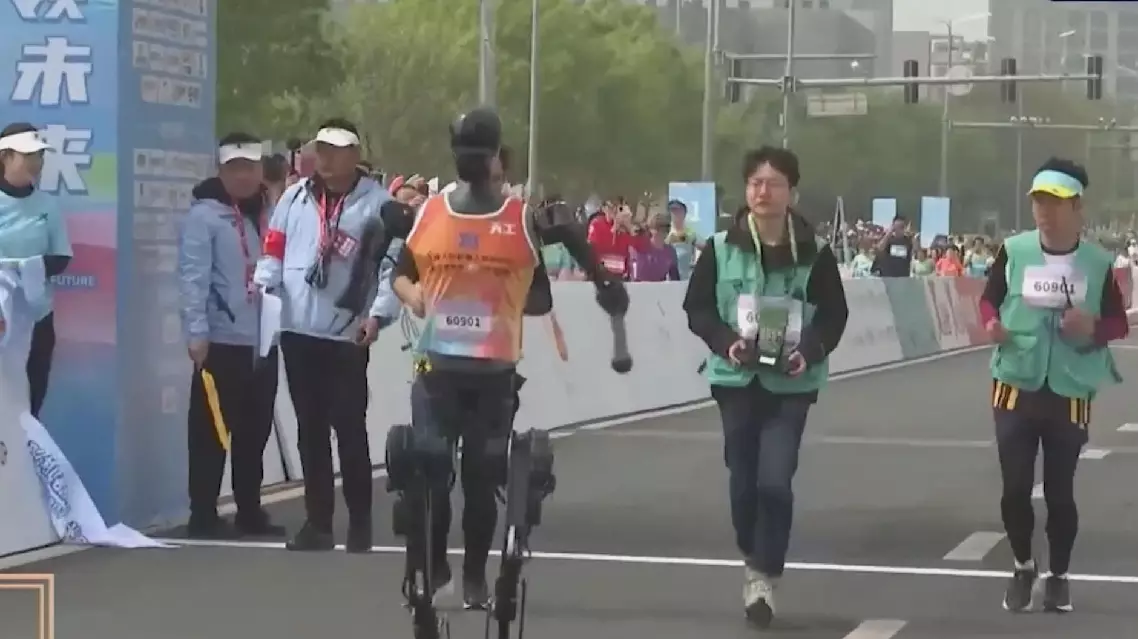
The world's first humanoid robot half-marathon, held in Beijing on Saturday, marks a milestone in robot development, attracting local residents to witness the breakthrough in the futuristic technology.
Among all 20 participating robotic "athletes" from across the country, the "Tiangong Ultra" humanoid robot developed by the Beijing Humanoid Robot Innovation Center won the champion.
The unique race attracted many science lovers, with many of them holding cameras and trying to record the historic moment.
"It is quite astonishing. The robots are running really fast," said Sun Jiude, an audience member, at the scene of racing.
"We are so excited. We are residents living around, and we got up at half past six to reach the site. We witnessed every single robot participating in the event, and we are very impressed by the progress China has made in this regard," said Wang Lijuan, who brought her son to watch the first-ever humanoid half-marathon.
The course of the Beijing half marathon involved steer slopes, and even requiring the robots to run across rails. The complex scenario tested the robots' ability to respond to accidents, with many of the "athletes" tripping multiple times and some accidentally running out of power amid running on the route.
"We should have all noticed that some of the robots are not running elegantly, and some might fall over in running. We would say that this is quite normal. This reflects that we are still experimenting with all kinds of technical routes for robots," said Jiang Guangzhi, director of the Beijing Municipal Bureau of Economy and Information Technology.
Setting up the first world half-marathon record for humanoids at around 2 hours and 40 minutes, "Tiangong Ultra" had received three months of "training" before its success, shortening the finishing time from eight hours to less than three.
The first half-marathon attempt of the humanoid happened on January 22. By that time, it had to be tied to a crane truck to prevent hitting the ground, with multiple researchers scrutinizing its condition. Despite all the close attention, the metal runner had to fall down from time to time.
With all the data collected, "Tiangong Ultra" received multiple rounds of upgrades, and gradually made larger strides with a more stable posture. To build robots that are comparable to human athletes in long-distance running, researchers have to tackle all kinds of difficulties, including heat dissipation, component durability, system reliability, algorithm optimization, and more. Completing a 21-kilometer half-marathon is not only about building robot runners, but also signifies that humanoids are another step closer to real-world, scalable applications.
China's first humanoid robot half-marathon attracts great public attention