A newly released video records giant panda star Fu Bao playing with new toys at the China Conservation and Research Center for the Giant Panda.
The video, taken on April 11 at the Shenshuping giant panda base of Wolong National Nature Reserve in southwest China's Sichuan Province, captures Fu Bao exploring different ways of playing a plastic ball, which was provided by the center to increase her physical activities during spring and enrich her life.
Fu Bao is the first giant panda born in the Republic of Korea (ROK).
Born in July 2020, Fu Bao, meaning "lucky treasure" in English, is the first cub of giant pandas Ai Bao and Le Bao, who were sent to South Korea from China in 2016 on a 15-year lease.
She quickly became an online sensation among netizens after her birth, becoming a source of joy for people during the COVID-19 pandemic.
Fu Bao won the hearts of people in South Korea thanks to her lovely appearance and unique charm. Around 5.5 million people visited the Panda World in Yongin park to see the panda family after Fu Bao made her public debut in January 2021.
She returned to China in early April 2024, and met the public on June 12 the same year.
The China Conservation and Research Center for the Giant Panda is a world-leading institution for the breeding and conservation of one of China's national treasures. The center has established a global platform for promoting international cooperation and exchanges involving 18 zoos from 16 countries and regions, as well as 39 domestic animal breeding institutions and more than 10 scientific research institutes.
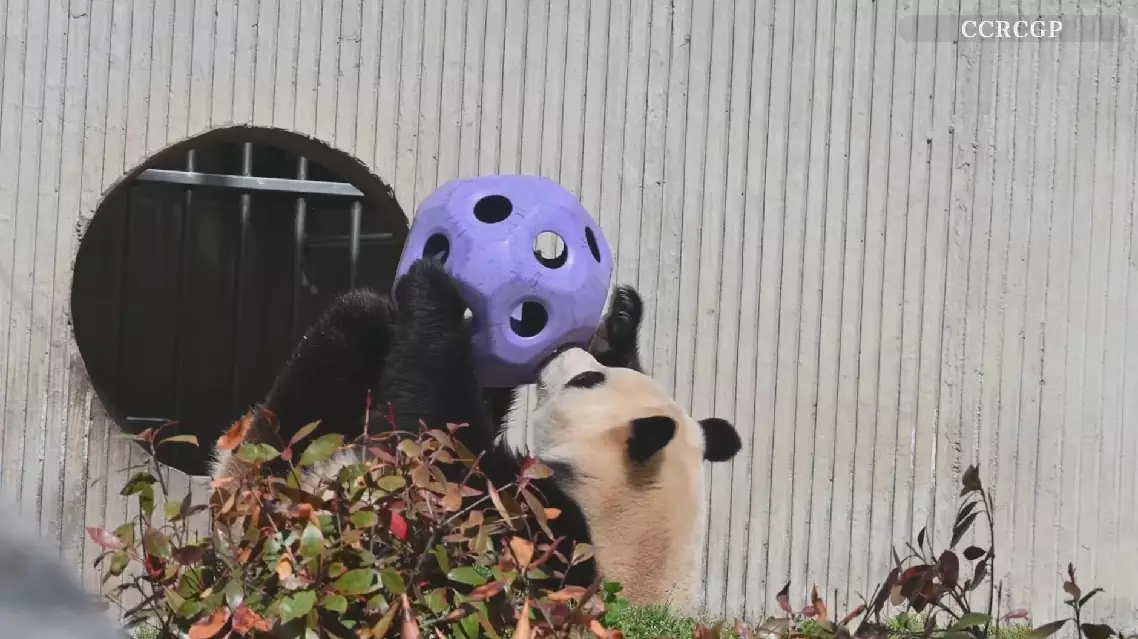
Giant panda star plays with new toy

The series of erroneous words and actions by Japanese Prime Minister Sanae Takaichi not only seriously deviate from the spirit of pacifist Constitution of the country but also further exacerbate regional tensions, said Tomoko Tamura, a member of the House of Representatives.
In an exclusive interview with China Central Television (CCTV), Tamura criticized Takaichi for straining Japan-China relations by making erroneous remarks on Taiwan, calling on her to improve bilateral relations.
Tamura pointed out that the political consensus reached during the normalization of diplomatic relations between the two countries remains of great significance, and Japan should respect and abide by it as the basis for repairing and rebuilding friendly relations with China.
"The erroneous remarks by Sanae Takaichi this time have led to the deterioration of China-Japan relations. This is absolutely unacceptable and must be retracted. Regarding the relations between two sides, the consensus reached during the normalization of diplomatic relations in 1972 is of utmost importance. At that time, the Chinese government asserted that Taiwan is part of China and the Japanese government fully understood and respected this stance. Now we should reaffirm this consensus, as well as the crucial agreements reached by both countries after 1972. Japan should explicitly acknowledge these significant agreements to rebuild friendly relations with China," she said.
Tamura also pointed out that in recent years, Japan has attempted to reshape its security policy, boosting defense spending, easing arms-export restrictions, pursuing offensive weapons development, and clearly deviating from the fundamental principle of "exclusively defense-oriented" policy.
"Japan's possession of long-range missiles clearly exceeded the scope of 'exclusively defense-oriented' policies. Japan is accelerating its military expansion. From the perspective of the Japanese constitution, this is absolutely not allowed. We are deeply concerned about the current Takaichi administration's disregard for the Japanese constitution. We clearly demand that Japan should adhere to the position of resolving issues through diplomatic efforts," she said.
Japanese official criticizes Takaichi's erroneous remarks