China's independently developed AG600, a large amphibious firefighting aircraft, has achieved comprehensive emergency response capabilities across multiple disaster scenarios, providing robust support for safeguarding the safety of people's lives and property, according to Huang Lingcai, chief designer of the AG600 series.
Among various natural disasters, forest fires are particularly challenging to control. Relying solely on manual firefighting poses significant risks to firefighters' lives. In contrast, the AG600 aircraft can release 12 tons of water in a single drop, covering a fire area of 4,000 square meters - an efficiency equivalent to that of 300 firefighters working for two hours.
"The aircraft has been involved in forest firefighting five times during the development process. It directly extinguished the fires twice and effectively controlled the fire's spread three times. Subsequently, the aircraft we have produced in large quantities will be stationed in key forests. In the event of a forest fire, these aircraft can be swiftly deployed to effectively minimize losses, thereby protecting people's lives and property," Huang said.
"I earnestly hope that this aircraft, soaring in the skies of our country within our borders, can effectively fulfill its missions and truly benefit the people," he said.
According to the chief designer, the AG600 aircraft is capable of flexibly carrying out various missions across a wide range of scenarios. It stands as a multi-mission large-scale aviation equipment platform.
"The AG600 aircraft can undertake forest and grassland firefighting missions in plains, grasslands, hills, and plateaus. It can also function as an aerial command center and cater to multi-mission scenarios such as personnel and material transfers and communication relays, fulfilling needs in various disaster situations," Huang said.
The AG600 aircraft on Sunday obtained its type certificate from the Civil Aviation Administration of China (CAAC) in Beijing, marking its successful development and approval to enter the market.
During its certification test flights, the AG600 aircraft has successfully conducted joint emergency rescue and firefighting operations with multiple aircraft types across several Chinese provinces, including Hubei, Sichuan, Guizhou, and Shaanxi.
Huang said in the future, the capabilities of the AG600 aircraft will be expanded to encompass hazardous chemical emergency response and medical support functions.
"In the future, tailored installation and validation of mission equipment can be conducted based on specific user requirements, enabling the execution of relevant tasks. Through the development of the AG600, we have comprehensively established a technological system for the research and development of large amphibious aircraft," Huang said.
Furthermore, the AG600 is anticipated to be developed for diverse purposes including maritime law enforcement and maritime environmental monitoring.
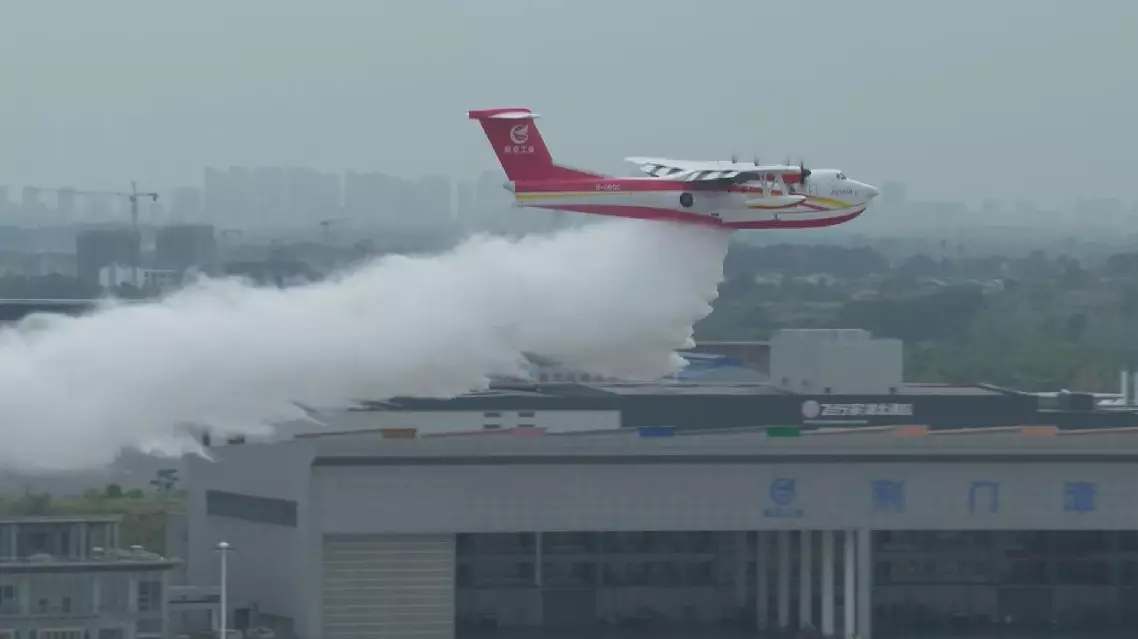
China's AG600 large amphibious aircraft enhances disaster response capabilities: chief designer