Skip to Content Facebook Feature Image

Innovation fuels China's NEV boom

China

China

China

Innovation fuels China's NEV boom

2025-04-26 19:43 Last Updated At:23:17

⁠⁠⁠⁠⁠⁠⁠Innovative breakthroughs in auto chips, operation system and batteries give Chinese new energy vehicles (NEVs) a powerful edge to thrive in global market.

Many futuristic models featuring the most advanced tech are on display at the ongoing 21st Shanghai International Automobile Industry Exhibition (Auto Shanghai 2025) which runs from April 23 to May 2.

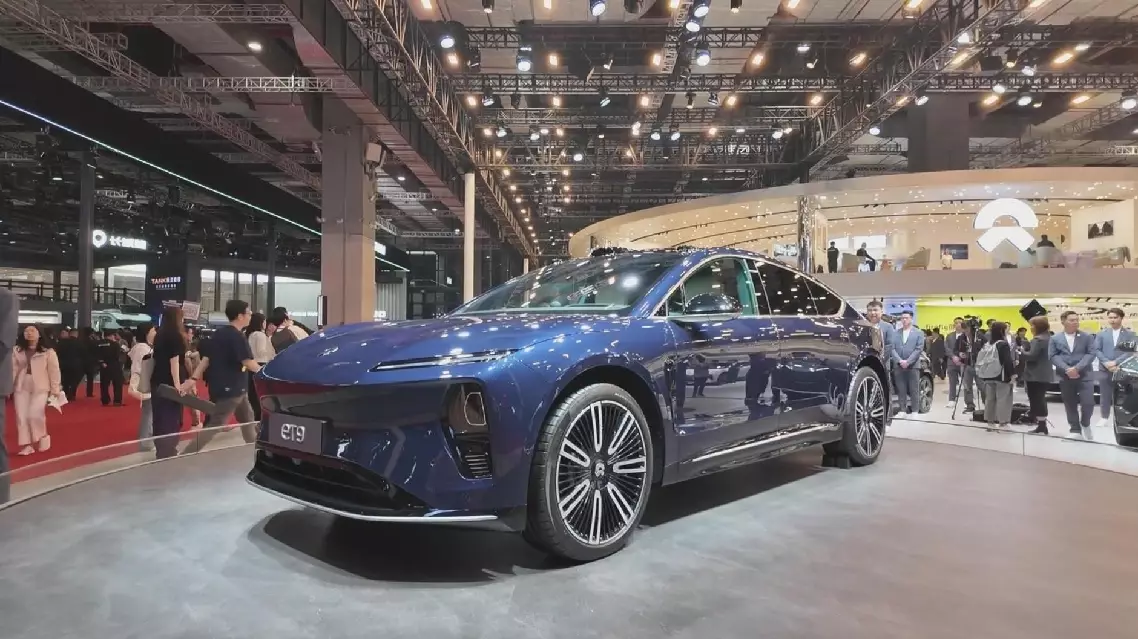
Major Chinese electric vehicle (EV) maker Nio showcases its crossover coupe ET9 model at the auto show. Those who watch films in this car will have an immersive experience as it features an intelligent chassis which allows the car to perform significant body shaking.

Those advanced features are supported by Nio's self-developed chips and operating system.

The world's first 5nm intelligent driving chip "NX9031" is also showcased at Nio’s exhibition booth of the auto show.

"The chip, the full-domain operating system, and the intelligent chassis are the new three core components of intelligent vehicles. They also represent the latest breakthroughs in technological innovation within China's automotive industry," said Li Bin, Nio's founder.

These technological breakthroughs are already being applied across many Chinese smart car models.

"Built on our all-new multi-energy platform architecture, we have launched a brand-new high-end vehicle series that feature cutting-edge technologies including intelligent assisted driving and AI smart cockpits," said Guo Baixun from GAC Motor.

In addition to automakers, Chinese EV suppliers are also pushing for innovation along the supply chain.

China-based global lithium battery manufacturer EVE Energy has achieved mass production of domestically made large cylindrical batteries that are applied in passenger vehicles.

Meanwhile, another leading Chinese battery maker, Sunwoda EVB, is betting big on the ultra-fast charging field.

"We are making strong advances in the ultra-fast charging field, aiming for even higher speeds. In the future, charging will be as fast as refueling, so energy replenishment will no longer be an issue,"  said Dai zhihua, vice president of SEVB Power Technology Co., Ltd.
Innovation fuels China's NEV boom
Innovation fuels China's NEV boom

The United States and Iran carried out fresh strikes on each other's targets, as tensions around the Strait of Hormuz escalated after the U.S. accused Iran of attacking commercial shipping and Iran said it was responding to recent U.S. "aggression".

Iranian state television reported early Sunday local time that several explosions were heard in the Sirik area of Hormozgan Province in southern Iran. It also said Qeshm Island and areas near Bandar Lengeh, both in southern Iran, had come under attack.

U.S. Central Command (CENTCOM) said on Saturday afternoon U.S. time that American forces had launched a new round of strikes on multiple targets inside Iran. It said the operation came after Iranian forces launched an attack drone early Saturday that hit an oil tanker sailing near the Strait of Hormuz.

CENTCOM said the U.S. strikes targeted 10 Iranian military sites in and around the strait, including surveillance facilities, communications systems, air defense positions, drone storage facilities and mine-laying equipment. It called the operation a direct response to what it described as Iran's continued actions against commercial shipping.

Shortly afterward, Iran's Islamic Revolutionary Guard Corps (IRGC) said its naval and air forces had used missiles and drones to strike eight key U.S. military facilities at Ali Al Salem Air Base in Kuwait and the U.S. Fifth Fleet in Bahrain.

The IRGC said the strikes were a decisive response to recent U.S. "aggression," accusing the U.S. of repeatedly breaking its commitments and using the IRGC Navy's "interception of a violating vessel" as a pretext to attack five Iranian coastal outposts.

In a separate statement, the IRGC Navy said U.S. strikes on the Sirik area would not change Iran's control over the Strait of Hormuz. It said Iran's warning shots at "violating" vessels were intended to remind ships to follow designated routes through the waterway.

U.S. President Donald Trump on Saturday also accused Iran of again violating the ceasefire agreement in a social media post.

The latest exchange of fire followed U.S. strikes on Iran on Friday, which CENTCOM said were launched in response to an Iranian drone attack on a commercial vessel passing through the Strait of Hormuz on Thursday.

Iran's Foreign Ministry condemned the U.S. airstrikes, saying they violated a memorandum of understanding between the two sides and that Iran would defend its sovereignty and security under international law.

US, Iran trade strikes again as tensions flare around Hormuz

US, Iran trade strikes again as tensions flare around Hormuz

Recommended Articles