Wang Yi, a member of the Political Bureau of the Communist Party of China Central Committee and Minister of Foreign Affairs, and Murat Nurtleu, Deputy Prime Minister and Minister of Foreign Affairs of Kazakhstan, held the second China-Kazakhstan foreign ministers' strategic dialogue in Almaty, Kazakhstan, on Friday.
Wang stated that China and Kazakhstan are inseparable cooperative partners and genuine friends with an unbreakable bond. The traditional friendship between the two nations is deeply rooted and time-tested. Under the strategic guidance of President Xi Jinping and President Tokayev, the permanent comprehensive strategic partnership between China and Kazakhstan has grown more substantial and enriched in content. Comprehensive cooperation between the two countries is accelerating and entering a fruitful phase. Bilateral trade volume continues to rise against global trends, setting new historical records. Numerous cooperation projects in fields such as new energy and connectivity have taken root. The positive effects of mutual visa exemption are being steadily released, and people-to-people exchanges have made breakthrough progress.
China is willing to work with Kazakhstan to implement the important consensus reached by the two heads of state, continuously strengthen strategic mutual trust, jointly build the high-quality Belt and Road Initiative, enhance multilateral international cooperation, and push China-Kazakhstan relations to open new horizons and achieve fresh outcomes, he said.
Wang emphasized that the recent Central Conference on Work Related to Foreign Affairs with Neighboring Countries has clearly defined the direction of China's neighborhood diplomacy in the coming period. China will adhere to the principles of amity, sincerity, mutual benefit, and inclusiveness, as well as the vision of building a community with a shared future, to join hands with neighboring countries in building a common homeland, jointly pursuing development and prosperity, and creating a better future. China has always regarded Kazakhstan as a priority in its neighborhood diplomacy and is willing to continue firmly supporting each other on issues concerning core interests, advancing the building of a China-Kazakhstan community with a shared future, and playing a leading and exemplary role in the region, said the Chinese foreign minister.
Nurtleu said that Kazakhstan regards China as a trustworthy and reliable good neighbor, good friend, and good partner. Kazakhstan appreciates the proactive foreign policy direction established by China's conference on neighborhood diplomacy. The all-weather friendship and high-level mutual trust between Kazakhstan and China remain unaffected by any geopolitical factors. Under the guidance of the two heads of state, the permanent comprehensive strategic partnership between the two countries has reached unprecedented new heights, with expanding cooperation content and increasingly closer interactions and frequent exchanges across various sectors and departments. China has become Kazakhstan's largest trading partner, and bilateral trade volume has repeatedly hit new highs. Kazakhstan is full of confidence in the future of bilateral relations and is committed to deepening mutually beneficial cooperation to achieve common prosperity and greater well-being for both peoples, ushering in the next golden 30 years of Kazakhstan-China relations.
The two foreign ministers conducted in-depth exchanges of views on bilateral and multilateral cooperation and reached a broad consensus.
Both sides agreed that deepening the integration of interests and accelerating joint development aligns with the fundamental interests of the two peoples and the trend of the times. They will continue to expand economic and trade cooperation and strive to achieve at an early date the bilateral trade volume target set by the two heads of state. The two sides will also broaden energy cooperation, enhance collaboration across the entire industrial chain, strengthen connectivity cooperation, and accelerate the construction of cross-border infrastructure.
Additionally, they agreed to explore innovative cooperation in artificial intelligence and the digital economy to inject new momentum into their respective development, jointly combat the "three evil forces" of terrorism, extremism and separatism, and build a solid security barrier for the region.
Both sides believe that China and Central Asian countries, connected by mountains and rivers, share a common destiny, and they will work together to ensure the success of the upcoming China-Central Asia Foreign Ministers' Meeting, prepare well for the second China-Central Asia Summit, and promote China-Central Asia cooperation to reach new heights, building a China-Central Asia community with a shared future.
The two sides also pledged to strengthen communication and coordination within multilateral frameworks such as the United Nations and the Shanghai Cooperation Organization, support free trade and the multilateral trading system, oppose unilateral protectionism, uphold universally recognized international rules, safeguard international fairness and justice, and practice true multilateralism.
Following the talks, the two sides signed documents, including a memorandum of understanding between the two foreign ministries.
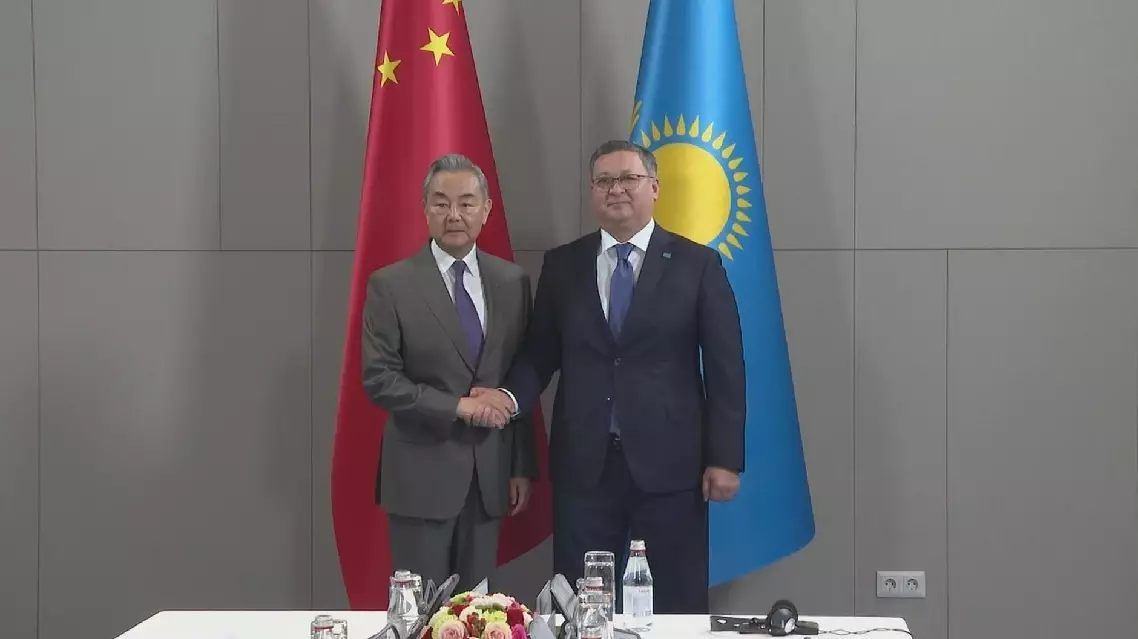
2nd China-Kazakhstan foreign ministers' strategic dialog held in Almaty
2nd China-Kazakhstan foreign ministers' strategic dialog held in Almaty