China's transportation system continued to maintain high-level operation nationwide to handle the holiday passenger surges on Friday, as short-haul trips rose sharply on the second day of the May Day holiday.
China's railway system handled 23.119 million passenger trips nationwide on Thursday, setting a new record for single-day passenger volume for the annual May Day holiday. The total passenger flow is expected to decline on Friday, but the proportion of short-distance passenger trips have increased significantly.
Railway authorities have enhanced the capacity of passenger transportation on popular routes between regions. The Guangzhou Railway Bureau expected to handle 2.68 million passenger trips on Friday, a year-on-year increase of 9.9 percent. The railway system of the Yangtze River Delta expects to handle 4.18 million passenger trips on Friday.
The passenger flow on the Hangzhou-Taizhou high-speed railway, in east China’s Zhejiang Province, has increased by more than 60 percent compared with normal days.
"To cope with the peak passenger flow, the Shaoxing North Station plans to add 25 trains, 14 of which will operate on the Hangzhou-Taizhou High-speed Railway, mainly bound to Hangzhou, Shanghai and Wenling," said Wang Jinlan, ticket sales manager of the Shaoxing North Station.
Road trips had also surged, with national expressways expected to handle over 55 million passenger vehicle trips on Friday. In the day, road travels across the country have mainly been short-distance ones within a same province and tours to nearby attractions.
Transportation and power departments in various regions have taken measures to ensure the charging of new energy vehicles.
At the Shandong Wucheng Service Area along the Dezhou-Shangrao Expressway, support personnel from the local power department have carefully inspected the 71 charging piles at 19 charging stations in the area, to promptly eliminate possible safety hazards.
In efforts to reduce possible congestion caused by charging new energy vehicles, Zhejiang's transportation and power supply authorities have upgraded the charging facilities at the Tiantai Service Area of the Hangzhou-Shaoxing-Taizhou Expressway, adding 20 fast-charging piles that can charge 40 NEVs at a same time.
At the Hengshui service area along the G45 Daqing-Guangzhou Expressway, in north China's Hebei Province, local transportation and power authorities have added mobile charging facilities, and used drones to guide car owners in real time to charge at the closest charging station in a timely manner, thereby improving charging efficiency.
The country's civil aviation system expects to handle a total of 2.16 million passenger trips on Friday.
As for water transportation, it is estimated that more than 2 million passenger trips will be made by water nationwide on Friday. The maritime authorities will conduct dynamic inspection and monitoring of long-distance passenger ships throughout the voyage to ensure the safety of water passenger transportation.
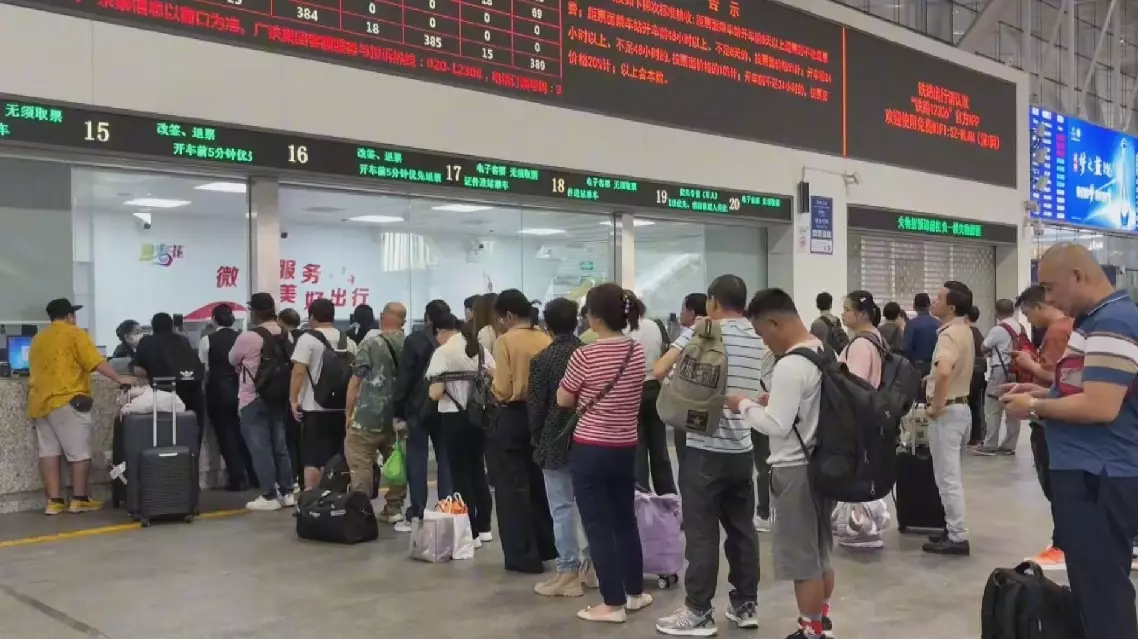
Short-distance trips surge on second day of China's May Day Holiday

A new round of trade-in subsidy program is energizing China's consumer market these days, with provinces across the country seeing a surge in demand for cars, home appliances and digital devices.
In north China's Shanxi Province, the new trade-in subsidy program, which started on January 9, has further helped boost sales in home appliances and digital devices which are covered by the new round of subsidies.
To enjoy the subsidies, six types of home appliances, including refrigerators and washing machines, must meet national Level 1 energy-efficiency or water-efficiency standards. Digital and smart products include four types, such as mobile phones and tablets, with a sales price cap of 6,000 yuan (about 800 U.S. dollars) per item.
In both categories, subsidies are set at 15 percent of the final transaction price. For home appliances, the maximum subsidy is 1,500 yuan per item. For digital products, the cap is 500 yuan per item. Each consumer can receive a subsidy for one unit in each category.
Neighboring Shanxi, Hebei Province kicked off the year of 2026 with the new round of trade-in subsidy program starting on January 1.
The subsidies cover automobiles, home appliances, and digital products. Individual consumers who purchase designated Level 1 energy-efficiency appliances or eligible digital products priced at no more than 6,000 yuan can receive subsidies equal to 15 percent of the transaction price. The maximum subsidy is 1,500 yuan per appliance and 500 yuan per digital or smart device, with each person limited to one subsidized item in each category.
Data showed that from Jan 1 to 9, Hebei's home appliance trade-in program alone disbursed more than 130 million yuan in subsidies, driving sales of over 920 million yuan.
In east China's Jiangsu Province, the new trade-in subsidy program, taking effect for two weeks, has brought the province a boom in trade-in.
At a local 4S store in Jiangsu's Suqian City, showroom traffic has spiked as salespeople walked customers through the new benefits from the trade-in subsidy program.
"Under the scrappage-and-replacement scheme, customers who buy a new energy vehicle (NEV) can receive a subsidy worth 12 percent of the vehicle price, capped at 20,000 yuan (about 2,860 U.S. dollars). For combustion-engine cars, the subsidy is 10 percent, with an upper limit of 15,000 yuan. For trade-ins, NEVs are able to receive a subsidy worth 8 percent of the vehicle price, up to 15,000 yuan, while combustion-engine cars will receive a 6-percent subsidy, with a cap of 13,000 yuan," said Sun Yue, a saleswoman at the store.
In the home appliance sector, Jiangsu's policy this year stipulates that only products that meet China's Level 1 energy-efficiency standard are eligible for subsidies. The scheme covers six major categories, including refrigerators and washing machines.
Consumers who purchase qualifying appliances can receive a subsidy equal to 15 percent of the final retail price, up to a maximum of 1,500 yuan per item. Each person is limited to one subsidized unit per product category.
Four types of digital and smart products, such as mobile phones and tablets, are eligible for a 15-percent subsidy capped at 500 yuan per unit, with a retail price no more than 6,000 yuan.
"With the national subsidy policy back in place this year, I went to the store to check what discounts I could get. It knocked 500 yuan off the price. [The discounted price is] very reasonable," said Wang Kang, a resident of Jiangsu's Xuzhou Province.
To enhance the shopping experience for consumers, many retailers are pairing subsidies with "one-stop" services that combine the delivery of new products with on-site collection of old ones.
"After consumers place an order for new home appliances, our staff will schedule a time to pick up the old units. Recycling the old appliance can also further offset the purchase price of the new one," said Yang Jie, a sales supervisor at a major home appliance company.
China's new trade-in program sparks consumption boom