The Yungang Grottoes in north China's Shanxi Province has drawn flows of visitors during the ongoing May Day holiday, thanks to high-speed rail connectivity and digital innovation.
International tourists also reached record levels, as the millennia-old stone carvings garnered renewed global appreciation through cutting-edge preservation and presentation methods.
Ivonne, a tour guide from Sri Lanka, has led groups to China multiple times annually over the past decade, noting the increase in tourism.
"I've been coming here for ten years, and this is the first time in a full group of 24 people. It's so popular. My groups have been already booked till end of October, fully booked that are waiting queues for that. So Europeans are very interested in China," she said.
The Yungang Grottoes, located in Datong City, were carved in the mid-5th century and inscribed as a UNESCO World Heritage Site in 2001.
Local travel agencies have closely collaborated with overseas tour groups to provide foreign visitors with guided tours and interpretation services.
"Tourism has rebounded to 2019 levels, and during peak seasons, there's even a shortage of guides. Backpackers and last-minute bookings keep everyone busy," said Zhang Zhenguo, Shanxi Touran International Travel Service.
To balance tourism and cultural preservation, the Yungang Grottoes have capped visitor numbers and implemented a reservation system. Despite this, daily visitors during holidays are expected to reach 30,000 to 50,000.
"To give visitors more time, we've extended opening hours during the May Day holiday from 07:00 to 22:00, instead of the previous 09:00 to 17:00," said Hang Kan, director of Yungang Research Institute.
To advance research and public access, the institute has digitized the grottoes through 3D scanning and replication. Sculptures and murals have been reproduced at a 1:1 scale using 3D printing technology.
"We've digitally scanned two-thirds of the caves with a precision of 0.03 millimeters, preserving vast amounts of data. This allows global exhibitions through digital displays and full-scale replicas," Hang said.
A dedicated supercomputing center supports the grottoes' digital initiatives, including VR experiences, cloud-based exhibitions, and 3D printing. These efforts bring global audiences and researchers closer to China's cultural treasures.
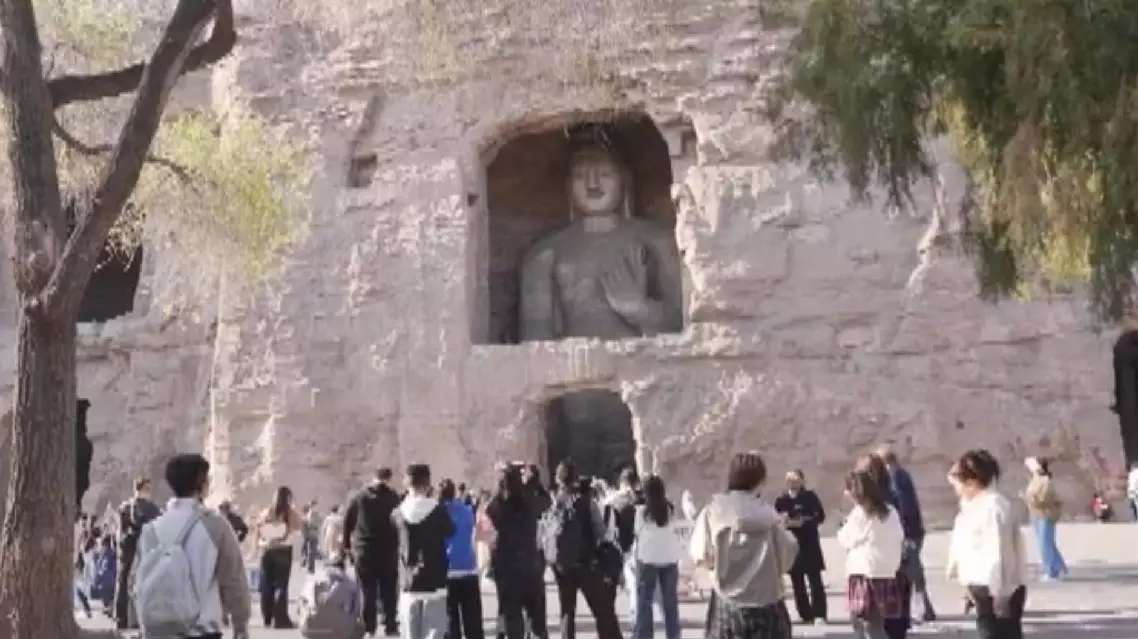
Digital innovation boosts tourism to Yungang Grottoes