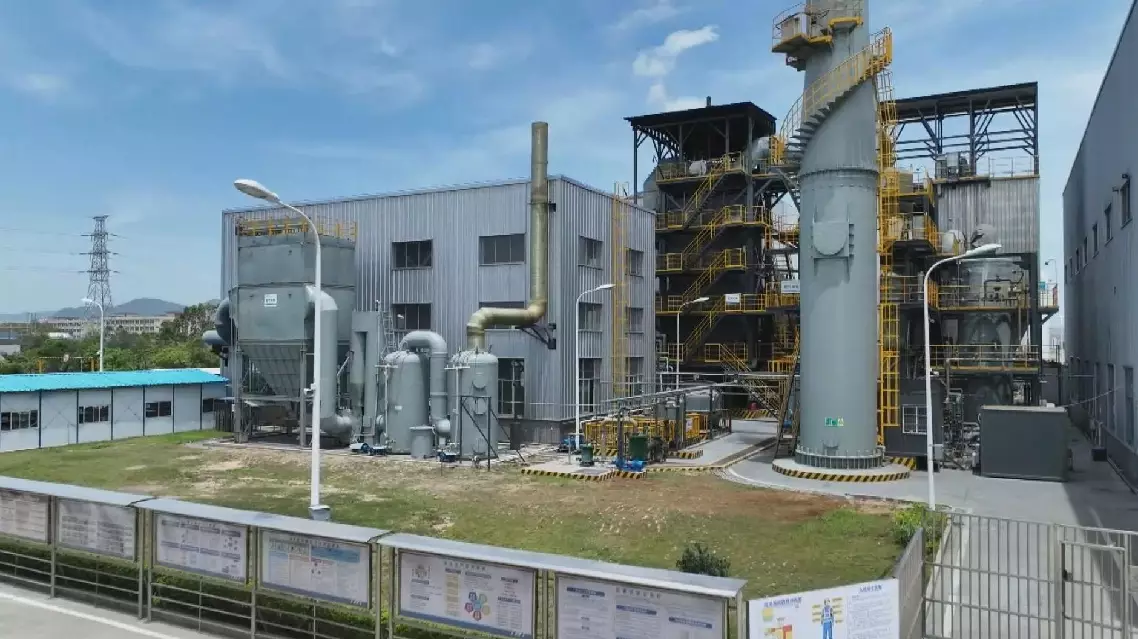
China's southern town of Guiyu, once plagued by heavy pollution from the treatment of electronic waste, has transformed into a national recycling hub, playing an important role in the country's efforts to develop its circular economy and achieve carbon neutrality.
Located in Shantou City of Guangdong Province, Guiyu, once the heartland of China's e-waste disposal, used to feature numerous family-run workshops where residents dismantled e-waste by hand using the most primitive way. Due to the high costs of pollution control equipment, Guiyu's environment suffered, with air often filled with an acrid stench.
The turning point came in 2015 with the launch of the Guiyu Circular Economy Industrial Park, and informal e-waste businesses began to relocate to the park. The goal is to achieve zero waste in the industrial park -- all components that can be reused are recycled, while the rest is processed for valuable material extraction.
Today, the park has evolved into an automated recycling hub for precise and efficient dismantling, with clear systems in place tracking various types of e-waste.
"We recycle all kinds of items, including keyboards and DVD players. We can accurately track which workshop receives e-waste and the timing of these transfers. We also monitor the sources and destinations of all e-waste," said Zhong Yingshan, director of the management committee at the park.
Guiyu is also home to China's first mobile phone safe recycling and disposal demonstration base, which began trial operations in January. A new device has been introduced that efficiently recycles heavy metals from mobile phone circuit boards for centralized and harmless disposal. Currently, the base processes 12,000 tons of waste circuit boards each year.
In recent years, China has consistently strengthened the top-level design of green and low-carbon development. A series of policies implemented by the government have supported the growth of the circular economy and the resource recycling industry.
To promote the development of the circular economy, China established a centrally administered state-owned enterprise, China Resources Recycling Group Co., in October 2024 in Tianjin. The company established nine new subsidiaries just recently, covering areas such as power batteries, new energy, non-ferrous metals and other resource recycling sectors.
According to China's plan for circular economy development during the 14th Five-Year Plan (2021-2025) period, by this year, the resource recycling industry system will be established, with the output value reaching 5 trillion yuan (about 697.3 billion U.S. dollars).
China's resource-recycling industry is evolving from traditional recycling practices to a high-tech, high-quality sector, according to Zhu Liyang, president of the China Association of Circular Economy.
"In the future, government experts and private enterprises will collaborate to promote the upgrading of the resource recycling industry towards greater standardization, higher value and enhanced efficiency," said Zhu.
China's e-waste disposal town transforms into national recycling hub