Skip to Content Facebook Feature Image

Chinese foreign trade firms step up efforts to stay competitive in global markets

China

China

China

Chinese foreign trade firms step up efforts to stay competitive in global markets

2025-05-10 03:19 Last Updated At:07:17

Chinese foreign trade companies are stepping up efforts to make their products more competitive amid an uncertain global trade environment.

At a home appliance company in east China's Jiangsu Province, vacuum storage containers are being produced at a pace of 100 units per minute. The containers, favored for their ability to keep food fresh, are set to be shipped to markets in Southeast Asia.

"Compared with traditional food storage containers, ours can greatly extend the preservation time of food. While the conventional ones can keep food fresh for about two days, ours can maintain freshness for at least a week," said Lyu Pingping, head of the company.

While some companies have increased sales by adopting innovative technologies, others have focused on securing raw material supplies to maintain high quality.

In south China's Hainan Province, a coconut juice company has established a comprehensive "planting-processing-sales" chain to secure a steady supply of high-quality coconuts.

The company is also targeting key coconut-producing areas in Southeast Asia, such as the Philippines and Vietnam, with its coconut grove areas spanning over 2,000 hectares.

In 2024 alone, the company imported over 200 million coconuts, with the import value in the first four months increasing by 80 percent year on year.

"We use the internationally advanced instant sterilization technology, resulting in a nutrient retention rate exceeding 95 percent. As of April, our product has reached 31 provinces and cities nationwide, making its way into major supermarkets and numerous chain convenience stores," said Huang Daoliang, head of the company.

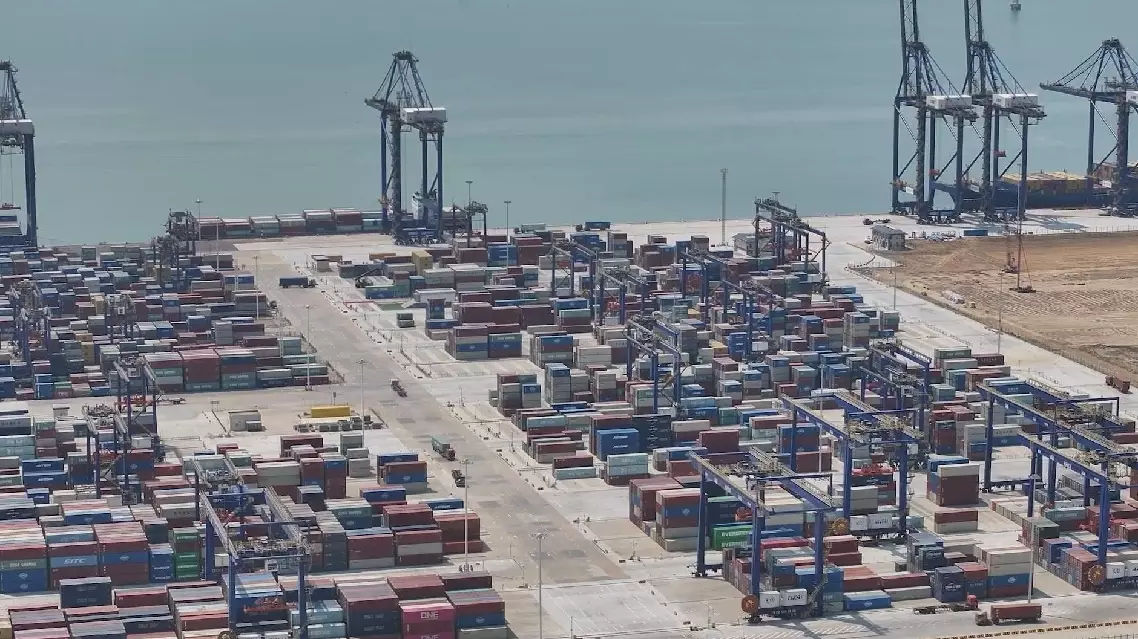
The strong sales from Chinese enterprises have significantly bolstered the country's foreign trade growth.

"In April, the growth rate of China's imports and exports accelerated by 4.3 percentage points compared with the first quarter's level, with exports rising and imports reversing their decline, demonstrating strong resilience," said Lyu Daliang, director general of the Department of Statistics and Analysis of the General Administration of Customs of China (GACC).
Chinese foreign trade firms step up efforts to stay competitive in global markets

Chinese foreign trade firms step up efforts to stay competitive in global markets
A new round of trade-in subsidy program is energizing China's consumer market these days, with provinces across the country seeing a surge in demand for cars, home appliances and digital devices.

In north China's Shanxi Province, the new trade-in subsidy program, which started on January 9, has further helped boost sales in home appliances and digital devices which are covered by the new round of subsidies.

To enjoy the subsidies, six types of home appliances, including refrigerators and washing machines, must meet national Level 1 energy-efficiency or water-efficiency standards. Digital and smart products include four types, such as mobile phones and tablets, with a sales price cap of 6,000 yuan (about 800 U.S. dollars) per item.

In both categories, subsidies are set at 15 percent of the final transaction price. For home appliances, the maximum subsidy is 1,500 yuan per item. For digital products, the cap is 500 yuan per item. Each consumer can receive a subsidy for one unit in each category.

Neighboring Shanxi, Hebei Province kicked off the year of 2026 with the new round of trade-in subsidy program starting on January 1.

The subsidies cover automobiles, home appliances, and digital products. Individual consumers who purchase designated Level 1 energy-efficiency appliances or eligible digital products priced at no more than 6,000 yuan can receive subsidies equal to 15 percent of the transaction price. The maximum subsidy is 1,500 yuan per appliance and 500 yuan per digital or smart device, with each person limited to one subsidized item in each category.

Data showed that from Jan 1 to 9, Hebei's home appliance trade-in program alone disbursed more than 130 million yuan in subsidies, driving sales of over 920 million yuan.

In east China's Jiangsu Province, the new trade-in subsidy program, taking effect for two weeks, has brought the province a boom in trade-in.

At a local 4S store in Jiangsu's Suqian City, showroom traffic has spiked as salespeople walked customers through the new benefits from the trade-in subsidy program.

"Under the scrappage-and-replacement scheme, customers who buy a new energy vehicle (NEV) can receive a subsidy worth 12 percent of the vehicle price, capped at 20,000 yuan (about 2,860 U.S. dollars). For combustion-engine cars, the subsidy is 10 percent, with an upper limit of 15,000 yuan. For trade-ins, NEVs are able to receive a subsidy worth 8 percent of the vehicle price, up to 15,000 yuan, while combustion-engine cars will receive a 6-percent subsidy, with a cap of 13,000 yuan," said Sun Yue, a saleswoman at the store.

In the home appliance sector, Jiangsu's policy this year stipulates that only products that meet China's Level 1 energy-efficiency standard are eligible for subsidies. The scheme covers six major categories, including refrigerators and washing machines.

Consumers who purchase qualifying appliances can receive a subsidy equal to 15 percent of the final retail price, up to a maximum of 1,500 yuan per item. Each person is limited to one subsidized unit per product category.

Four types of digital and smart products, such as mobile phones and tablets, are eligible for a 15-percent subsidy capped at 500 yuan per unit, with a retail price no more than 6,000 yuan.

"With the national subsidy policy back in place this year, I went to the store to check what discounts I could get. It knocked 500 yuan off the price. [The discounted price is] very reasonable," said Wang Kang, a resident of Jiangsu's Xuzhou Province.

To enhance the shopping experience for consumers, many retailers are pairing subsidies with "one-stop" services that combine the delivery of new products with on-site collection of old ones.

"After consumers place an order for new home appliances, our staff will schedule a time to pick up the old units. Recycling the old appliance can also further offset the purchase price of the new one," said Yang Jie, a sales supervisor at a major home appliance company.

China's new trade-in program sparks consumption boom

China's new trade-in program sparks consumption boom

Recommended Articles