Global officials and experts were captivated by groundbreaking AI innovations during the Second AI Capacity Building Workshop, which opened Monday at Tsinghua University in Beijing, hosted by China's Ministry of Foreign Affairs.
Officials and experts from 34 countries and international organizations, including ASEAN and the African Union, are participating in the six-day event.
At the Zhongguancun Innovation Zone's exhibition and trading center, visitors were mesmerized by AI's diverse applications, from embodied intelligent robots and smart NEVs to a cloud-based embroidery system that crafts custom designs in just three minutes.
During their visit, foreign envoys eagerly recorded China's AI innovations on their mobile phones, describing the nation's technological advancements as "far beyond amazement".
Additionally, they exchanged contact information with representatives from multiple Chinese enterprises on-site for potential future cooperation. Foreign envoys and business leaders also actively engaged in discussions with Chinese experts and scholars, aiming to advance AI capabilities in their own countries.
"I feel very pleased about everything, about the technical knowledge, about the experience, especially the experience of China. I'm going to bring all [that] good news to my country. Globally, usually the countries that know the most, they don't like to share, especially in the West. But China is using a different approach, and that is very important for us, because we can collaborate, cooperate and work together and that [is a] win-win situation," said Ronald Rodrigo Delgado Cruz, director of the AI Research and Development Department at the Venezuelan Ministry of Science and Technology.

China's sci-tech advancements wow global business leaders at Beijing workshop
As China marks the 90th anniversary of the victory of the Long March, a roughly 12,500-kilometer military odyssey, German writer Christian Y. Schmidt shared his and fellow author Volker Haering's extraordinary cycling journey retracing the the historic route with local audiences in Germany.
The Long March (1934-1936) was a military maneuver by the Chinese Workers' and Peasants' Red Army that later became a defining episode in modern Chinese history, symbolizing endurance and perseverance as troops crossed some of the country's harshest terrain to establish a new revolutionary base. Some marched as far as 12,500 kilometers, enduring hunger, thirst and cold.
Schmidt and his friend, fellow writer Haering spent 138 days between 2023 and 2024, cycling nearly 7,000 kilometers along the historic route of the Chinese Red Army, starting from Ruijin County in east China's Jiangxi Province and heading northwest.
Their experiences have been compiled into a book titled "Der lange Fahrrad-Marsch: 7.000 Kilometer durch das Reich der Mitte".
Last week, Schmidt shared extraordinary journey with audiences at the Confucius Institute at Dusseldorf, drawing engagement from local attendees seeking fresh perspectives on Chinese modern history.
"I think we can take away an inspiration from this: As long as you keep moving forward, never give up, and always keep your eyes fixed on your goal, you will surely be able to keep going. And if you encounter difficulties along the way, you just have to find ways to overcome them," said Schmidt.
The presentation prompted reflections on endurance and modern development among the German audience.
"Mao Zedong once said, 'Nothing is impossible in the world if you dare to scale the heights.' I think this is precisely the spirit demonstrated during the Long March. Who could have imagined that after enduring such hardship, victory could still be achieved in the end? I think that is the lesson we can draw from it. In a sense, the memory of the Long March seems deeply etched into the genes of future generations," said Kneppel, an attendee.
"China's development is indeed nothing short of a miracle. China has achieved astonishing leaps in technological development. Driven by the government, China displays tremendous vitality, focus, and purposeful effort. The Chinese government unites people from all over the country to march toward the exact same goal, and I have witnessed this with my own eyes," said Maria, another attendee.
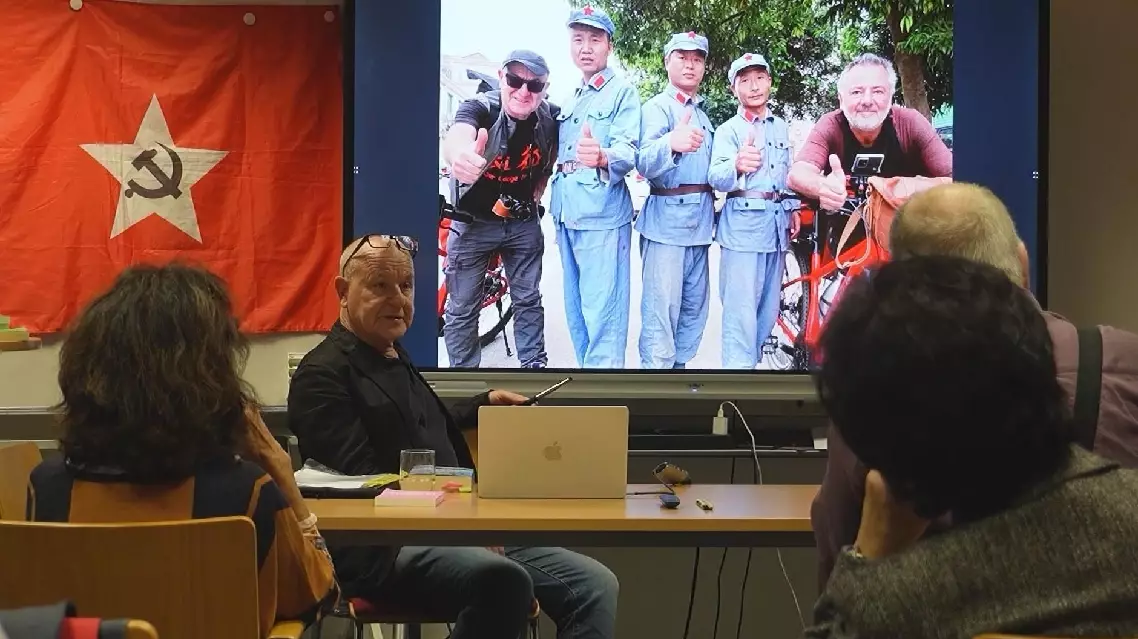
German writer shares 7,000 km Long March cycling journey with audiences