Around 400 business leaders and United Nations (UN) officials gathered in Singapore on Thursday for a summit aims at accelerating the UN's Sustainable Development Goals.
The 2nd Global Business Summit on Belt and Road Infrastructure Investment, themed “Connect for a Better World”, comes as ASEAN and China mark 35 years of dialogue relations. The summit is convened by the UN Global Compact’s Belt and Road Action Platform, established in 2020 after heads of state at the Belt and Road Forum urged companies in participant countries to adopt the UN’s Ten Principles on human rights, labor, environment and anti‑corruption.
Six years later, the platform’s focus has narrowed to a single question: what Chinese industry can actually deliver abroad.
"We see climate challenge is very urgent and we believe that Chinese companies and industrial leaders in particular can play a very active role in combating climate change and reducing carbon emissions, as well as other greenhouse gas emissions," said Meng Liu, head of the UN Global Compact China Office.
Delegates adopted a Singapore Declaration on high-quality Belt and Road cooperation, and launched two new expert groups: one on sustainable energy and the other on digital infrastructure.
Twelve sustainability initiatives, covering green energy, biodiversity, supply-chain ESG and responsible AI were launched at the summit. Organizers say the emphasis has shifted from pledges to delivery.
"No one's making big announcements anymore per se, because they're operationalizing. Sustainability is being put into action. It's being embedded, and you're actually delivering on those commitments. So I think it's maturing, and I don't think it's in retreat at all," said David Fogarty, CEO and executive director of the UN Global Compact Network Singapore.
Among the large Chinese delegation is wind turbine maker Mingyang Smart Energy. Its priority markets are Europe, Southeast Asia and Belt and Road participant countries. The company says the technology and the scale are proven, but the challenges are compliance, and winning trust in each new market.
"In terms of scalability and capability, I think China is definitely the leader. But still, when going into a different market, we have to follow the local compliance requirements. Chinese companies are trying to be partners, but not the breakers of the market," said Hu Yang, brand director of Mingyang Smart Energy Group.
Going global, Hu says, is no longer about going out. It is about going in: learning local rules, and making sure communities on the ground see the benefit of the technology arriving on their coastlines.
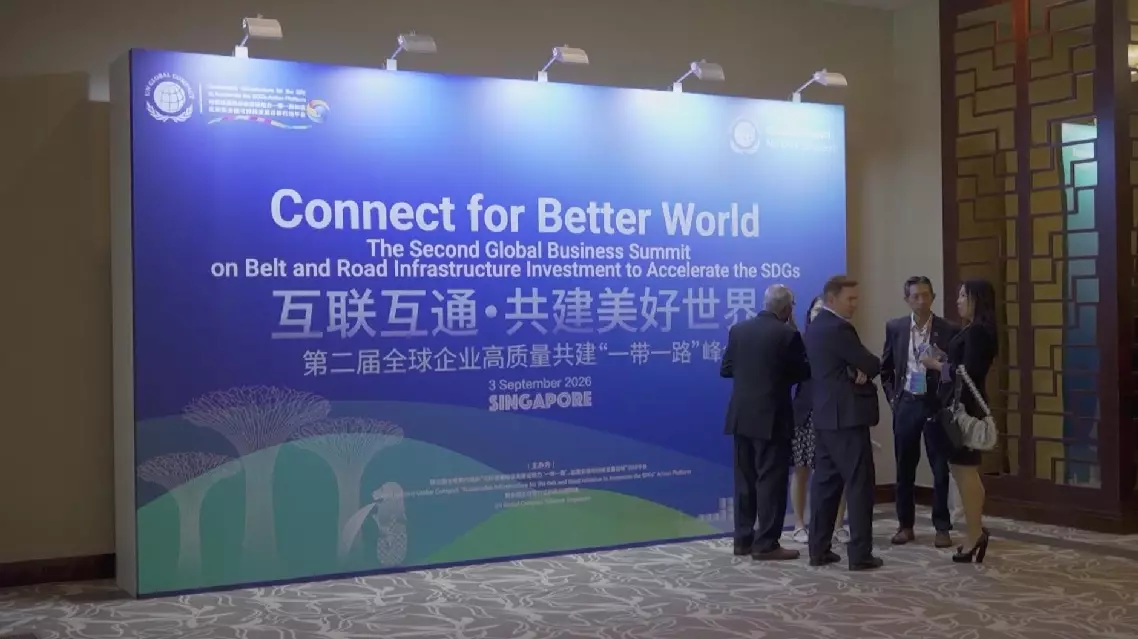
Global business summit on high-quality Belt and Road cooperation held in Singapore