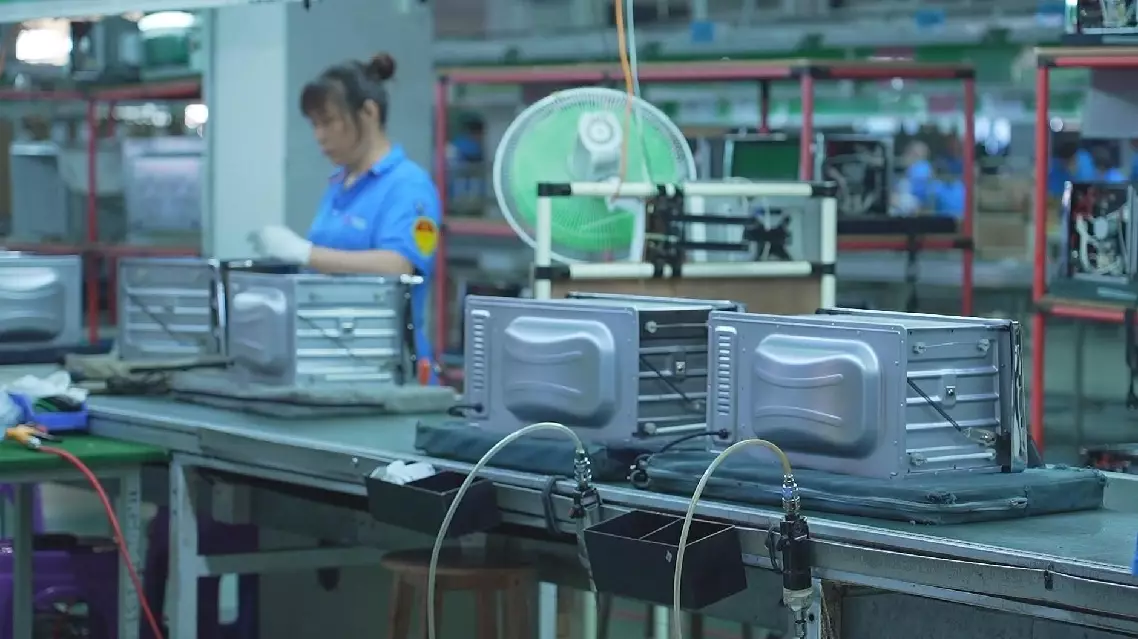
Home appliance manufacturers in Zhongshan, south China's Guangdong Province are finding ways to adapt to tariff policies of the United States without lowering their prices.
Last year, home appliances were China's fourth-largest export to the United States, but the trade flow is now under growing strain amid U.S. tariff hikes. Despite the temporary reduction announced by Beijing and Washington, the full set of U.S. tariffs on Chinese goods remains steep.
Zhongshan is a major manufacturing hub for home appliances. For years, much of its goods headed straight to American homes. But a fresh wave of U.S. tariffs in April brought shipments to a standstill.
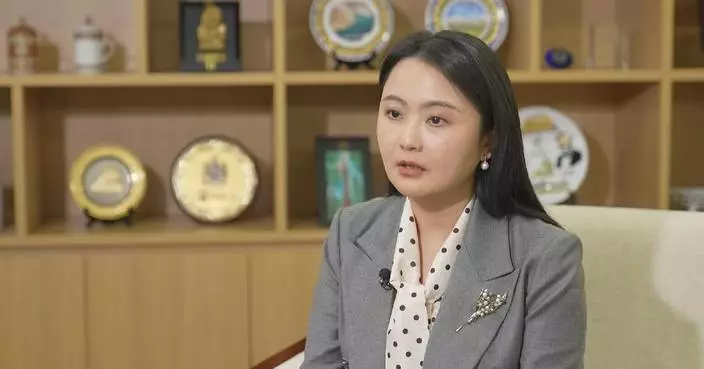
"We have five big buyers. One of them stocked here about 30 containers, I think, totally is about five million U.S. dollars," said Ricky Liang, vice president and sales director of Guanglong Gas and Electrical Appliances.
Liang's products now face up to 55 percent in tariffs -- a mix of Trump's first term policies, new levies linked to fentanyl, and blanket tariffs on most countries.
"They [clients] even feel anxious because they know I will not lower the price, and they know the tariff will be shouldered by themselves," said Liang.
Liang's clients include Walmart, the world's largest retailer, whose CEO recently warned price hikes are hard to avoid "given the reality of narrow retail margins".
To cushion the blow from tariffs, Liang's factory -- like many others -- is moving some production overseas.
"In China, we are in charge of the developing, the tooling. And then we also make some key components from China. In Vietnam, we do some simple assembly and also some production there. We also need to find more buyers, for example, these items are also for Europe," said Liang.
Dongfeng Town, located in northern Zhongshan City, is home to over 8,500 companies in the home appliance supply chain.
The town government has set up a new cross-border e-commerce association to help manufacturers handle small, direct-to-consumer orders and offset the impact of tariffs on their large container shipments. Local businessman Huang Long owns a company manufacturing luxury cabinets for wine and cigars, and half of his exports go to the United States.
To cope with the tariff policies, Huang, also executive vice president of the Zhongshan Dongfeng Cross-Border E-Commerce Association, said his company is seeking more opportunities in China's domestic market, and local manufacturers are making joint efforts to explore overseas markets.
"Our products are non-essential. When prices rise, consumers tend to cut back, so tariffs hit us harder. We've been in domestic e-commerce since 2011. The local market is still huge. Now, the town is pooling our supply chain resources together to build a brand for overseas markets," said Huang.
In Natou Town, another company is taking a different path - gaining more market share with high-tech manufacturing.
"Today, advances in AI, automation and robotics have made China's manufacturing efficiency world-class. For large-scale production, that means lower costs. Our high-end products now rival, or even surpass brands from Japan, Korea, Europe, and the U.S. in both tech and design. With that edge, we are steadily gaining ground in global markets," said Michael Yao, CEO of Homa Appliances.
Manufacturers hope that more duties will be lifted after the 90-day "cooling period". In the meantime, they are preparing for a long fight by building factories overseas, exploring new markets, and doubling down on innovation.
The pressure is real, but so is their determination to keep moving forward, and to keep winning.
Chinese home appliances exporters adapt to US tariffs without lowering prices