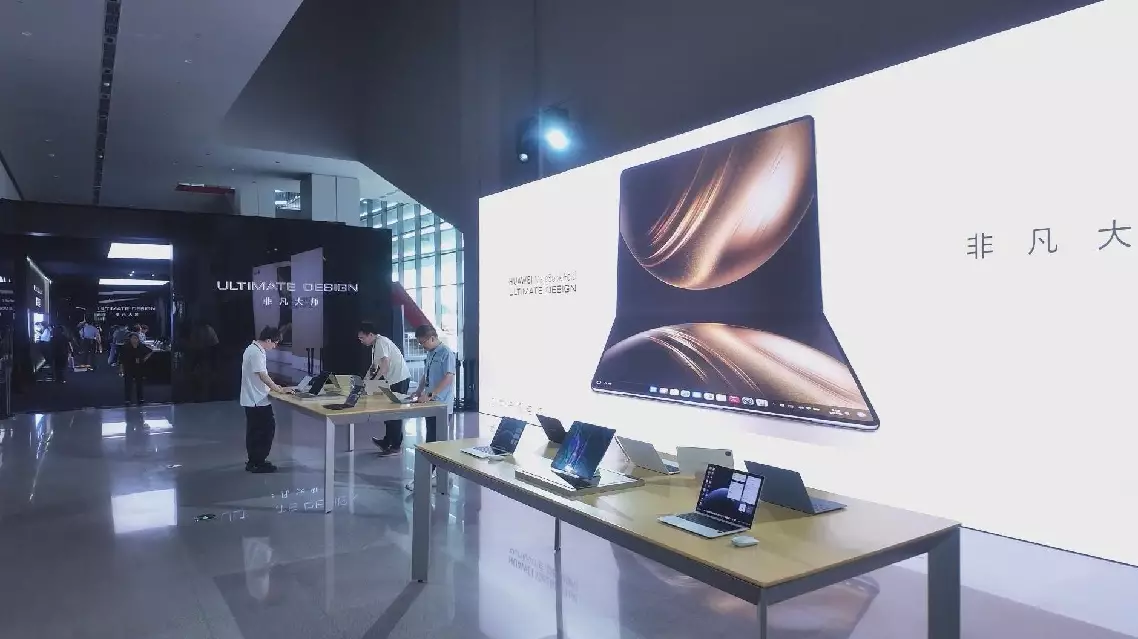
Huawei launched its first laptop running with the self-developed Harmony operating system (HarmonyOS) on Monday, marking a milestone in the development of China's personal computer (PC) industry.
The brand new computer is believed to signify that China now has a completely independent and controllable PC operating system, filling the gap of domestic market in the sector that have long been dominated by Windows and macOS.
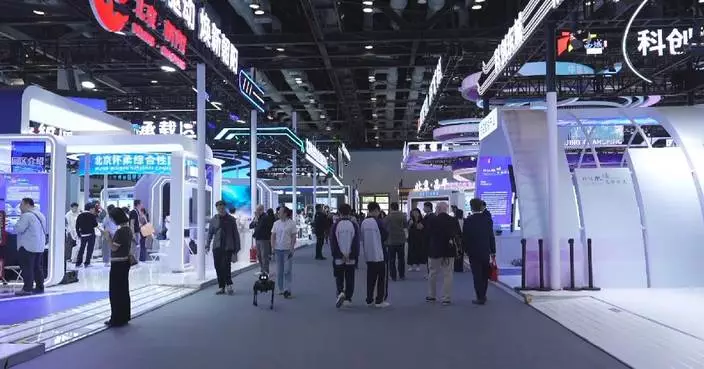
At an exhibition area in Chengdu City of southwest China's Sichuan Province, the technicians simulated some extreme application scenarios to test the smoothness of the HarmonyOS PC.
It only took one second to open a 1G-sized PowerPoint document with more than 100 pages. When opening the windows of more than a dozen applications and files simultaneously, the operation remained smooth without lag.
The foldable-screen laptop boasts powerful artificial intelligence capabilities. Once the built-in agent has been activated, the computer can assist users in creating PowerPoint production using only voice commands. The virtual keyboard can be awakened when users place their hands on the screen. Cross-device operation is also possible, enabling users to move pictures directly from another tablet to this computer for processing.
Yu Chengdong, executive director of Huawei and chairman of Huawei's Consumer Business Group, told China Central Television (CCTV) that the HarmonyOS PC is a crucial step in the development of the HarmonyOS ecosystem.
HarmonyOS is the first of its kind to achieve the goal of running different terminal devices with a single operating system, he said.
"We have restructured the operating system starting from the kernel. With a unified digital infrastructure and a unified ecosystem, we have built an independent and controllable system that is full-link and future-oriented," said Yu.
He noted that the HarmonyOS PC has been encrypted from hardware to software, ensuring data security even if the hard drive is removed.
"The microkernel design of HarmonyOS PC strictly isolates the core modules of the operating system from other service applications, reducing high-risk vulnerabilities by more than 50 percent. We currently have over 150 dedicated computer ecosystem applications in the process of accelerated adaptation, and another 1,000 integrated ecosystem applications have already completed adaptation," Yu said.
The HarmonyOS computers offers a range of software for office work, design and creation, practical tools, financial management, audio-visual entertainment, education and learning, and games. It is expected that more than 2,000 integrated applications will be compatible by the end of this year.
HarmonyOS also features a groundbreaking "hand-eye collaboration" function which enables seamless cross-device connection. Press the shortcut key, and the mouse will automatically appear on the target device where the user's eye is focusing. The feature can also work with the cross-device clipboard.
In addition, HarmonyOS PC supports the simultaneous transfer of files and images to four users, which will significantly enhance the efficiency of team collaboration.
"It is developed based on our long-term tests of human eye movements in the laboratory. Even if the user is not directly facing this device, it can still easily transfer the operation from another device to the target one. The connection delays between devices are all within milliseconds, almost imperceptible to users," said Zeng Qunfan, an expert in HarmonyOS software product management.
Huawei launches 1st laptop with self-developed Harmony system