SUNNYVALE, Calif.--(BUSINESS WIRE)--May 19, 2025--
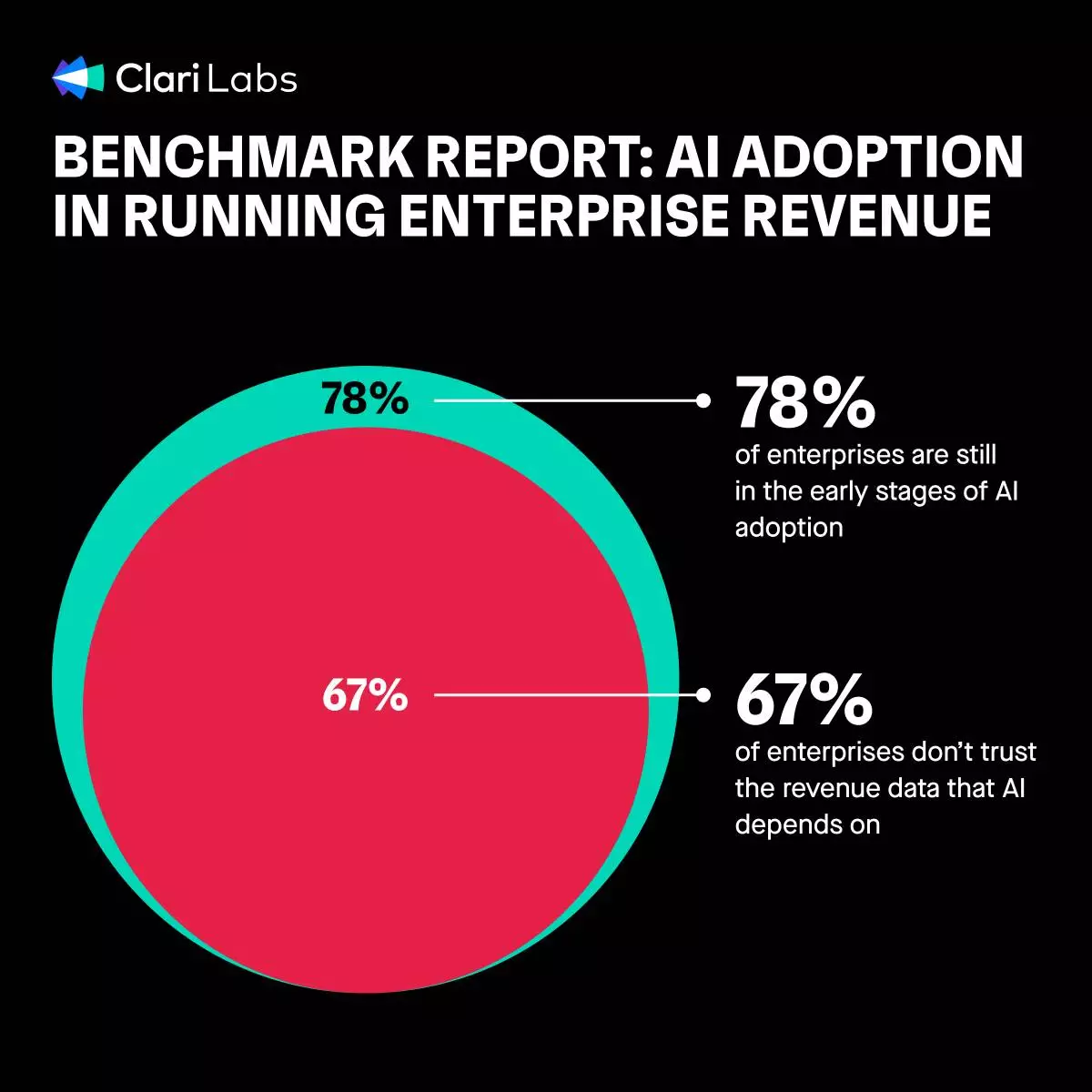
New research from Clari Labs on AI Adoption in Running Enterprise Revenue shows that while AI is proven to unlock revenue growth, 78% of enterprises are still in the early stages of AI adoption — and 67% of enterprises don’t trust the revenue data that AI depends on. To unlock the full potential of AI and agents, enterprises must re-architect how they run revenue.
This press release features multimedia. View the full release here: https://www.businesswire.com/news/home/20250519941062/en/
The New Revenue Partners: CIO and CRO
Enterprise AI success now depends on deep alignment between the Chief Revenue Officer (CRO) and the Chief Information Officer (CIO). In leading companies, these two executives are co-authoring a new paradigm: revenue growth powered by data, guided workflows, AI, and Revenue Context to understand who did what, when, and what outcome it drove.
As CIOs take a more active role in driving revenue outcomes, they’re asking: What’s the state of AI for Revenue adoption across enterprises? Where are peers struggling — and where are they winning? And what foundation is truly required to scale AI for Revenue? To answer these questions, Clari Labs surveyed enterprise revenue leaders across hundreds of major enterprises.
The Rise of the Revenue Architect
To capitalize on AI’s potential, enterprises are building new roles and structures to run revenue with precision and context:
As a result, a new enterprise career is emerging: the Revenue Architect. This enterprise leader is responsible for ensuring the organization is structurally ready to scale AI for Revenue — by delivering trusted data, aligning systems, and enabling consistent execution across go-to-market teams.
Forward-thinking enterprises are investing in Revenue Architects to orchestrate the transformation to predictive revenue and deploy AI agents with confidence — ensuring those agents succeed by equipping them with the Revenue Context they need to guide decisions and drive the right actions.
Key Findings: AI Adoption in Running Enterprise Revenue
While Clari’s customers represent some of the earliest and most successful enterprise adopters of AI, this new research benchmarks AI adoption across the broader market (not Clari customers) — surveying 400 enterprise CROs, Chief Sales Officers (CSOs), and Revenue Operations leaders at companies with 1,000+ employees across North America. The research reveals that most enterprises have yet to build the foundation needed to scale AI for Revenue successfully:
67% of enterprise leaders don’t trust their revenue data.
AI will transform revenue — but it requires all revenue data, activities, and outcomes to be centralized and unified .
Revenue data is an amalgamation of structured and unstructured data that today is scattered across CRMs, spreadsheets, emails, recorded conversations, BI systems, and siloed tools, teams, and regions. The inability to centralize and easily visualize revenue data erodes trust and creates blind spots.
49% of revenue leaders only discover revenue risk after missing their number.
CRMs only capture part of the picture. Spreadsheets are out of date. Activity data, conversational data, and email data live in silos.
In most enterprises, critical revenue teams operate without the rigor and governance to understand who did what, when, and what outcome it drove — making it impossible to drive consistent execution and guide teams and AI agents to win.
67% of enterprises in North America missed their 2024 revenue target.
Despite that, 91% of revenue leaders are confident about hitting their revenue goals in 2025. That optimism, however, depends on addressing deep operational flaws.
Forty percent of leaders say their reps are spending time on the wrong accounts and activities, while 64% report losing up to 30% of pipeline due to handoff gaps, organizational silos, and missed opportunities.
AI is the only way to close the execution gap — exposing new insights, guiding teams through critical motions like pipeline reviews, forecast calls, and account plans.
Frontline distrust is the top barrier to AI success.
The #1 blocker to AI adoption? Lack of trust in AI outputs from frontline sellers.
AI must prove value to sellers to achieve widespread adoption. Most AI today focuses on narrow tasks, not the bigger picture. Reps are flooded with disconnected suggestions that lack strategic context.
True guided selling isn't about telling reps what to do — it's about helping them see the larger strategy, knowing how and where to spend their time, spotting opportunity and risk — executing like the CRO of their territory.
When enterprises miss revenue targets, executives’ jobs are at risk.
Forty-three percent of enterprise leaders say missed revenue targets will lead to job cuts. To avoid that risk, enterprise revenue leaders are betting on AI to drive predictable growth.
Thirty percent of revenue leaders plan to increase their investment in AI — recognizing its potential to guide teams through critical activities like pipeline reviews, forecasting reviews, and cadences to ensure the right actions happen consistently, on time, and are aligned to company revenue objectives.
Unlock the Full Value of AI for Revenue
Addressing the challenges uncovered in the research, from data fragmentation to frontline distrust, Clari today announced Revenue Context TM — the industry’s first set of platform capabilities designed to ensure AI and agents work and collaborate at enterprise scale across the entire revenue process, end to end.
Revenue Context enables Revenue Architects to comprehensively track all human- and machine-driven signals across deals, accounts, reps, regions, segments, products, and more. All context is captured in Clari’s revenue data platform, the world’s largest managing over $5 trillion in revenue.
Clari customers are already realizing the impact of AI at enterprise scale:
“Most CIOs lack the data and context to answer the fundamental question: who did what, when, that led to what outcome? Without Revenue Context, AI will fail them,” said Andy Byrne, CEO and Co-Founder, Clari. “Furthermore, without Revenue Context, the CRO cannot answer the most important question in business: will they meet, beat, or miss on Revenue? The CIO and CRO have an industry-changing opportunity to easily answer these questions and use AI to transform how they run revenue across the enterprise.”
Additional Resources
About Clari
Clari is the only Enterprise Revenue Orchestration leader that delivers Revenue Context to run revenue and inform AI and agents at enterprise scale.
The Clari Revenue Orchestration Platform leverages all structured and unstructured data from every human- and machine-generated revenue interaction into a single, time-series data model, the world’s largest of its kind — managing over $5 trillion in revenue for global enterprises.
More than 1,500 organizations — including Okta, Adobe, Workday, Zoom, and Cisco — run revenue on Clari to improve win rates, prevent slipped deals, forecast with accuracy, and boost the productivity of all revenue-critical employees.
Clari: Run Revenue ® with AI + Revenue Context. Learn more: https://www.clari.com/
Survey Methodology
The survey was conducted by Censuswide, among a sample of 400 respondents in North America — Chief Revenue Officers, VPs of Sales, and those responsible for planning and executing Revenue Operations. The data was collected between January 31-February 11, 2025. Censuswide abides by and employs members of the Market Research Society and follows the MRS code of conduct and ESOMAR principles. Censuswide is also a member of the British Polling Council.
78% of Enterprises Stalled With AI Adoption — Because They Don’t Trust Their Revenue Data: Clari Labs Research