To help companies in southwest China connect more closely with global markets, Chongqing Municipality has built an efficient, multimodal transport network linking rail, river, and sea through the New International Land-Sea Trade Corridor and China-Europe Railway Express.
As the core rail hub of the New International Land-Sea Trade Corridor, Chongqing's railway container center is bustling. This hub links the northern Silk Road Economic Belt facilitated by the China-Europe Railway Express, with the southern Maritime Silk Road. Together with Guoyuan Port on the Yangtze River, it forms a vital logistics channel connecting China with global markets.
"We've now opened up four major routes in all directions, covering most of the world, including the EU, ASEAN countries, and the Americas. As a hub, there may be some market-driven shifts, but overall, our cargo volume has kept growing steadily over the past few years," said Han Chao, Deputy General Manager of Chongqing International Logistics Hub Park. Chongqing is advancing an open economy in line with industrial transformation trends. Exports of new energy vehicles, solar products, and lithium batteries are growing steadily. In 2024, Chongqing's NEV exports almost doubled.
To support western China's auto industry going global, Chongqing is also streamlining logistics and customs services along the land-sea corridor.
"In the past five years, we have seen a clear rise in car shipments by container. So, we set up a dedicated loading area and support services to improve efficiency from arrival to loading, for cars made in Chongqing and beyond," said Deng Yunlian, Assistant General Manager of Chongqing Branch of China United International Rail Containers Co., Ltd.
Over the past eight years, the land-sea corridor has helped western Chinese regions build strong links to global markets, reaching 563 ports in 127 countries and regions. In the first quarter of this year, the rail-sea intermodal cargo volume rose by almost 70 percent year on year.
"The new trade corridor has provided greater market space for China, as well as regions and countries along the route. It has strengthened commercial circulation and industrial complementarity between China and ASEAN nations, as well as other countries, serving as an embodiment of China's Dual Circulation Development Model," said Liu Wei, Director of Logistics and Operation Center under the New International Land-Sea Trade Corridor.
By strengthening customs and transport infrastructure, Chongqing is transforming itself from an inland manufacturing base into a global logistics connector. As the land-sea corridor expands its reach, the city is playing a pivotal role in advancing China's regional integration and international trade.
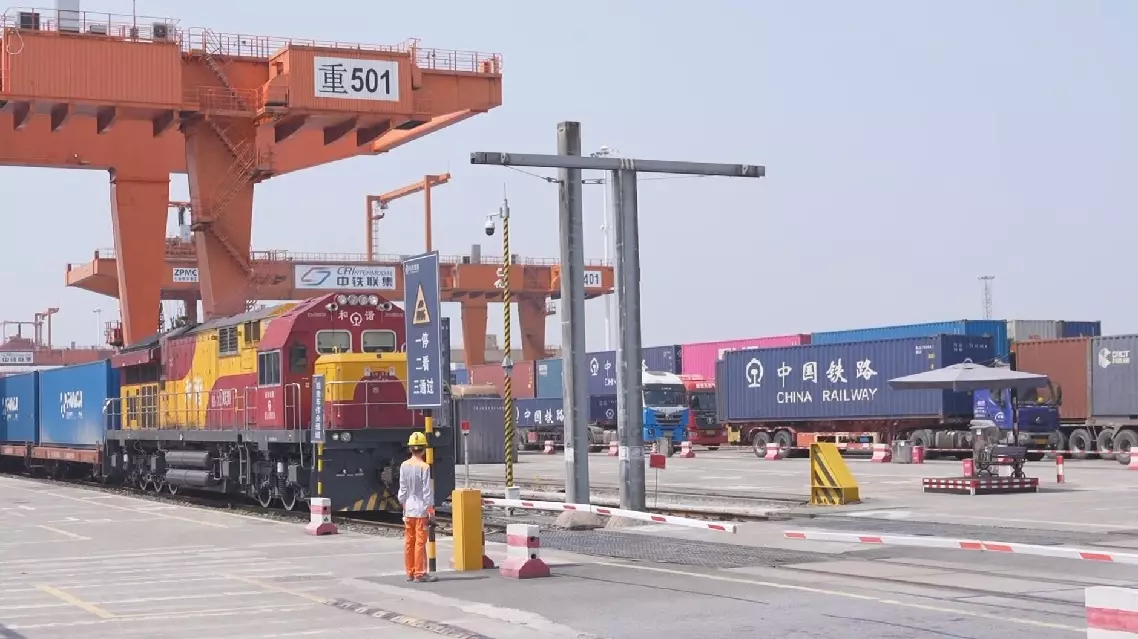
New land-sea corridor boosts Chongqing's role as global transfer hub