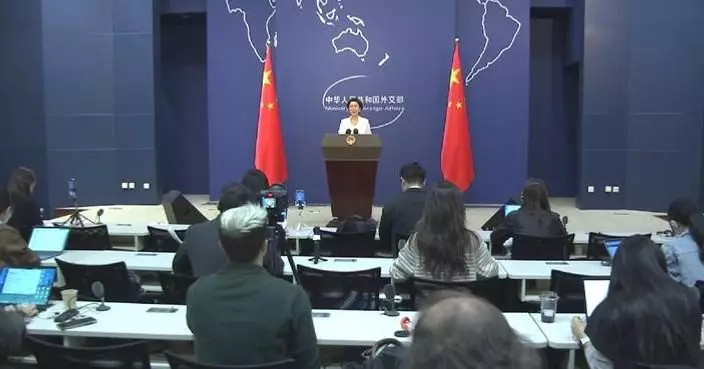
China's upcoming Tianwen-2 mission will confront unprecedented technical challenges to explore what scientists call a "living fossil" of the solar system, said Zhang Xiaotian, an associate professor at Beihang University, as the country is preparing for its first asteroid sample-return and comet exploration.
China is poised to take a major step forward in deep space exploration with the upcoming launch of Tianwen-2, a groundbreaking mission aimed at probing a near-Earth asteroid and a main-belt comet.
Scheduled for liftoff on May 29 from the Xichang Satellite Launch Center in Sichuan Province, Tianwen-2 will be the country's first mission to collect and return samples from an asteroid, an ambitious effort that could yield vital clues about the early solar system.
According to the China National Space Administration (CNSA), the spacecraft will conduct first rendezvous with asteroid 2016HO3, to perform close flybys, surface attachment, and sample collection. It will later continue its journey to investigate main-belt comet 311P, a small body with both asteroid-like and comet-like characteristics.
"We know that the Moon is Earth's natural satellite, located approximately 380,000 kilometers away. In contrast, even at its closest approach, asteroid 2016HO3 is about 40 times farther than the Earth-Moon distance, which makes its exploration significantly more challenging. Scientifically, this asteroid serves as a 'living fossil' for studying the formation and evolutionary history of the solar system, and thus holds immense research value," said Zhang.
"From a technical perspective, many may recall that China's lunar exploration program began in 2007 with the launch of Chang'e-1 and progressed through to Chang'e-5 in 2020, successfully completing the three-phase strategy of orbiting, landing, and returning from the Moon. In the case of the 2016HO3 mission, the Tianwen-2 probe will first conduct a flyalong with the asteroid, then approach and attach to its surface, perform surface sampling, and finally detach and return, essentially achieving the orbit, landing, and return phases in a single mission. This will be made possible by the solid technological foundation built through our earlier space endeavors. Furthermore, Tianwen-2 will achieve stable attachment to the asteroid's surface, providing a reliable condition for sampling. Various techniques such as robotic arms, drilling, and scooping will be employed to collect material samples," he said.
After the sample return capsule is released and begins its journey back to Earth, the main probe will continue its voyage to comet 311P, using a gravity assist from Earth to slingshot toward the second target, according to Zhang.
"After the return capsule is separated to deliver the samples back to Earth, Tianwen-2 will continue its mission by using Earth's gravity for a slingshot maneuver toward its second target, 311P. 311P is a small celestial body located in the asteroid belt between the orbits of Mars and Jupiter. It possesses the material composition typical of a comet, but follows an orbit more characteristic of an asteroid. Studying this object will help us better understand the composition and internal structure of small bodies in the solar system, as well as their evolutionary mechanisms," said Zhang.
CNSA confirmed that preparations are progressing smoothly. The Tianwen-2 probe has already completed assembly, testing, fueling, and integration with the Long March-3B Y110 rocket, which has been transferred to the launch pad. Final system checks, payload integration, and coordinated drills with ground control centers have all been successfully carried out.
The entire mission is expected to last around ten years. Approximately two and a half years will be dedicated to the encounter with 2016HO3, followed by the extended cruise to 311P.
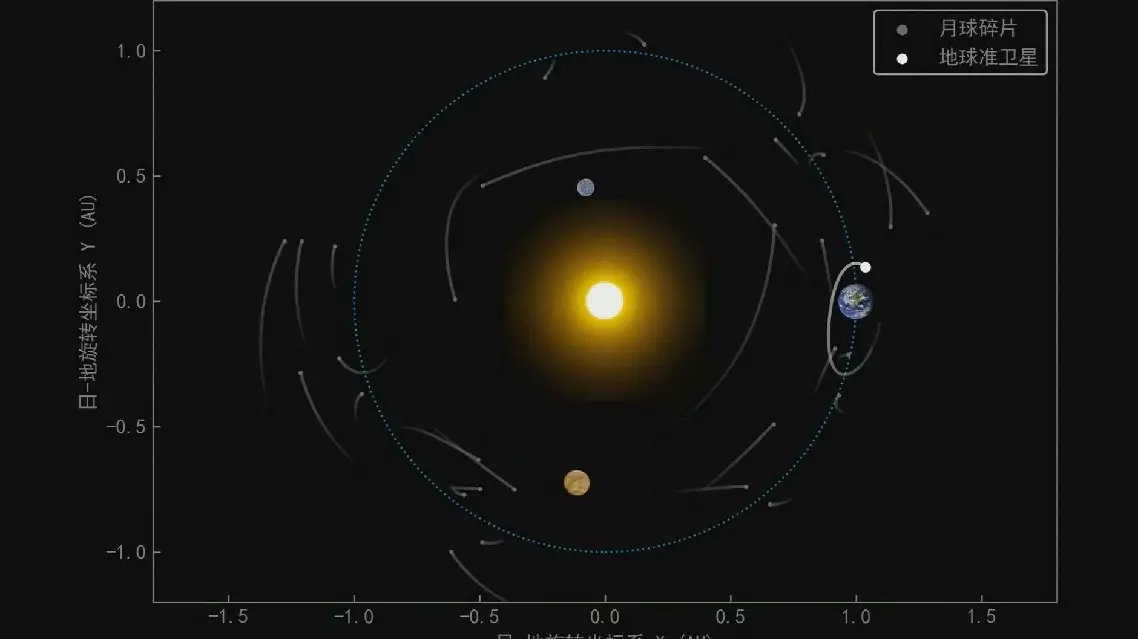
Discovered in 2016 by the Pan-STARRS telescope in Hawaii, the asteroid 2016HO3 is a quasi-satellite of Earth, located millions to tens of millions of kilometers away from Earth.
The asteroid, which runs stably near the Earth's orbit, contains ancient materials from the early solar system, making it a "living fossil" that is useful for studying how the solar system formed and evolved.
The main-belt comet 311P, a celestial anomaly that orbits in the main asteroid belt between Mars and Jupiter, was discovered by American scientists in 2013. Regarded as a "rebel" of the main asteroid belt, it displays features of both comets and asteroids.
Studying it will provide researchers with valuable insights into the composition, structure and evolution of small space objects, helping to fill gaps in our understanding of the solar system.
China's Tianwen-2 to unlock secrets of solar system ’fossils’: professor