WARSAW, Poland (AP) — Poland is set to hold a presidential runoff election on Sunday, with a right-wing nationalist and a pro-European liberal running neck-and-neck in a race that could shape the future of one of NATO's and the European Union’s most strategically important member states.
The vote comes amid heightened regional tensions driven by Russia’s war in neighboring Ukraine, security concerns across Europe and internal debates about the rule of law.
The winner will replace conservative incumbent Andrzej Duda, whose second term expires this summer. Most political power in Poland lies with a government led by a prime minister and parliament, but the president holds the power to veto laws and influences foreign policy.
Sunday’s vote follows a first round on May 18, in which Warsaw Mayor Rafał Trzaskowski won 31.36% of the vote and Karol Nawrocki, a conservative historian, earned 29.54%. Eleven other candidates were eliminated.
Nawrocki, a 42-year-old historian with no political experience who is not even a party member, was tapped by Law and Justice as part of a push for a fresh start.
Law and Justice governed Poland from 2015 to 2023, when it lost power to a centrist coalition led by Prime Minister Donald Tusk.
Nawrocki currently heads the Institute of National Remembrance, which embraces nationalist historical narratives. He led efforts to topple monuments to the Soviet Red Army in Poland. Russia responded by putting him on a wanted list, according to Polish media reports.
Nawrocki’s supporters describe him as the embodiment of traditional, patriotic values. Many oppose abortion and LGBTQ+ visibility and say Nawrocki reflects the traditional values they grew up with.
He is also the preferred favorite of Trump, with the conservative group CPAC holding its first meeting in Poland on Tuesday to give him a boost. Kristi Noem, the U.S. Homeland Security Secretary and a prominent Trump ally, strongly praised him and urged Poles to give him their vote.
A common refrain from his supporters is that Nawrocki will restore “normality,” as they believe Trump has done. U.S. flags appear at his rallies.
Nawrocki performed better in the first round than expected, an indication he was underestimated in the polling. But his quick political rise has not been without controversy, with reports of links to underworld figures whom he met while boxing or working as a hotel security guard in the past.
Nawrocki has also been linked to a scandal involving the acquisition of a Gdansk apartment from an elderly pensioner named Jerzy. Allegations suggest Nawrocki promised to care for Jerzy in return but failed to fulfill the commitment, leading the man to end up in a publicly funded retirement home.
His shifting explanations have raised questions about his transparency and credibility. After the scandal erupted he donated the apartment to a charity.
It recently emerged that Nawrocki took part in a 2009 Gdansk hooligan brawl involving about 140 rival soccer fans, some later convicted of crimes. Nawrocki described the fight as a form of “noble" combat.
His behavior during a presidential debate on Friday also generated a lot of discussion. At one point during the debate, as Trzaskowski spoke, Nawrocki put something in his mouth. He later said it was a nicotine pouch.
His critics say all of these things make him unfit to represent Poland as the head of state. His supporters dismiss the allegations as politically motivated, and it is not clear if any of the allegations will hurt him.
Trzaskowski, 53, is Warsaw’s mayor and a close ally of Prime Minister Donald Tusk. A deputy leader of the pro-EU Civic Platform, he has been prominent in national politics for years. This is his second presidential bid after narrowly losing to Duda in 2020.
Supporters credit him with modernizing Warsaw through infrastructure, public transit expansion and cultural investments. He is widely seen as pro-European, pragmatic and focused on aligning Poland more closely with EU norms, especially on democratic governance and judicial independence.
Fluent in several foreign languages including English and French, he is praised by supporters but mocked by opponents, who see those skills as a sign of elitism and taunt him with the nickname “Bonjour” at right-wing rallies.
His right-wing critics accusing him of being willing to sell out Poland's sovereignty to the EU and embracing green economic policies, which they believe are harmful to Poland's traditional reliance on coal as an energy source.
His open support for LGBTQ+ rights, including appearances at Pride parades, has made him a polarizing figure in conservative and rural areas. His conservative critics feel he is out of touch with traditional Polish values and say his administration has mismanaged aspects of Warsaw’s real estate and budget.
Voter fatigue is another challenge. Some centrist and progressive voters have expressed disappointment with the Tusk government’s failure to deliver on key promises, particularly on easing Poland’s near-total abortion ban.
Trzaskowski has sought to reinvigorate that base, leading a major Warsaw rally on Sunday that aimed to mobilize voters.
He has framed the election as a choice between a European future and authoritarian nationalism. His campaign stresses democratic institutions, EU cooperation and women’s rights, messages that resonate more in cities than in rural areas.

The liberal presidential candidate Rafal Trzaskowski, front center, waves as he and supporters of take part in a march one week ahead of a decisive presidential election in Warsaw, Poland on Sunday, May 25, 2025. (AP Photo/Czarek Sokolowski)
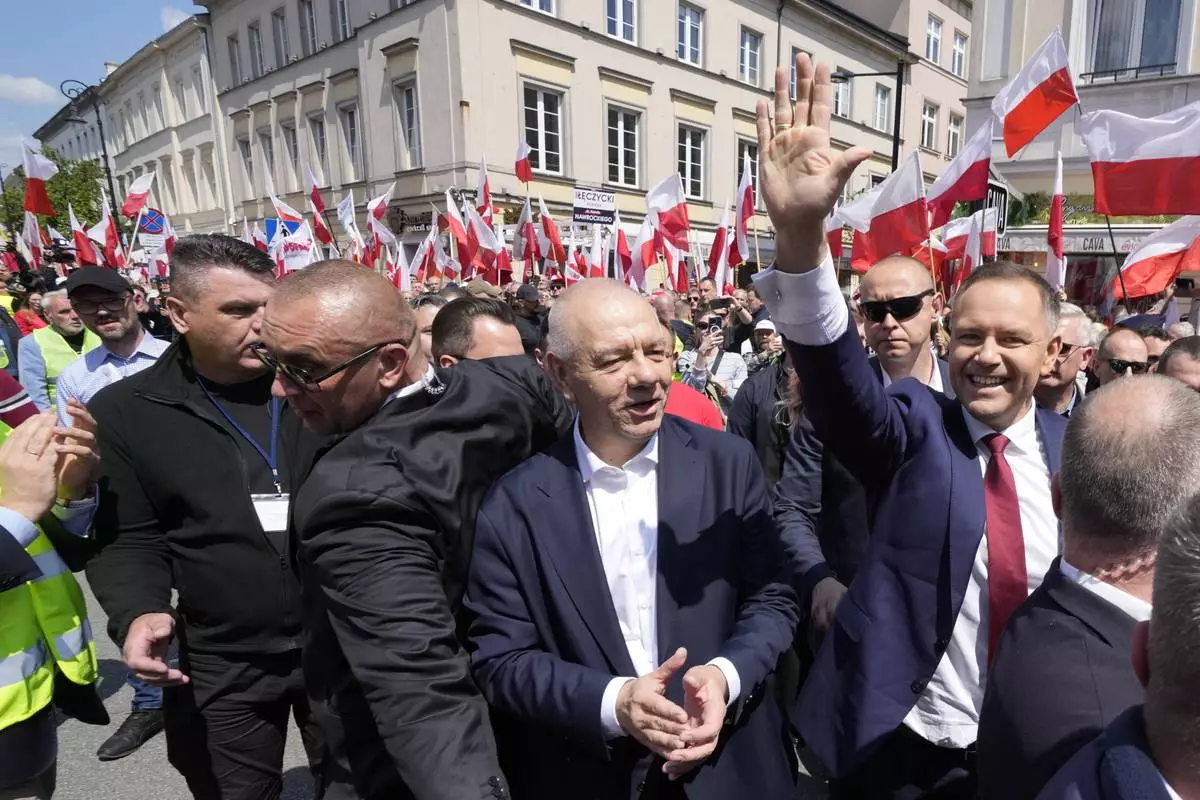
Conservative presidential candidate Karol Nawrocki, right, waves as he takes part in a march one week ahead of a decisive election in Warsaw Poland on Sunday, May 25, 2025. (AP Photo/Czarek Sokolowski)
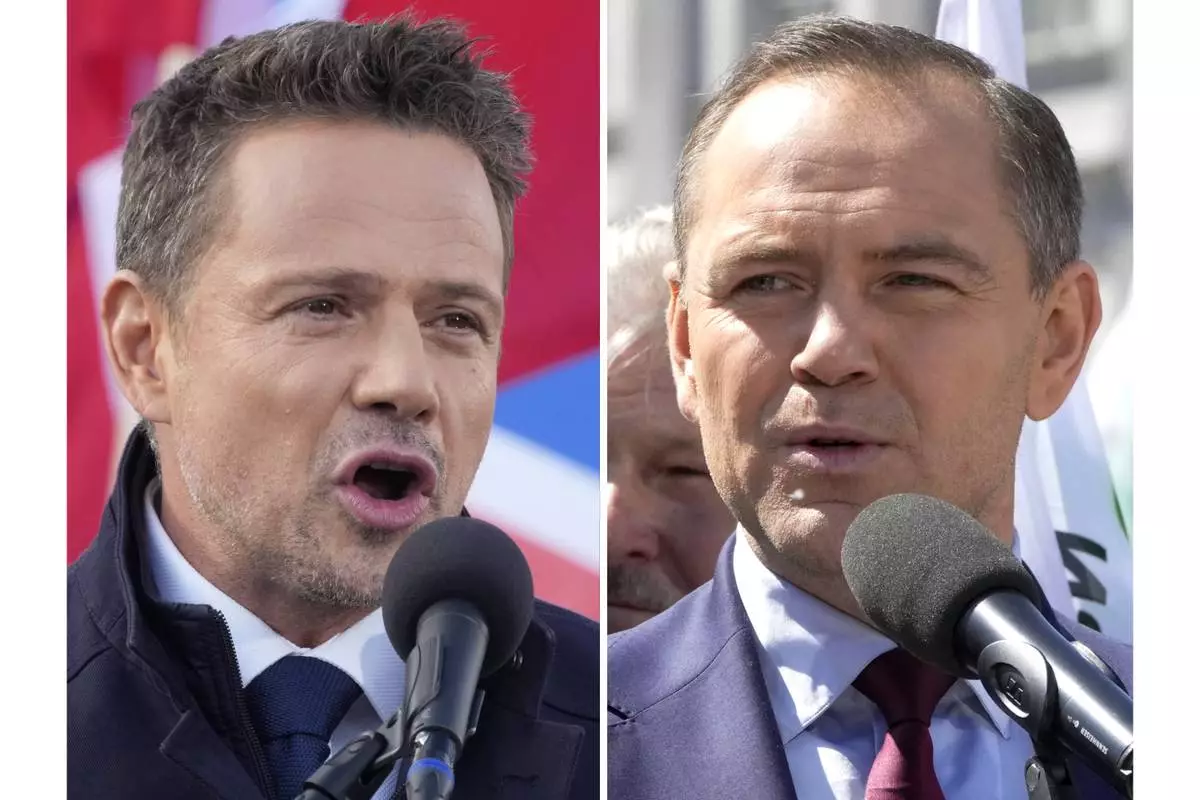
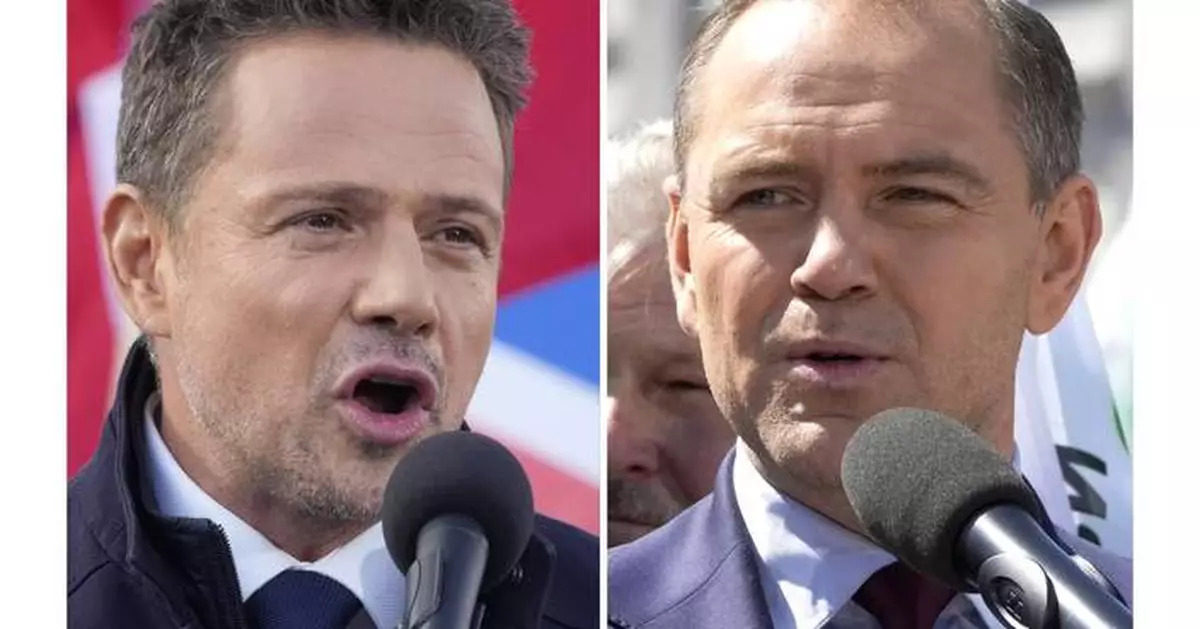
This combination of photos shows Rafal Trzaskowski, left, in Warsaw, Friday, May 9, 2025, and Karol Nawrocki, right, in Warsaw, Poland, Tuesday, May 20, 2025 (AP Photos/Czarek Sokolowski, File)
DUBAI, United Arab Emirates (AP) — Saudi Arabia bombed Yemen's port city of Mukalla on Tuesday after a weapons shipment from the United Arab Emirates arrived for separatist forces in the war-torn country, and warned that it viewed Emirati actions as “extremely dangerous.”
The bombing followed tensions over the advance of Emirates-backed separatist forces known as the Southern Transitional Council. The council and its allies issued a statement supporting the UAE's presence, even as others allied with Saudi Arabia demanded that Emirati forces withdraw from Yemen in 24 hours' time.
The UAE called for “restraint and wisdom” and disputed Riyadh’s allegations. But shortly after that, it said it would withdraw its remaining troops in Yemen. It remained unclear whether the separatists it backs will give up the territory they recently took.
The confrontation threatened to open a new front in Yemen's decade-long war, with forces allied against the Iranian-backed Houthi rebels possibly turning their sights on each other in the Arab world's poorest nation.
It also further strained ties between Saudi Arabia and the UAE, neighbors on the Arabian Peninsula that increasingly have competed over economic issues and regional politics, particularly in the Red Sea area. Tuesday’s airstrikes and ultimatum appeared to be their most serious confrontation in decades.
“I expect a calibrated escalation from both sides. The UAE-backed Southern Transitional Council is likely to respond by consolidating control,” said Mohammed al-Basha, a Yemen expert and founder of the Basha Report, a risk advisory firm.
“At the same time, the flow of weapons from the UAE to the STC is set to be curtailed following the port attack, particularly as Saudi Arabia controls the airspace.”
A military statement carried by the state-run Saudi Press Agency announced the strikes on Mukalla, which it said came after ships arrived there from Fujairah in the UAE.
“The ships’ crew had disabled tracking devices aboard the vessels, and unloaded a large amount of weapons and combat vehicles in support of the Southern Transitional Council’s forces,” the statement said.
“Considering that the aforementioned weapons constitute an imminent threat, and an escalation that threatens peace and stability, the Coalition Air Force has conducted this morning a limited airstrike that targeted weapons and military vehicles offloaded from the two vessels in Mukalla,” it added.
It wasn't clear if there were any casualties.
The Emirati Foreign Ministry hours later denied it shipped weapons but acknowledged it sent the vehicles “for use by the UAE forces operating in Yemen.” It also claimed Saudi Arabia knew about the shipment ahead of time.
The ministry called for “the highest levels of coordination, restraint and wisdom, taking into account the existing security challenges and threats.”
The Emirati Defense Ministry later said it would withdraw its remaining troops from Yemen over “recent developments and their potential repercussions on the safety and effectiveness of counter-terrorism operations.” It gave no timeline for the withdrawal. The UAE broadly withdrew its forces from Yemen years earlier.
Yemen’s anti-Houthi forces not aligned with the separatists declared a state of emergency Tuesday and ended their cooperation with the UAE. They issued a 72-hour ban on border crossings in territory they hold, as well as entries to airports and seaports, except those allowed by Saudi Arabia. It remained unclear whether that coalition, governed under the umbrella of Yemen's Presidential Leadership Council, would remain intact.
The Southern Transitional Council’s AIC satellite news channel aired footage of the strike's aftermath but avoided showing damage to the armored vehicles.
“This unjustified escalation against ports and civilian infrastructure will only strengthen popular demands for decisive action and the declaration of a South Arabian state,” the channel said.
The attack likely targeted a ship identified as the Greenland, a vessel flagged out of St. Kitts. Tracking data analyzed by the AP showed the vessel had been in Fujairah on Dec. 22 and arrived in Mukalla on Sunday. The second vessel could not be immediately identified.
Jens Laerke, a spokesperson for the U.N. humanitarian office, urged combatants to protect civilians and civilian infrastructure, like the port, saying any disruption to its operations “risks affecting the already dire humanitarian situation and humanitarian supply chains.”
Mukalla is in Yemen's Hadramout governorate, which the council seized in recent days. The port city is some 480 kilometers (300 miles) northeast of Aden, which has been the seat of power for anti-Houthi forces after the rebels seized the capital, Sanaa, in 2014.
Yemen, on the southern edge of the Arabian Peninsula off East Africa, borders the Red Sea and the Gulf of Aden. The war there has killed more than 150,000 people, including fighters and civilians, and created one of the world's worst humanitarian disasters.
The Houthis, meanwhile, have launched attacks on hundreds of ships in the Red Sea corridor over the Israel-Hamas war in the Gaza Strip, disrupting regional shipping. The U.S., which earlier praised Saudi-Emirati efforts to end the crisis over the separatists, has launched airstrikes against the rebels under both Presidents Joe Biden and Donald Trump.
Tuesday's strike in Mukalla comes after Saudi Arabia targeted the council in airstrikes Friday that analysts described as a warning for the separatists to halt their advance and leave the governorates of Hadramout and Mahra.
The council had pushed out forces there affiliated with the Saudi-backed National Shield Forces, another group in the anti-Houthi coalition.
Those aligned with the council have increasingly flown the flag of South Yemen, which was a separate country from 1967-1990. Demonstrators have been rallying to support political forces calling for South Yemen to secede again.
A statement Tuesday from Saudi Arabia's Foreign Ministry directly linked the council's advance to the Emiratis for the first time.
“The kingdom notes that the steps taken by the sisterly United Arab Emirates are extremely dangerous,” it said.
Allies of the council later issued a statement in which they showed no sign of backing down.
Associated Press writer Jamey Keaten in Geneva contributed to this report.
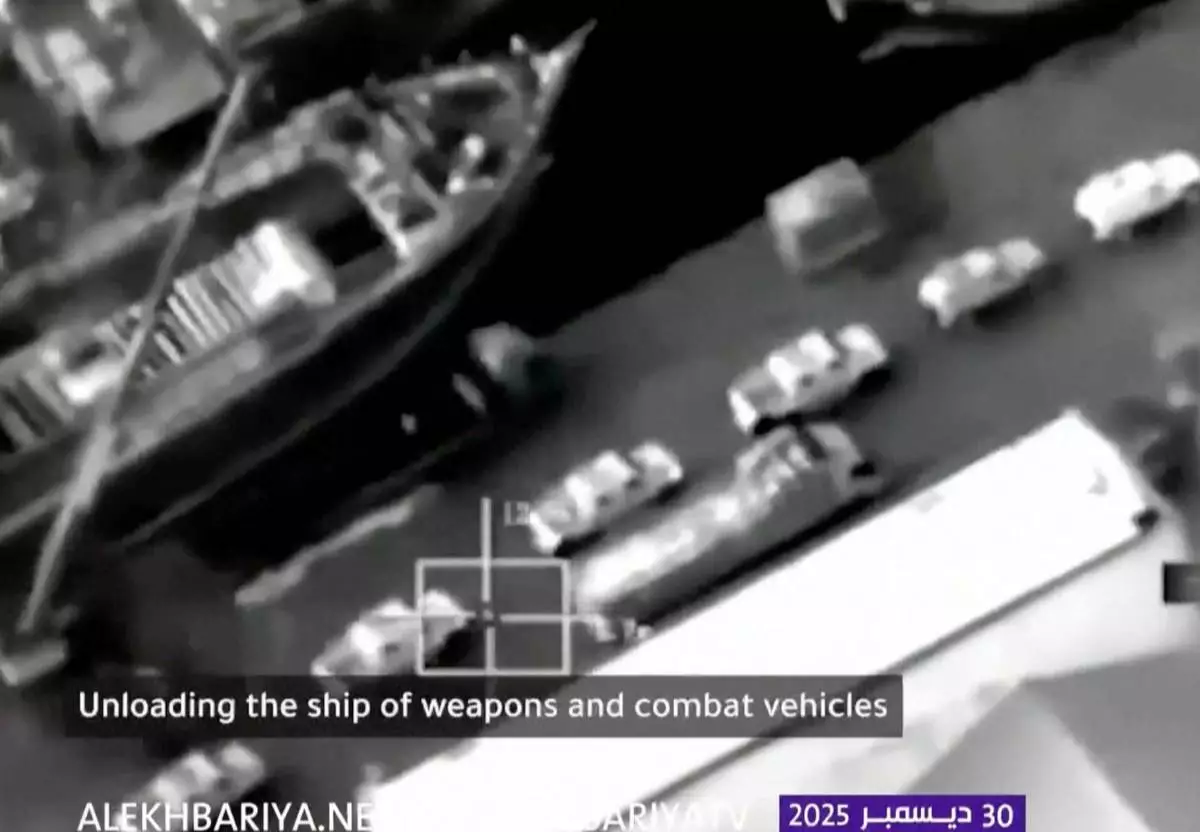
This frame grab from video broadcast by Saudi state television on Tuesday, Dec. 30, 2025, shows what the kingdom describes as a shipment of weapons and armored vehicles coming from the United Arab Emirates, at Mukalla, Yemen. (Saudi state television via AP)