China is actively cultivating international aerospace talents, aiming to promote global aerospace cooperation and development.
Among the several institutes undertaking the tasks, one has distinctive features. It is affiliated to the United Nations (UN) and run by Beihang, a leading university for aerospace education in China.
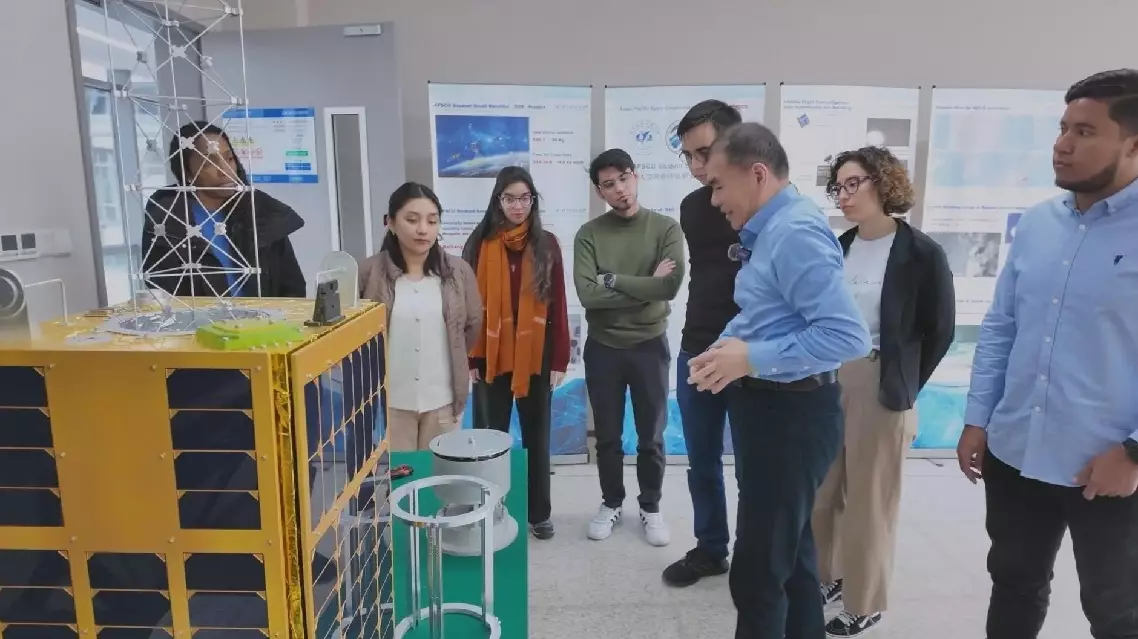
The Regional Centre for Space Science and Technology Education in Asia and the Pacific (China), or RCSSTEAP, is based in Hangzhou International Innovation Institute of Beihang University in Hangzhou City of east China's Zhejiang Province.
It teaches international students, mostly from the Asian and Pacific region, knowledge on space science and technology, covering remote sensing and geographic information systems, global navigation satellite systems, micro-satellite technology, space law and policy and space project management.
The aim is to meet the demands for young talents in addressing problems, for example, to increase agricultural efficiency and disaster prevention and mitigation.
He Lingfeng, an associate professor of RCSSTEAP, has been teaching the students how to use equipment for monitoring natural disasters.
"And see, this is a crack of the slope. This is very detailed information for monitoring, or for detecting the landslide's causes," he showed how to operate a drone with a remote controller at the class.
He and his students not only use drones in class but also in the field practice.
"To learn about UAV will help me and the other students to understand the current trend of the technology, and also it will be used in their country to develop their country in the future," said Sonarch Chedpong, a student from Thailand.
An UN official praised the efforts while joining the celebration last year for the tenth anniversary of the founding of the RCSSTEAP, stressing that it is a need for all.
"There is a need for coordination, a need for more international cooperation and the need for capacity building. And there is a large place for this center to contribute to capacity building to bridge the gap between the faring nations and the emerging nations," said Driss El Hadani, deputy director of the UN Office for Outer Space Affairs.
Dr.El-Hadani said that China is showing a good example in passing on the space science and technology and that’s just why the UN chose to work with the country, and this cooperation is set to expand.
The international students have set goals for themselves after graduation.
"China is quickly developing in deep space with the probes and exploration of the other bodies of the solar system. And I hope to cooperate in image processing areas of the data generated by those display probes," said Costa Guimaraes Francisco Vinicius, a student from Brazil.
"I want to initiate or to build an aerospace company in my country in Bolivia. Because I think this is going to be like a huge investment in my country," said Cortez Huaycho Maria Jose, a Bolivian student.
"I believe I would want to take whatever I have learned here in Beihang University, take it back home and put plans in place such that whatever I have seen here can be replicated back in my country to improve the livelihood in my country," said Somo Indi Genealogy, a Nigerian student at the RCSSTEAP.
China active in cultivating international space talents