The Hengdian World Studios in eastern China's Zhejiang Province is welcoming more entertainment industry insiders from across the world who are keen to explore the rising trend of micro dramas being produced there.
In the first four months of the year, over 1,000 micro drama crews finished filming projects in Hengdian -- one of China's premier production centers -- with this number already exceeding the total number produced during the entirety of last year.
With vertical shooting formats, a social media-friendly style and a shooting period of only a week, how micro dramas are shot differs greatly from traditional drama and films.
Now, more filmmakers and actors from over a dozen countries have come to Hengdian to study how these popular micro dramas are being made.
Many pointed to the accessibility of these short series for attracting more viewers, and also hailed the comprehensive facilities available at Hengdian.
"What I liked that stood out to me was getting people's attention from the very get-go. Then it's easier for them to sit through the whole thing," said Richard Venter, an actor from South Africa.
"Here you can find everything. They have the sets, camera, people and everything," said Alejandra Munoz, a choreographer from Mexico.
"I really like Chinese films. And that's the reason why I'm here in this workshop," said Leonida Matajis, a filmmaker from Serbia.
The increasing reach of these drama shows is drawing in more interested parties from around the world who are keen to tap into the success.
"Since October last year, many entertainment industry players from North America, Europe, Southeast Asia, South Korea, and Japan have come to us. They want to learn about the process of shooting micro dramas," said Guo Shu, general manager of the International Business Department of Hengdian World Studios.
China's mature industrial chain of short dramas is having an increasingly significant influence on the global entertainment industry. There are now over 400 micro drama apps worldwide, with Chinese companies holding 80 percent of the market share.
Hengdian World Studios has signed a memorandum of understanding with global production firm Dalynn Studio to strengthen international cooperation, and representatives are hopeful of building on the success and riding the crest of the wave of the current micro drama trend.
"Your business model is working really well. The speed of production, the model that you have built is really really successful. So I think we can learn from you in the sense of technical [expertize] and production," said Marta Camara, a partner in Dalynn Studio.
"Stories can be changed but the business model is the successful [part] that can be replicated," said Mary Lynn, the company's CEO.
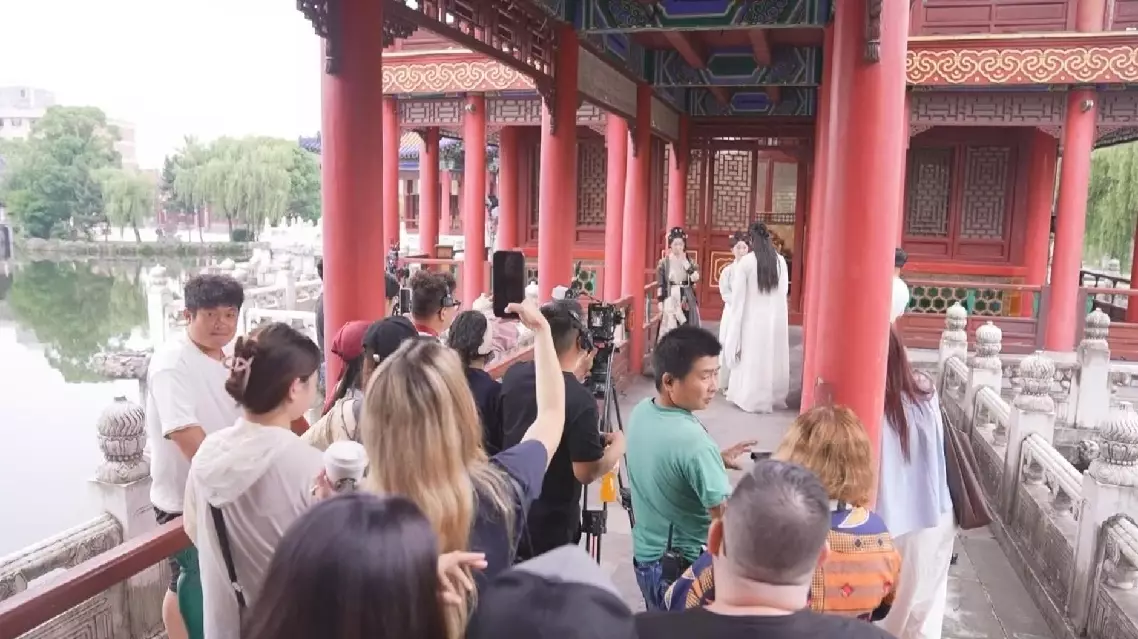
Foreign actors, filmmakers flock to Hengdian World Studios to explore micro drama phenomenon

A new round of trade-in subsidy program is energizing China's consumer market these days, with provinces across the country seeing a surge in demand for cars, home appliances and digital devices.
In north China's Shanxi Province, the new trade-in subsidy program, which started on January 9, has further helped boost sales in home appliances and digital devices which are covered by the new round of subsidies.
To enjoy the subsidies, six types of home appliances, including refrigerators and washing machines, must meet national Level 1 energy-efficiency or water-efficiency standards. Digital and smart products include four types, such as mobile phones and tablets, with a sales price cap of 6,000 yuan (about 800 U.S. dollars) per item.
In both categories, subsidies are set at 15 percent of the final transaction price. For home appliances, the maximum subsidy is 1,500 yuan per item. For digital products, the cap is 500 yuan per item. Each consumer can receive a subsidy for one unit in each category.
Neighboring Shanxi, Hebei Province kicked off the year of 2026 with the new round of trade-in subsidy program starting on January 1.
The subsidies cover automobiles, home appliances, and digital products. Individual consumers who purchase designated Level 1 energy-efficiency appliances or eligible digital products priced at no more than 6,000 yuan can receive subsidies equal to 15 percent of the transaction price. The maximum subsidy is 1,500 yuan per appliance and 500 yuan per digital or smart device, with each person limited to one subsidized item in each category.
Data showed that from Jan 1 to 9, Hebei's home appliance trade-in program alone disbursed more than 130 million yuan in subsidies, driving sales of over 920 million yuan.
In east China's Jiangsu Province, the new trade-in subsidy program, taking effect for two weeks, has brought the province a boom in trade-in.
At a local 4S store in Jiangsu's Suqian City, showroom traffic has spiked as salespeople walked customers through the new benefits from the trade-in subsidy program.
"Under the scrappage-and-replacement scheme, customers who buy a new energy vehicle (NEV) can receive a subsidy worth 12 percent of the vehicle price, capped at 20,000 yuan (about 2,860 U.S. dollars). For combustion-engine cars, the subsidy is 10 percent, with an upper limit of 15,000 yuan. For trade-ins, NEVs are able to receive a subsidy worth 8 percent of the vehicle price, up to 15,000 yuan, while combustion-engine cars will receive a 6-percent subsidy, with a cap of 13,000 yuan," said Sun Yue, a saleswoman at the store.
In the home appliance sector, Jiangsu's policy this year stipulates that only products that meet China's Level 1 energy-efficiency standard are eligible for subsidies. The scheme covers six major categories, including refrigerators and washing machines.
Consumers who purchase qualifying appliances can receive a subsidy equal to 15 percent of the final retail price, up to a maximum of 1,500 yuan per item. Each person is limited to one subsidized unit per product category.
Four types of digital and smart products, such as mobile phones and tablets, are eligible for a 15-percent subsidy capped at 500 yuan per unit, with a retail price no more than 6,000 yuan.
"With the national subsidy policy back in place this year, I went to the store to check what discounts I could get. It knocked 500 yuan off the price. [The discounted price is] very reasonable," said Wang Kang, a resident of Jiangsu's Xuzhou Province.
To enhance the shopping experience for consumers, many retailers are pairing subsidies with "one-stop" services that combine the delivery of new products with on-site collection of old ones.
"After consumers place an order for new home appliances, our staff will schedule a time to pick up the old units. Recycling the old appliance can also further offset the purchase price of the new one," said Yang Jie, a sales supervisor at a major home appliance company.
China's new trade-in program sparks consumption boom