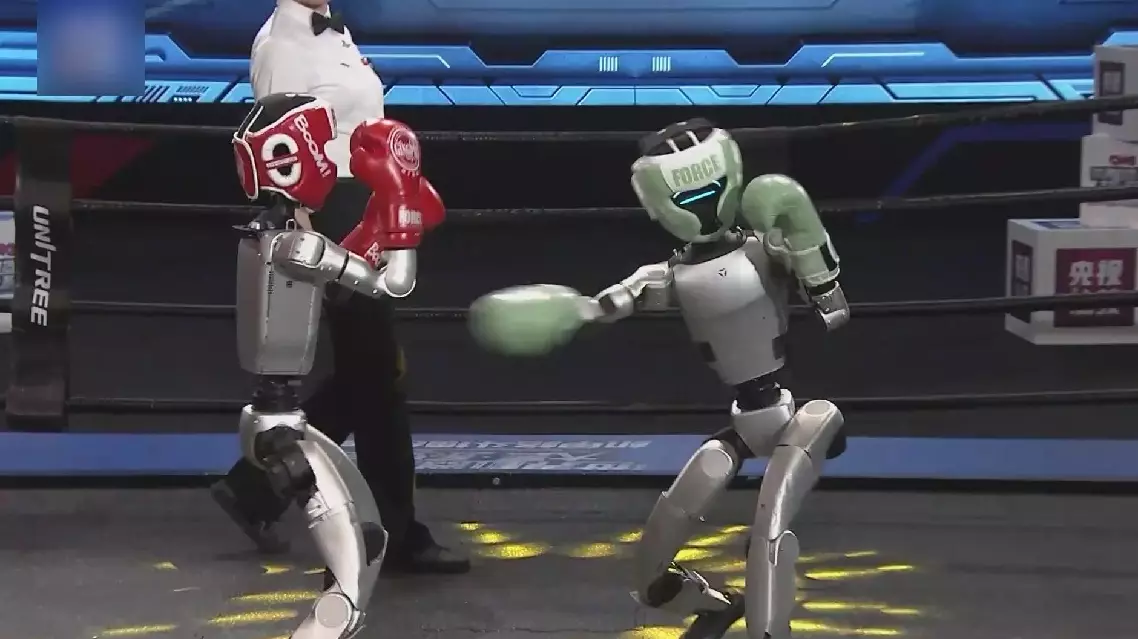
The China Media Group (CMG) World Robot Competition - Mecha Fighting Series, the first-ever humanoid robot fighting tournament, opened in Hangzhou, east China's Zhejiang Province, on Sunday, as contestants, including robots developed by Unitree Robotics armed with a wide range of combat skills, gathered for a livestreamed showdown, while putting on display Chinese robotics firms' tech prowess.
This competition marks a historic moment as it is the world's first combat sports event centered around humanoid robots, signaling the gradual integration of artificial intelligence (AI) into combat sports, the CMG report said, noting that all humanoid battlebots are equipped with domestically developed technologies.
The competition includes demonstration and competitive matches, with humanoid robots showcasing combat moves and robots controlled by humans in real-time fighting in the arena, according to the organizer.
Unitree Robotics, a prominent player in the humanoid robot industry, is the partner in the match. During the event, robots demonstrated boxing one-on-one and in groups, displaying their moves and capabilities for their exhibition session.
Four human operator teams controlled the robots to compete in a tournament-style series of boxing matches.
Driven by rapid advancement in embodied intelligence, China's humanoid robots are evolving at an accelerated pace, extending their reach into both industrial and household applications. According to the Chinese Institute of Electronics, China's humanoid robot market is projected to reach 870 billion yuan (120 billion U.S. dollars) by 2030.
World's first humanoid robot boxing match kicks off in China
Rawalpindi, the garrison city neighboring Pakistan's capital Islamabad, is on high security alert ahead of the expected second round of U.S.-Iran talks.
Rawalpindi is not only an important transport hub for Pakistan's capital, Islamabad, but is also home to Nur Khan Air Base, where the U.S. delegation landed during the first round of U.S.-Iran talks.
More than 600 checkpoints were set up in the city, and local business activities were also reduced, local media reported.
Footage from a China Media Group (CMG) reporter showed that many shops in major commercial districts in downtown Rawalpindi were closed, and more police were visible on the streets.
U.S. President Donald Trump said in a Truth Social post on Sunday that U.S. representatives were going to Islamabad for negotiations. Sources say advance teams from the U.S., including security personnel, have arrived in Islamabad to coordinate arrangements for the expected talks.
Meanwhile, Iran's official news agency IRNA said on the same day that the country had rejected taking part in the second round of talks.
On Feb. 28, Israel and the United States launched joint attacks on Tehran and several other Iranian cities, killing Iran's then Supreme Leader Ali Khamenei, along with senior military commanders and civilians. Iran responded by launching waves of missile and drone strikes targeting Israel and U.S. bases and assets in the Middle East, and exercising tight control over the Strait of Hormuz.
A ceasefire was achieved between the warring parties on April 8, which was followed by lengthy talks between the Iranian and U.S. delegations in Pakistan's capital Islamabad on April 11 and 12.
Security strengthened in key city near Pakistan's capital ahead of expected U.S.-Iran talks