A 55-year-old Chinese paraglider shared his extraordinary survival story with the China Media Group (CMG) on Tuesday after being unexpectedly lifted by a powerful updraft into the upper atmosphere during a flight over the Qilian Mountains -- reaching an altitude of 8,598 meters without oxygen, and narrowly escaping death.
Peng Yujiang, a certified B-level paraglider, was conducting a routine equipment test on Saturday at a training site about 3,000 meters above sea level in northwest China's Gansu Province.
"I had just bought a second-hand paragliding harness and wanted to test it. So I was conducting ground parachute shaking. After a while, the wind suddenly picked up and lifted me into the air. I tried to land as soon as possible, but I failed," said Peng.
What started as a calm session quickly turned dangerous when a sudden surge of wind pulled him into rapidly forming cumulonimbus clouds. Despite trying to descend, he became trapped in the cloud system.
"I found myself surrounded by cumulonimbus clouds and trapped inside. It was terrifying -- everything around me was white. Without the compass, I wouldn't have known which direction I was heading. I thought I was flying straight, but in reality, I was spinning. Eventually, I managed to fly out toward the northeast," said Peng.
Experts said Peng encountered a rare and dangerous phenomenon known as "cloud suck" -- a condition where strong convective updrafts carry paragliders to extreme altitudes. Experts explained that inside such clouds, temperatures can plummet to minus 40 degrees Celsius and oxygen levels are severely low.
Without an oxygen mask and with his face exposed, Peng endured freezing conditions as ice crystals formed on his face, body and equipment. His gloves were not fully zipped, leaving his hands numb and nearly frozen. Still, he managed to control his paraglider using his compass and radio communication with teammates.
"As soon as I came out of the clouds, I was very excited because I had survived. The scariest moment was when I tried to pull out of the spiral and failed and when the canopy nosedived. It's still frightening to think about. I'm not sure about the future, but for now I definitely won't fly for a while," said Peng.
Looking back at his flight data, Peng was shocked to learn he had reached 8,598 meters -- far higher than he had realized mid-air. He suspects he may have briefly lost consciousness during descent.
Peng has been paragliding for four and a half years and holds a B-level license -- China's second tier in a five-level system, requiring at least 20 days of flight experience and a minimum of 40 individual flights.
The Gansu provincial aeronautical sports association issued a report on Wednesday, saying that ground parachute shaking does not require prior approval and that Peng's experience was entirely an unforeseen accident. However, Peng was still handed a six-month flight suspension, as the flight site and airspace had not been approved in advance.

Chinese paraglider narrowly escapes death after reaching altitude of 8,598 meters without oxygen

Chinese paraglider narrowly escapes death after reaching altitude of 8,598 meters without oxygen
Chinese Foreign Minister Wang Yi said on Tuesday that mediation efforts of the Pakistani side regarding the Middle East tensions are in the common interests of all parties.
Wang, also a member of the Political Bureau of the Communist Party of China Central Committee, made the remarks in his talks with Pakistani Deputy Prime Minister and Foreign Minister Mohammad Ishaq Dar in Beijing.
During their talks, the two sides exchanged views on current international issues and regional conflicts.
Wang welcomed the visit of the Pakistani side to Beijing for discussion on easing tensions in the Middle East, just after its holding of a quadrilateral foreign ministers' meeting in Islamabad.
He said China supports and looks forward to Pakistan playing a unique and important role in easing the situation and resuming peace talks. This process is no easy task, and Pakistan's mediation efforts are in line with the common interests of all parties, Wang added.
He noted China is willing to make joint efforts with Pakistan to end the hostilities as soon as possible, create opportunities for peace and open the window for peace talks.
On bilateral ties, Wang said this year marks the 75th anniversary of the establishment of diplomatic relations between China and Pakistan, calling on both sides to implement the important consensus reached by the leaders of the two countries and constantly advance the building of a China-Pakistan community with a shared future.
For his part, Dar said the Pakistan-China friendship is precious and deeply rooted in people's hearts, adding that Pakistan is willing to work with China to promote the continuous development of the all-weather strategic cooperative partnership between the two countries.
Dar thanked China for supporting Pakistan's mediation of the situation in Iran, adding that the current conflict has disrupted international energy supplies and caused heavy damage to developing countries.
Noting that solutions can only be found through negotiation, Dar said Pakistan is willing to strengthen communication and coordination with China to push all parties to start peace talks as soon as possible and restore regional peace.
The two sides also put forward a five-point initiative for restoring peace and stability in the Gulf and the Middle East region:
I. Immediate cessation of hostilities: China and Pakistan call for immediate cessation of hostilities and utmost efforts to prevent the conflict from spreading. Humanitarian assistance must be allowed to all war-affected areas.
II. Start of peace talks as soon as possible. Sovereignty, territorial integrity, national independence and security of Iran and the Gulf states should be safeguarded. Dialogue and diplomacy is the only viable option to resolve conflicts. China and Pakistan support the relevant parties in initiating talks, with all parties committing to peaceful resolution of disputes, and refraining from the use or the threat of use of force during peace talks.
III. Security of nonmilitary targets. The principle of protecting civilians in military conflict should be observed. China and Pakistan call on parties to the conflict to immediately stop attacks on civilians and nonmilitary targets, and fully adhere to International Humanitarian Law, and stop attacking important infrastructure, including energy, desalination and power facilities, and peaceful nuclear infrastructure, such as nuclear power plants.
IV. Security of shipping lanes. The Strait of Hormuz, together with its adjacent waters, is an important global shipping route for goods and energy. China and Pakistan call on the parties to protect the security of ships and crew members stranded in the Strait of Hormuz, allow the early and safe passage of civilian and commercial ships, and restore normal passage through the Strait as soon as possible.
V. Primacy of the United Nations Charter. China and Pakistan call for efforts to practice true multilateralism, to jointly strengthen the primacy of the United Nations, and to support the conclusion of an agreement for establishing a comprehensive peace framework and realizing lasting peace based on the purposes and principles of the UN Charter and international law.
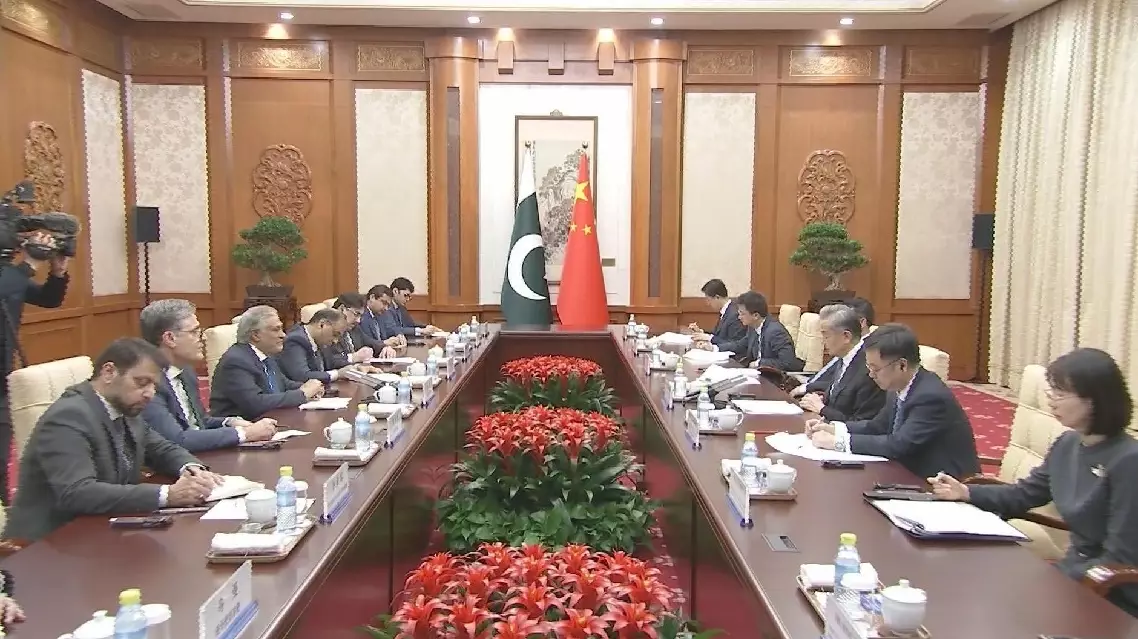
Pakistan's mediation efforts in common interests of all parties: Chinese FM