The 2025 Taipei International Dragon Boat Championships were held in Taiwan from Friday to Sunday, celebrating this year's Dragon Boat Festival, which fell on Saturday.
Amid the thunderous beat of drums and enthusiastic cheers, contestants in the dragon boat championships powered through the Keelung River in Taipei, paddling with fierce determination to claim the lead.
The three-day competition drew 221 teams and over 5,000 athletes. Participants competed in men's, women's, and mixed divisions, racing in both large and small dragon boats, according to the organizer.
Before the race, the competitors energized themselves with spirited cheers. One of the racers Chen Hsueh-mei said that although her team lacks race experience and just received one month of training, they still enjoyed themselves in the event.
"We will play hard and enjoy this race," said Chen, the only racer who has some experience in the team.
"We are supper excited to be here, thrilled. We are coming from Okinawa, Japan, so we flew in yesterday, and we are just stoked to be here," said another racer named Pattran.
The Dragon Boat Festival, also known as Duanwu Festival, commemorates renowned Chinese patriotic poet Qu Yuan, who was also a minister of the State of Chu during the Warring States Period (475 B.C.-221 B.C.).
In addition to the dragon boat races, a rich array of cultural activities related to the festival were also held, including on-land dragon boat experiences and egg-balancing contests.
"I took part in the dribbling game and I did for 110 times. In my school, my classmates and teachers taught me stories about Qu Yuan," said a local child.
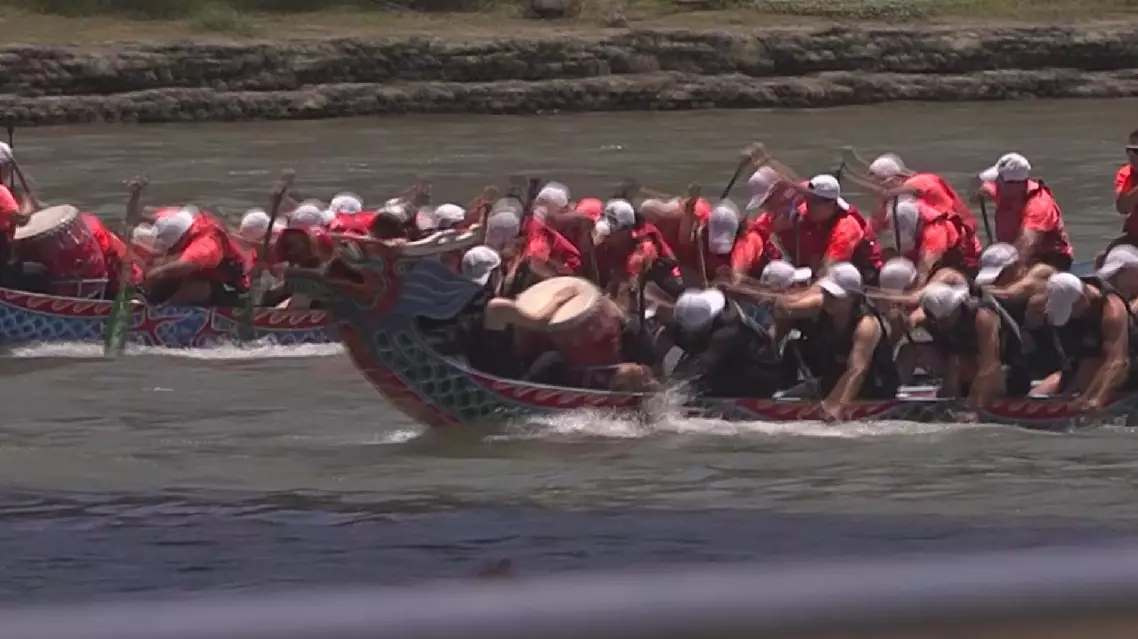
Taipei holds dragon boat championships to celebrate Duanwu Festival

The massive production complex of BASF in Zhanjiang City in south China's Guangdong Province has become a major symbol of China-Germany cooperation and green power utilization.
The company on Thursday put the multibillion-euro site into full operation, marking the largest single investment project wholly owned by a German enterprise in China.
With an investment of 8.7 billion euros, the integrated site covers about 4 square kilometers, the company said. Industry analysts say the project underscores BASF's long-term commitment to expanding in China as the country continues to promote high-standard opening up.
Unlike traditional plants, it runs entirely on green power, using 100 percent renewable electricity and fully electric-driven compressors for its core steam cracker.
"By utilizing 100 percent of the renewable energy, our products made in Zhanjiang contribute also significantly to the lower carbon product footprint. Our current product footprint for such a site like ours will probably be around 4 million tons of CO2. And today, we are at 1.7 million tons of CO2," said Haryono Lim, president of Mega Projects Asia at BASF.
Cutting carbon emissions by more than half, the Zhanjiang site is setting new benchmarks for sustainable chemical production.
"We wanted to distinctively move to South China to participate in the strong growth around the Pearl River Delta and in Guangdong Province. And then, of course, Zhanjiang offers great opportunities with its good infrastructure, deep-sea harbor, and great support by the local government," said Markus Kamieth, CEO of BASF.
The local government's support has been key to the company's growth in the region, and the project is now driving broader green ambitions.
"BASF's full operation boosts the region's low-carbon hydrogen transition by developing the hydrogen value chain to attract related industries, supplying low-cost green power from offshore wind and solar, driving green upgrades in local petrochemicals and steel, and helping build a national pilot zone for zero-carbon industrial parks," said Yang Jiedong, director of the Administrative Committee of Zhanjiang Economic and Technological Development Zone.
BASF Zhanjiang production complex goes fully green, using 100 percent renewable electricity