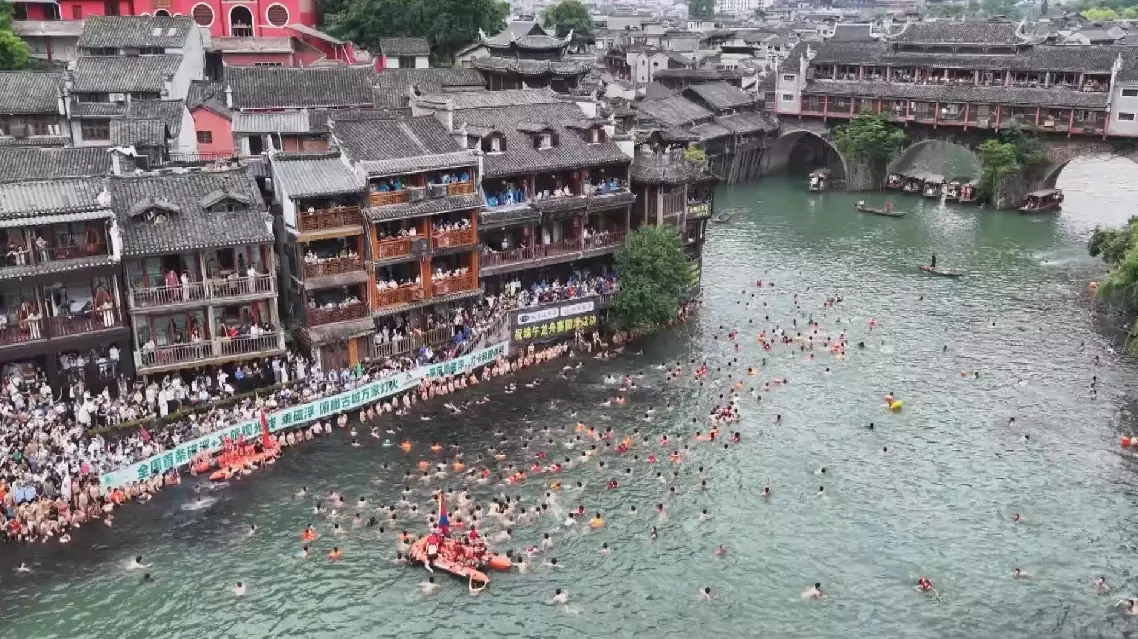
Instead of dragon boat racing, a competition of snatching ducks is put up for the Duanwu or Dragon Boat Festival in Old Town of Fenghuang in western Hunan Province of central China this year.
The annual festival on the fifth day of the fifth month on the traditional Chinese calendar fell on Saturday this year. It is a time to get rid of misfortune as venomous animals were believed to appear at this juncture. It is also a time to commemorate the beloved Chinese poet Qu Yuan (339-278 BC) from the Warring States Period (475-221 BC).
The duck-snatching competition in Fenghuang, a tourist attraction of Xiangxi Tujia and Miao Autonomous Prefecture in Hunan, attracted several tens of thousands of visitors on Saturday. The organizers had 500 live ducks thrown into the river at noon, among them were 20 special "lucky ducks." As the ducks splashed into the water, contestants jumped in and tried to catch as many as possible, arousing laughters and excitement.
"I think this event was really well organized and full of fun. We really enjoyed it. We felt very excited while watching, and the whole duck-snatching process was fascinating. Only it was a bit too short," said one visitor.
The duck-snatching competition has become an annual event in Fenghuang, blending competitiveness and amusement, drawing tens of thousands of tourists each year.
In Lhasa, the regional capital of Xizang in southwest China, the Dragon Boat Festival took on a distinctive local twist featuring a race of traditional cowhide boats and dragon boats.
On Saturday morning, the boat race kicked off on the Lhasa River, with 10 dragon boat teams and 20 cowhide boat teams. The dragon boat teams were manned by competitors from across China, while the cowhide boat teams were local Tibetan rowers.
The festival also featured performances of Tibetan intangible cultural heritage, including cowhide boat dances. These activities displayed Xizang's rich cultural heritage and charm.
In Diqing Tibetan Autonomous Prefecture in southwest China's Yunnan Province, the Dragon Boat Festival was celebrated in a more equestrian style with a Shangri-La Horse Racing event. Local Tibetan riders demonstrated impressive horsemanship, with stunning movement like "eagle wings" that captivated spectators.
Many visitors hailed the distinctive celebration.
"It was really exciting to see it on site, as you feel completely different. This is truly a unique Dragon Boat Festival," said a tourist from Beijing.
Outside the racetrack, the organizers put up an exhibition of traditional saddles and horse gear, with a rich collection of historical and ethnic artifacts.
"We've come with a total of 180 sets of horse gear to the exhibition this time, including horse pads from the Ming Dynasty (1368-1644), gilded saddles from the Qing Dynasty (1644-1911), and inlaid gold and silver objects, plus cowhide saddles of Yi ethnic group," said Sokhang Shengge, curator of the Yushu Tibetan Culture and Folk Custom Museum in northwest China's Qinghai Province.
In addition to the performances and exhibitions, visitors enjoyed local delicacies such as butter tea and traditional pastries, spending a festival full of highland flavor.
Dragon Boat Festival celebrated across China with vibrant local traditions