China's inbound tourism reached new highs during the Dragon Boat Festival holiday, with immigration authorities reporting record-breaking border crossings as the country's expanded visa-free policies attracted international visitors.
The Dragon Boat Festival, also known as Duanwu Festival, is a traditional Chinese holiday to commemorate the ancient Chinese poet Qu Yuan from the Warring States Period (475-221 B.C.). Celebrated on the fifth day of the fifth month of the Chinese lunar calendar, the festival fell on May 31 this year.
According to the National Immigration Administration, about 231,000 foreign travelers entered China under visa exemption programs during the three-day holiday, marking a 59.4 percent year-on-year increase.
Beijing's ports handled 178,000 border crossings, including 54,000 foreign nationals, a 34.7 percent jump from 2024. The capital hosted over 1,700 themed cultural events during the holiday, blending traditional celebrations with modern attractions.
"It's very delicious. You have the sweet ones. You have the salty ones. I like both. I think zongzi is absolutely delicious and I look forward every year to have some zongzi with my friends," said a French tourist enjoying the festival treats.
Ancient capitals emerged as favorite destinations, with northwest China's Xi'an seeing 17,000 border crossings, up 63 percent year on year.
Central China's Hubei Province, hometown of poet Qu Yuan, reported a 21.1 percent increase in international visitors exploring landmarks like the Yellow Crane Tower, using China's efficient rail network.
Regionally-focused policies were popular, particularly the six-month-old visa exemptions for South Korean and Japanese citizens. Since the visa-free policies took effect last November, Liaoning Province in northeast China has received 140,000 foreign arrivals, a 40 percent year-on-year growth, with 71 percent coming from these two nations.
"It was my first time visiting China and to Dalian. So what I liked about traveling to Dalian was that it was clean, had a lot of delicious food, and was convenient for traveling," said a Korean tourist.
In the eastern province of Shandong, 420 passengers arrived on cruise ships from South Korea's Pyeongtaek on May 31, the first day of the holiday, including 260 first-time visa-free visitors.
Data shows that during the Dragon Boat Festival holiday, the number of Korean tourists entering and leaving ports in Shandong reached 11,000, an increase of 117.5 percent year on year.
"We coordinated in advance with cruise operators and travel agencies to obtain passenger information and itineraries, implementing dedicated channels for Japanese and Korean tour groups while prioritizing clearance for seniors, children, and other special-needs travelers," said Sun Feixiang, head of the fifth duty team at the Yantai Entry-Exit Border Inspection Station.
The Guangdong-Hong Kong-Macao Greater Bay Area was a major draw during the holiday, with its "Greater Bay Area Dragon Boat Championship" featuring teams from all three regions. Traditional five-color zongzi and trendy ice zongzi emerged as popular souvenirs, reflecting the blend of heritage and modernity that attracted record numbers of travelers through area border crossings.
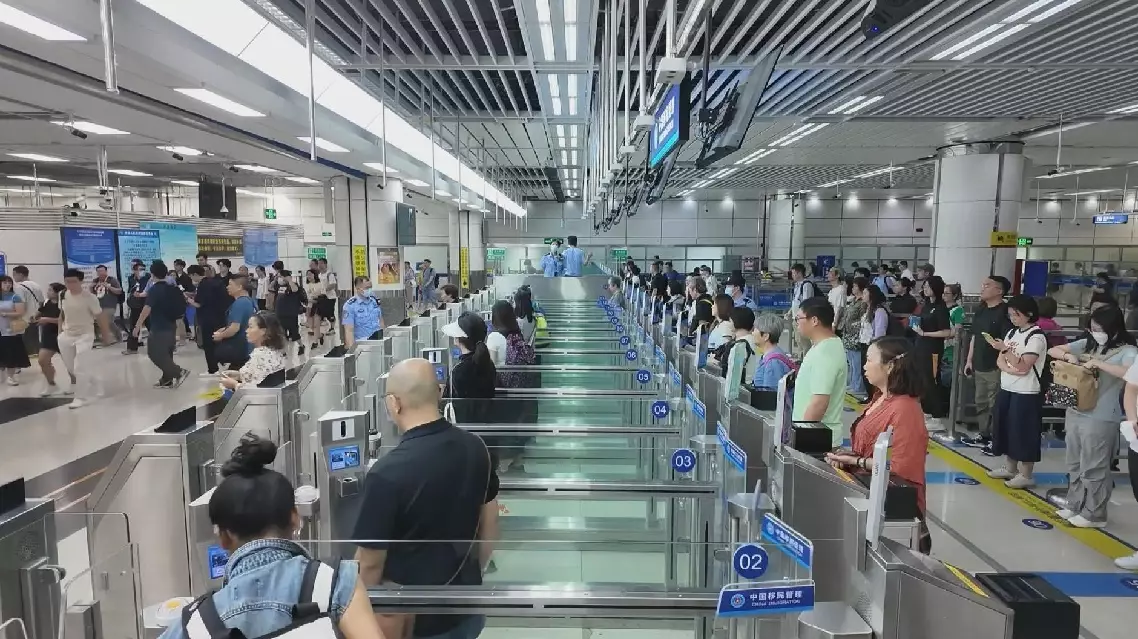
Shenzhen's major ports including Luohu, Huanggang and Futian all reported historic passenger volumes. The Shenzhen Bay Port hit 20 million crossings for the year on June 2, 45 days earlier than in 2024, with holiday traffic up approximately 30 percent year on year. Huanggang Port alone processed over 690,000 passenger crossings and 30,000 vehicles during the three-day holiday.
"Shenzhen is a nice city, I think, for my parents. It's their first time visiting China," said French tourist Valentin, echoing the international appeal of the region.
Zhuhai's border crossings with Macao handled 1.964 million passenger trips, a 6.7 percent year-on-year increase, while the Hong Kong-Zhuhai-Macao Bridge experienced 55 percent more vehicle traffic and 45 percent more passengers compared to last year.
China sees surge in inbound tourism during Dragon Boat Festival holiday