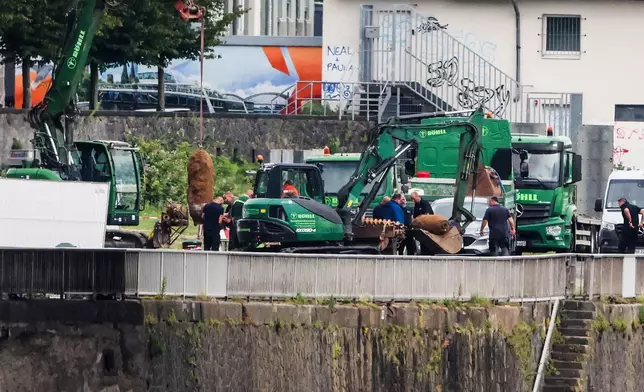
COLOGNE, Germany (AP) — Three unexploded U.S. bombs from World War II were defused on Wednesday in Cologne after the German city's biggest evacuation since the end of the war.
More than 20,000 residents were evacuated from the city center earlier Wednesday after the bombs were unearthed on Monday during preparatory work for road construction.
Click to Gallery
Ambulances drive to the Eduardus Hospital in Cologne-Deutz to evacuate the hospital before specialists defuse three unexploded U.S. bombs from World War II that were unearthed earlier this week in Cologne, Wednesday, June 4, 2025. (Henning Kaiser/dpa via AP)
Two of the three unexploded World War II bombs are defused and prepared to be loaded onto vehicles for removal, Wednesday, June 4, 2025, in Cologne, Germany. ( Christoph Reichwein/dpa via AP)
One of the three unexploded bombs from the Second World War is fenced off with screens as specialists prepare to defuse them in Cologne, Tuesday, June 3, 2025. (Thomas Banneyer/dpa via AP)
One of the three unexploded bombs from the Second World War is fenced off with screens as specialists prepare to defuse them in Cologne, Tuesday, June 3, 2025. (Thomas Banneyer/dpa via AP)
Experts defused the bombs within about an hour, city authorities said in a statement.
Even 80 years after the end of the war, unexploded bombs dropped during wartime air raids are frequently found in Germany. Sometimes, large-scale precautionary evacuations are needed. The location this time was unusually prominent — just across the Rhine River from Cologne’s historic center.
Significantly bigger evacuations have occurred in other German cities.
The evacuations included homes, 58 hotels, nine schools, a hospital and two nursing homes, several museums and office buildings and the Messe/Deutz train station. It also included three bridges across the Rhine, including the heavily used Hohenzollern railway bridge, which leads into Cologne's central station. Shipping on the Rhine also was suspended.
Clearance to go ahead with defusing the bombs was delayed somewhat because one person refused in the historic center initially refused to leave their home, city authorities said.

Ambulances drive to the Eduardus Hospital in Cologne-Deutz to evacuate the hospital before specialists defuse three unexploded U.S. bombs from World War II that were unearthed earlier this week in Cologne, Wednesday, June 4, 2025. (Henning Kaiser/dpa via AP)
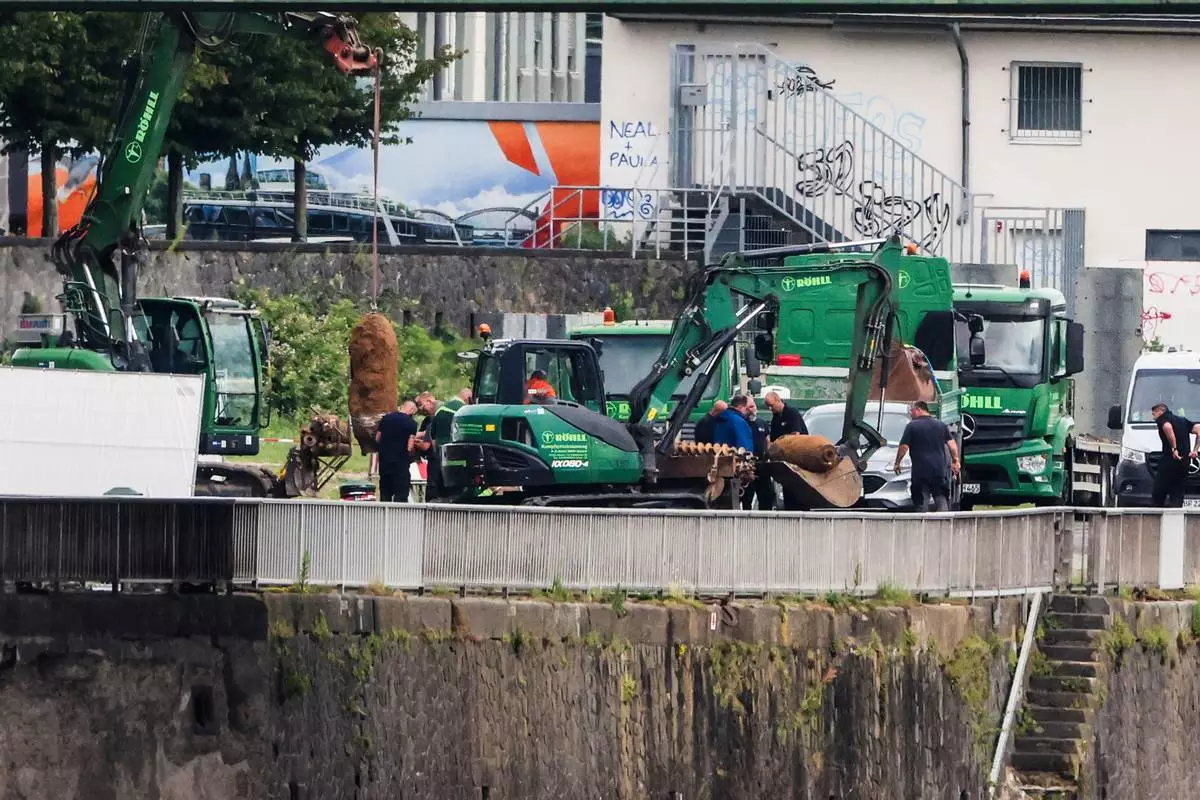
Two of the three unexploded World War II bombs are defused and prepared to be loaded onto vehicles for removal, Wednesday, June 4, 2025, in Cologne, Germany. ( Christoph Reichwein/dpa via AP)

One of the three unexploded bombs from the Second World War is fenced off with screens as specialists prepare to defuse them in Cologne, Tuesday, June 3, 2025. (Thomas Banneyer/dpa via AP)

One of the three unexploded bombs from the Second World War is fenced off with screens as specialists prepare to defuse them in Cologne, Tuesday, June 3, 2025. (Thomas Banneyer/dpa via AP)
WASHINGTON (AP) — U.S. forces have boarded an oil tanker previously sanctioned for smuggling Iranian crude oil in Asia, the Pentagon said Tuesday, as it puts into place a global warning to track down vessels tied to Tehran.
U.S. forces “conducted a right-of-visit maritime interdiction” and boarded the M/T Tifani “without incident,” the Pentagon said on social media.
The Tifani was captured in the Bay of Bengal — between India and Southeast Asia — and was carrying Iranian oil, according to a U.S. defense official who spoke on condition of anonymity to discuss an ongoing military operation. The U.S. military will decide in the next four days what to do with the vessel, such as tow it back to the U.S. or turn it over to another country, the official said.
It's the latest move in the U.S. war on Iran to stop any ship tied to Tehran or those suspected of carrying supplies that could help its government, from weapons and oil to metals and electronics. The announcement comes ahead of the expiration of an already tenuous ceasefire between the U.S. and Iran, and as Pakistan attempts to broker talks between Washington and Tehran.
It is the second vessel linked to Iran that has been interdicted by the U.S. military. The U.S. Navy attacked and seized an Iranian-flagged cargo ship Sunday that it said had tried to evade its blockade of Iranian ports, with President Donald Trump saying an American destroyer blew a hole in the ship’s engine room.
The Pentagon on social media described the Tifani as “stateless” despite it being a Botswana-flagged vessel.
“As we have made clear, we will pursue global maritime enforcement efforts to disrupt illicit networks and interdict sanctioned vessels providing material support to Iran — anywhere they operate,” the Pentagon announcement said, echoing previous statements from Trump administration officials. “International waters are not a refuge for sanctioned vessels.”
Gen. Dan Caine, chairman of the Joint Chiefs of Staff, said last week that the enforcement actions would extend beyond Iranian waters and the area under control of U.S. Central Command.
U.S. forces in other areas of responsibility, he told reporters at the Pentagon, “will actively pursue any Iranian-flagged vessel or any vessel attempting to provide material support to Iran.” He specifically pointed to operations in the Pacific and said the U.S. would target vessels that left before the blockade began outside the Strait of Hormuz, a crucial waterway for energy and other shipments.
The military also detailed an expansive list of goods that it considers contraband, declaring that it will board, search and seize them from merchant vessels “regardless of location.” A notice published Thursday says any “goods that are destined for an enemy and that may be susceptible to use in armed conflict” are “subject to capture at any place beyond neutral territory.”
The U.S. military’s actions against Iranian-linked vessels, namely the attack over the weekend on the cargo ship named the Touska, have raised questions about the two-week ceasefire.
The U.S. and Iran are operating in “an awkward space where the law doesn’t give you a clean yes-or-no answer” on whether the ceasefire was violated, said Jason Chuah, a law professor at the City University of London and the Maritime Institute of Malaysia.
“The United States seems to take the line that the conflict never fully switched off — that is there is still a state of armed conflict,” Chuah said. “By saying that, it can keep doing things like enforcing a blockade and even using limited force at sea.”
But Iran is treating the ceasefire as a pause on all hostile acts, Chuah said. Iran’s joint military command has called the armed boarding an act of piracy and a violation of the ceasefire.
The U.S. earlier had instituted a blockade against sanctioned oil tankers linked to Venezuela but had never fired on those vessels.
Blockades and even limited attacks on vessels can be lawful in wartime, with merchant vessels becoming legitimate targets if they contribute to military actions, carry contraband or are incorporated into enemy logistics, Chuah said.
It's harder to prove that a ship such as the Touska is realistically contributing to military action against the U.S., Chuah said.
“The whole dispute really turns on a deceptively simple question: Did the ceasefire actually suspend the right to use force?” Chuah said. “If it did, then firing on vessels or seizing them is very hard to square with the United Nations Charter.”
Mark Cancian, a retired Marine colonel and a senior defense adviser with the Center for Strategic and International Studies, said a violation is up for interpretation because there were no defined terms.
“Trump announced it. The Iranians agreed. But there’s no formal agreement,” Cancian said. “So whether it broke the ceasefire or not depends on your perspective. ... Nothing was written down.”
Michael O’Hanlon, a defense and foreign policy analyst at the Brookings Institution, said the U.S. did not violate the ceasefire because it was limited to bombing Iran, not the blockade.
“We agreed to stop dropping bombs on them, and that’s the basic thing they wanted,” O’Hanlon said, adding that the U.S. still had to enforce the blockade “if you’re going to make it mean anything.”
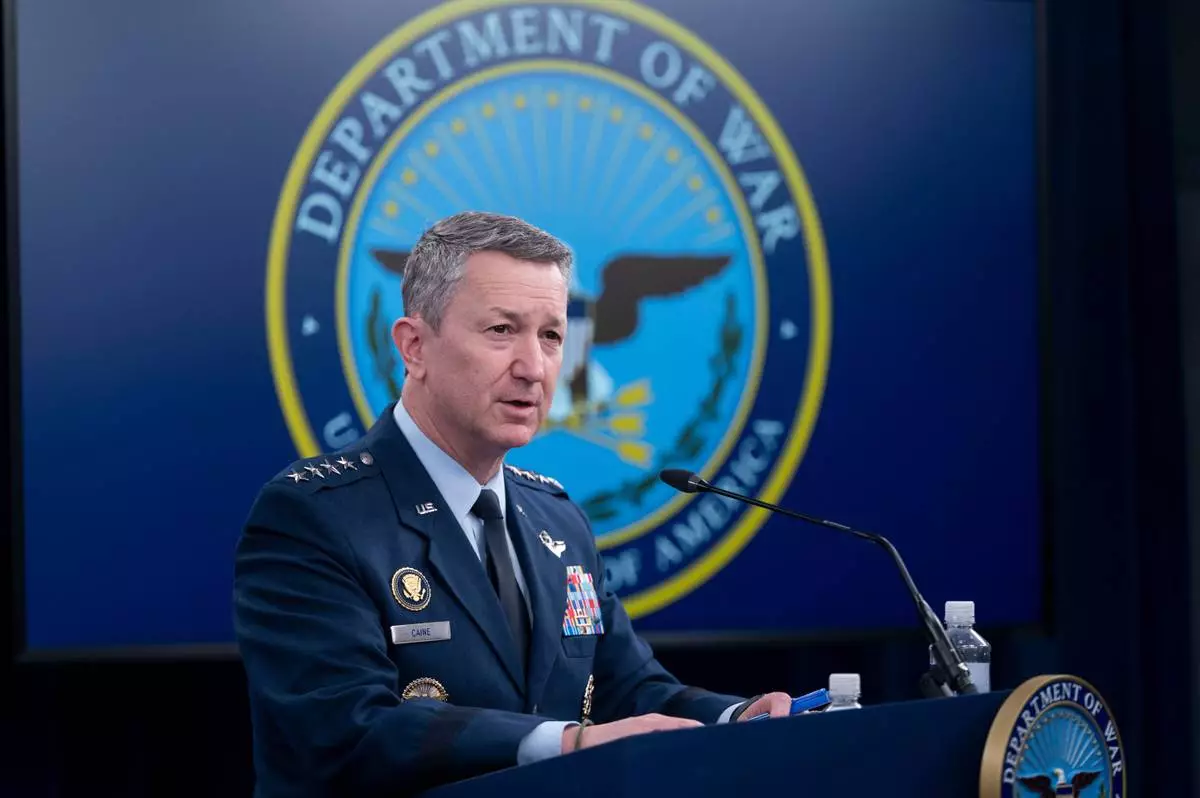
Chairman of the Joint Chiefs of Staff Gen. Dan Caine speaks to members of the media during a press briefing at the Pentagon, Thursday, April 16, 2026 in Washington. (AP Photo/Kevin Wolf)
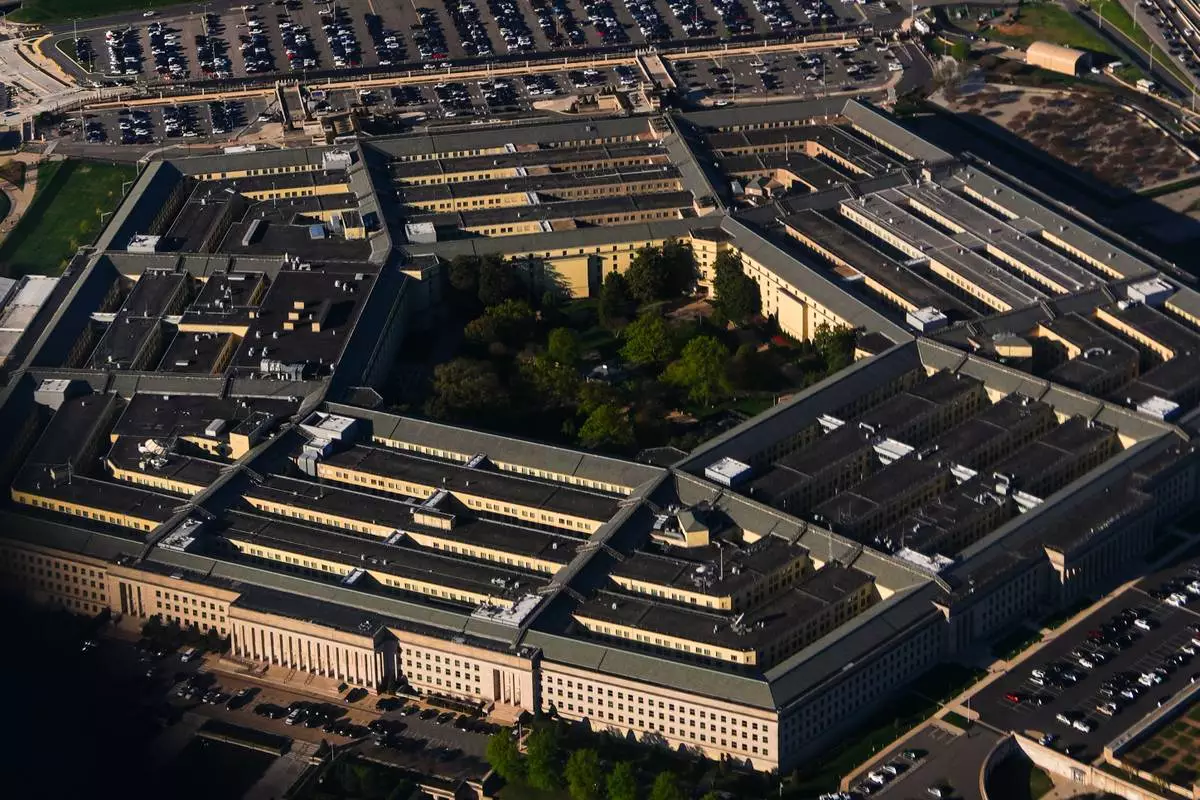
The Pentagon is seen from an airplane, Tuesday, April 7, 2026, in Washington. (AP Photo/Julia Demaree Nikhinson)