Skip to Content Facebook Feature Image

Stephen King on 'The Life of Chuck,' the end of the world and, yes, joy

ENT

Stephen King on 'The Life of Chuck,' the end of the world and, yes, joy
ENT

ENT

Stephen King on 'The Life of Chuck,' the end of the world and, yes, joy

2025-06-04 23:49 Last Updated At:23:51

NEW YORK (AP) — Stephen King ’s first editor, Bill Thompson, once said, “Steve has a movie camera in his head.”

So vividly drawn is King’s fiction that it’s offered the basis for some 50 feature films. For half a century, since Brian De Palma’s 1976 film “Carrie,” Hollywood has turned, and turned again, to King’s books for their richness of character, nightmare and sheer entertainment.

Open any of those books up at random, and there’s a decent chance you’ll encounter a movie reference, too. Rita Hayworth. “The Wizard of Oz.” “Singin’ in the Rain.” Sometimes even movies based on King’s books turn up in his novels. That King’s books have been such fodder for the movies is owed, in part, to how much of a moviegoer their author is.

“I love anything from ‘The 400 Blows’ to something with that guy Jason Statham,” King says, speaking by phone from his home in Maine. “The worst movie I ever saw was still a great way to spend an afternoon. The only movie I ever walked out on was ‘Transformers.’ At a certain point I said, ‘This is just ridiculous.’”

Over time, King has developed a personal policy in how he talks about the adaptations of his books. “My idea is: If you can’t say something nice, keep your mouth shut,” he says.

The most notable exception was Stanley Kubrick’s “The Shining,” which King famously called “a big beautiful Cadillac with no engine inside.” But every now and then, King is such a fan of an adaptation that he’s excited to talk about it. That’s very much the case with “The Life of Chuck,” Mike Flanagan’s new adaptation of King’s novella of the same name published in the 2020 collection “If It Bleeds.”

In “The Life of Chuck,” which Neon releases in theaters Friday (nationwide June 13), there are separate storylines but the tone-setting opening is apocalyptic. The internet, like a dazed prize fighter, wobbles on its last legs before going down. California is said to be peeling away from the mainland “like old wallpaper.”

And yet in this doomsday tale, King is at his most sincere. “The Life of Chuck,” the book and the movie, is about what matters in life when everything else is lost. There is dancing, Walt Whitman and joy.

“In ‘The Life of Chuck,’ we understand that this guy’s life is cut short, but that doesn’t mean he doesn’t experience joy,” says King. “Existential dread and grief and things are part of the human experience, but so is joy.”

It’s telling that when King, our preeminent purveyor of horror, writes about doom times, he ends up scaling it down to a single life. While darkness and doom have, and probably always will, mark his work, King — a more playful, instinctual, genre-skipping writer than he’s often credited as — “The Life of Chuck” is a prime example of King, the humanist.

“An awful lot of people assume, because he writes so much stuff that’s so scary, they kind of forget the reason his horror works so well is he’s always juxtaposing it with light and with love and with empathy,” says Flanagan, who has twice before adapted King (“Doctor Sleep,” “Gerald’s Game”) and is in the midst of making a “Carrie” series for Amazon.

“You forget that ‘It’ isn’t about the clown, it’s about the kids and their friendship," adds Flanagan. “‘The Stand’ isn’t about the virus or the demon taking over the world, it’s ordinary people who have to come together and stand against a force they cannot defeat.”

King, 77, has now written somewhere around 80 books, including the just released “Never Flinch.” The mystery thriller brings back King’s recent favorite protagonist, the private investigator Holly Gibney, who made her stand-alone debut in “If It Bleeds.” It’s Gibney’s insecurities, and her willingness to push against them, that has kept King returning to her.

“It gave me great pleasure to see Holly grow into a more confident person,” King says. “She never outgrows all of her insecurities, though. None of us do.”

“Never Flinch” is a reminder that King has always been less of a genre-first writer than a character-first one. He tends to fall in love with a character and follow them through thick and thin.

“I’m always happy writing. That’s why I do it so much,” King says, chuckling. “I’m a very chipper guy because I get rid of all that dark stuff in the books.”

Dark stuff, as King says, hasn’t been hard to come by lately. The kind of climate change disaster found in “The Life of Chuck,” King says, often dominates his anxieties.

“We’re creeping up little by little on being the one country who does not acknowledge it’s a real problem with carbon in the atmosphere,” King says. “That’s crazy. Certain right wing politicians can talk all they want about how we’re saving the world for our grandchildren. They don’t care about that. They care about money.”

On social media, King has been a sometimes critic of President Donald Trump, whose second term has included battles with the arts, academia and public financing for PBS and NPR. Over the next four years, King predicts, “Culture is going to go underground.”

In “Never Flinch,” Holly Gibney is hired as a bodyguard by a women’s rights activist whose lecture tour is being plagued by mysterious acts of violence. In the afterward of the book, King includes a tribute to “supporters of women’s right to choose who have been murdered for doing their duty.” “I’m sure they’re not going to like that,” King says of right-wing critics.

The original germ for “The Life of Chuck” had nothing to do with current events. One day in Boston, King noticed a drummer busking on Boylston Street. He had the vision of a businessman in a suit who, walking by, can’t resist dancing with abandon to the drummer’s beat.

King, a self-acknowledged dancer (though only in private, he notes), latched onto a story that would turn on the unpredictable nature of people, tracing the inner life of that imagined passerby. In the film, he’s played by Tom Hiddleston. Chuck first appears, oddly, on a billboard that haunts and confuses a local teacher (Chiwetel Ejiofor) who's struggling to get his students to care about literature or education with the possible end of the world encroaching.

It’s a funny but maybe not coincidental irony that many of the best King adaptations, like “Stand By Me” and “The Shawshank Redemption," have come from the author’s more warm-hearted tales. “The Life of Chuck,” which won the People’s Choice Award last fall at the Toronto International Film Festival, is after a similar spirit.

When King reached out about attending the TIFF world premiere, Flanagan was shocked. The last time King had done that for one of his own adaptations was 26 years ago, for “The Green Mile.” That movie, like “The Shawshank Redemption,” was a box-office disappointments, King recalls, a fate he's hoping “The Life of Chuck” can avoid.

“He views this movie as something that’s a bit precious,” says Flanagan. “He’s said a few things to me in the past about how earnest it is, how this is a story without an ounce of cynicism. As it was being released into a cynical world, I think he felt protective of it. I think this one really means something to him.”

The Stephen King industrial complex, meanwhile, keeps rolling along. Coming just this year are series of “Welcome to Derry” and “The Institute” and a film of “The Long Walk.” King, himself, just finished a draft of “Talisman 3.”

If “The Life of Chuck” has particular meaning to King, it could be because it represents something intrinsic about his own life. Chuck's small, seemingly unremarkable existence has grace and meaning because, as Whitman is quoted, he "contains multitudes” that surprise and delight him. King's fiction is evidence — heaps of it — that he does, too.

“There are some days where I sit down and I think, ‘This is going to be a really good day,’ and it’s not, at all,” says King. “Then other days I sit down and think to myself, ‘I’m really tired and don’t feel like doing this,’ and then it catches fire. You never know what you’re going to get.”
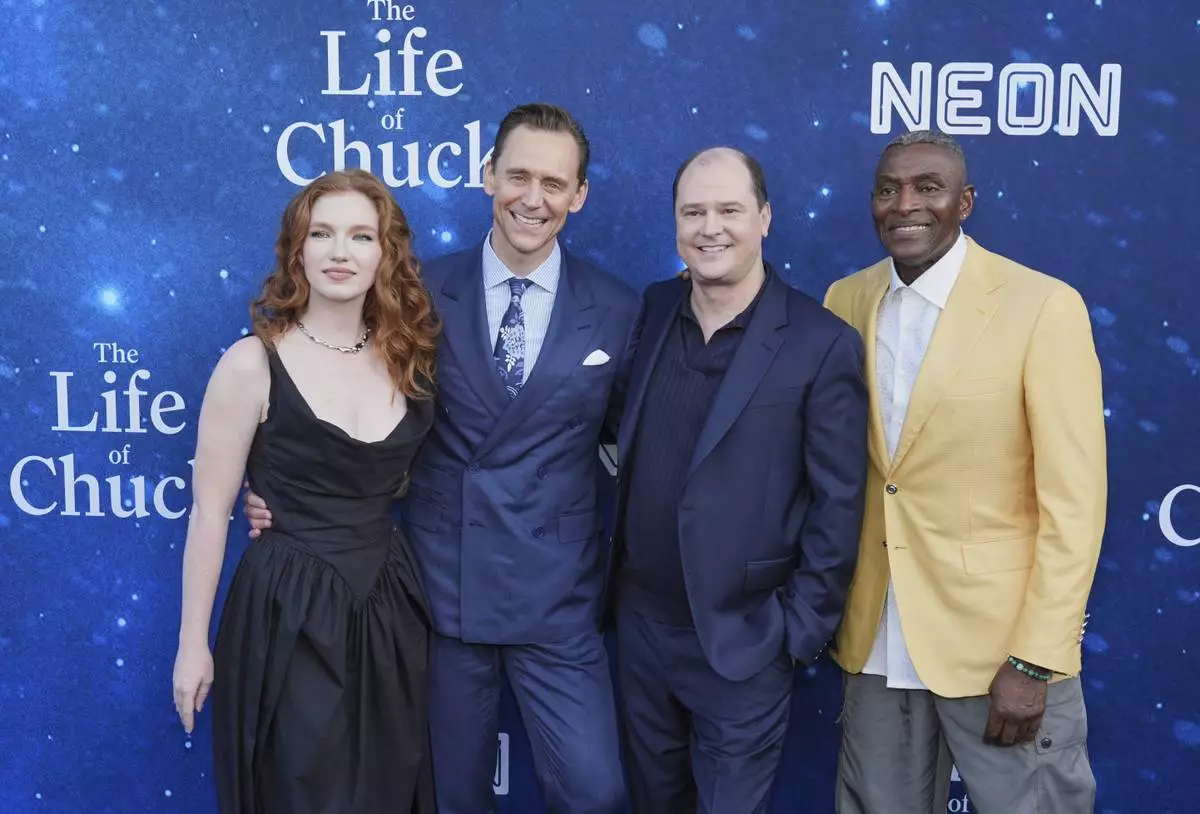
Mike Flanagan, second from right, writer/director of "The Life of Chuck," poses with cast members, from left, Annalise Basso, Tom Hiddleston and Carl Lumbly at the premiere of the film on Monday, June 2, 2025, at Hollywood Legion Theater in Los Angeles. (AP Photo/Chris Pizzello)

Mike Flanagan, second from right, writer/director of "The Life of Chuck," poses with cast members, from left, Annalise Basso, Tom Hiddleston and Carl Lumbly at the premiere of the film on Monday, June 2, 2025, at Hollywood Legion Theater in Los Angeles. (AP Photo/Chris Pizzello)

FILE - Author and screenwriter Stephen King appears at the premiere of "The Life of Chuck" during the Toronto International Film Festival in Toronto on Sept. 6, 2024. (Christopher Katsarov/The Canadian Press via AP, File)
FILE - Author and screenwriter Stephen King appears at the premiere of "The Life of Chuck" during the Toronto International Film Festival in Toronto on Sept. 6, 2024. (Christopher Katsarov/The Canadian Press via AP, File)

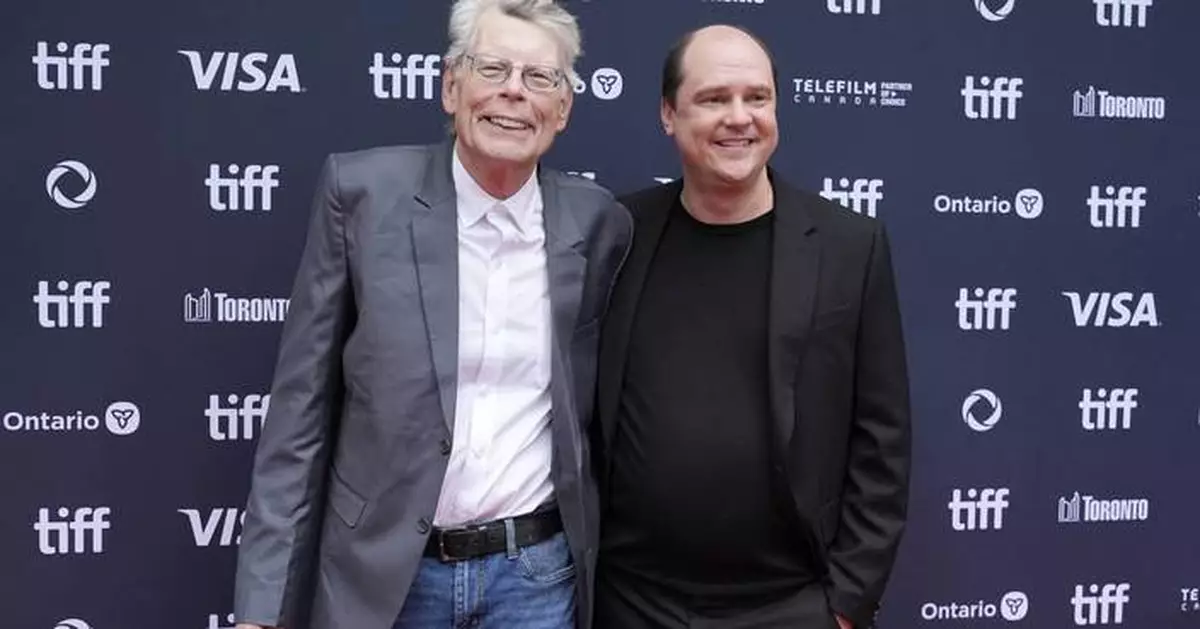
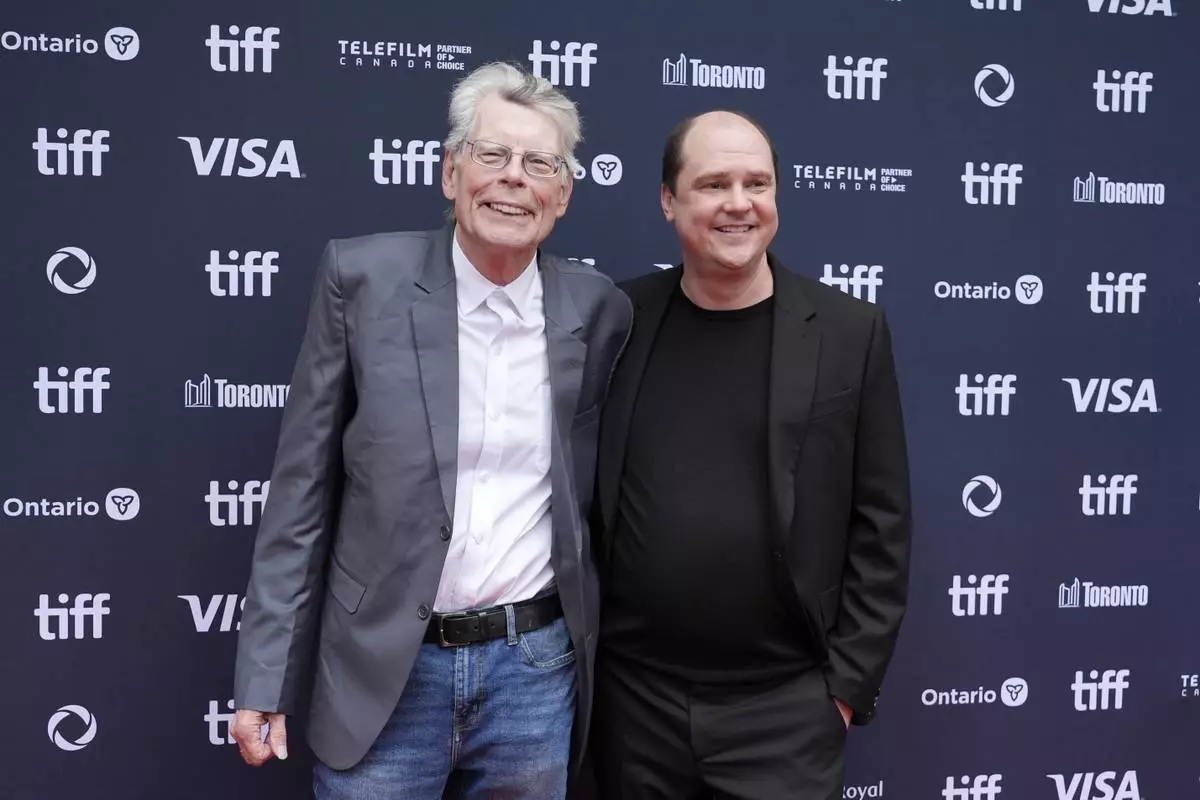
FILE - Stephen King, left, and Mike Flanagan appear at the premiere of "The Life of Chuck" during the Toronto International Film Festival in Toronto on Sept. 6, 2024. (AP Photo/Chris Pizzello, File)
FILE - Stephen King, left, and Mike Flanagan appear at the premiere of "The Life of Chuck" during the Toronto International Film Festival in Toronto on Sept. 6, 2024. (AP Photo/Chris Pizzello, File)

WASHINGTON (AP) — The Smithsonian Institution gave the White House new documents on its planned exhibits Tuesday in response to a demand to share precise details of what its museums and other programs are doing for America’s 250th birthday.

For months, President Donald Trump has been pressing the Smithsonian to back off “divisive narratives” and tell an upbeat story on the country’s history and culture, with the threat of holding back federal money if it doesn’t. The institution is a cornerstone of American culture, operating 21 museums and a zoo that are among the most popular tourist destinations in Washington.

By Tuesday, the Smithsonian was supposed to provide lists of all displays, objects, wall text and other material dedicated to this year’s anniversary and other purposes. Smithsonian Secretary Lonnie Bunch III told staff, in an email obtained by The New York Times and The Washington Post, that “we transmitted more information in response to that request.”

The White House did not respond to a request for comment, leaving it unclear whether it was satisfied with the material it received. Bunch indicated there was more to come, saying the institution will continue to engage in providing “relevant and appropriate materials.”

The Trump administration’s intent is to ensure Americans get an positive accounting of the country’s history, not one weighted by complexities or shameful episodes of the past.

The ultimatum was laid out in a Dec. 18 letter to Bunch from the White House budget director, Russell Vought, and the domestic policy director, Vince Haley.

“We wish to be assured that none of the leadership of the Smithsonian museums is confused about the fact that the United States has been among the greatest forces for good in the history of the world,” the letter said.

Americans “will have no patience for any museum that is diffident about America’s founding or otherwise uncomfortable conveying a positive view of American history, one which is justifiably proud of our country’s accomplishments and record.”

The Smithsonian is not a federal entity but receives a majority of its money from Congress.

The White House initially asked for all relevant materials in September but said documents turned over by the Smithsonian fell far short of what it requested.

In his March executive order, Trump claimed there had been a “concerted and widespread” effort over the past decade to rewrite American history by replacing “objective facts” with a “distorted narrative driven by ideology rather than truth.”

As part of that, Trump tasked Vice President JD Vance with overseeing efforts to “remove improper ideology” from all areas of the institution. Like other vice presidents, Vance serves on the Smithsonian’s board.

The Smithsonian and the White House did not respond to requests for comment Tuesday afternoon.

The prospect of polishing the historical record to satisfy a president is concerning to many who study the past.

“History is about evidence," said Matthew Delmont, a history professor at Dartmouth College. “It's about welcoming complexity and nuance. It’s not about crafting a single story that needs to make everyone feel happy.”

Jim McSweeney, a retired archivist from the National Archives, said: “Here’s our history. Here’s our shared experience. We have to learn from it and never go back and try to whitewash or change anything based upon your political leanings.”

In the months leading up to Trump’s order in August for an official review of all Smithsonian exhibits, Trump fired the head archivist of the National Archives and said he was firing the National Portrait Gallery’s director, Kim Sajet, who maintained the backing of the Smithsonian’s governing board, but ultimately resigned.

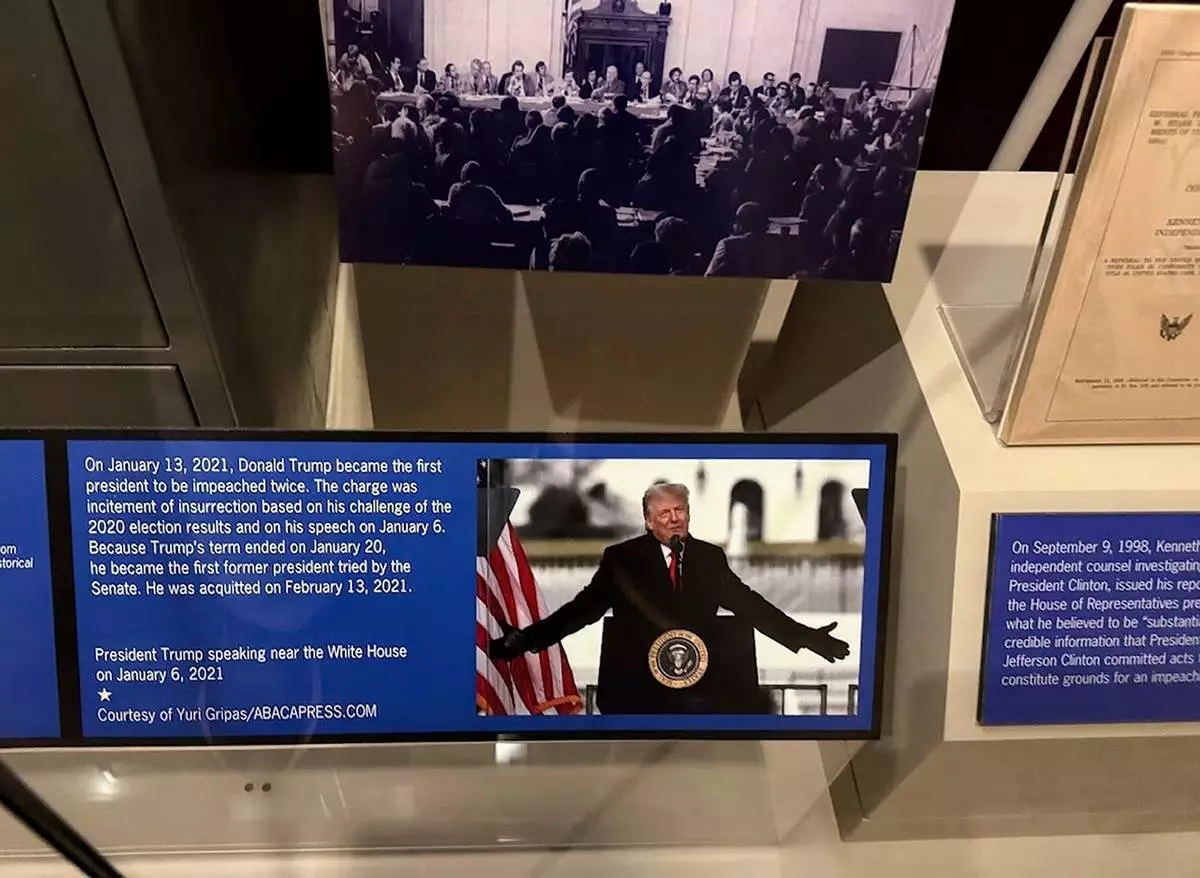
Already, references to Trump’s two impeachments have been removed from his photo portrait display at the Smithsonian’s National Portrait Gallery in its “American Presidents” exhibition, though the text was available online.

Administration officials have couched the accounting as work needed before the nation celebrates the 250th anniversary of the Declaration of Independence on July 4, which the letter calls “a singular opportunity to justify confidence in the operations of America’s leading cultural institutions.”

The Smithsonian review is just one part of Trump's broadside against a culture he deems too liberal.

Trump fired the board of the Kennedy Center, one of the nation’s premier cultural institutions, handpicking a new one that voted to add his name to the storied complex’s exterior. In the months since, a number of artists have withdrawn from performances at the venue, some citing the name change and Trump’s involvement.

At the White House, Trump designed a partisan and subjective “Presidential Walk of Fame” featuring gilded photographs of himself and predecessors, with plaques on what they did. He excludes Democrat Joe Biden, who is represented instead by an autopen to symbolize what Trump has described as a presidency in absentia.

At the time, the White House said Trump was a primary author of the plaques, which praised him as a historically successful figure and described Biden as the worst president in history and one who brought the U.S. to "the brink of destruction.”

This story was first published on Jan. 13, 2026. It was published again on Jan. 14, 2026, to correct that Vice President JD Vance was already on the Smithsonian Board of Regents when President Donald Trump directed him to oversee the removal of “improper ideology” from the institution. Vance was not placed on the board to oversee that effort.

FILE - A new sign at the presidential impeachment exhibit in the Smithsonian's National Museum of American History in Washington, on Aug. 26, 2025, describes the counts against President Donald Trump in his second impeachment trial. The Senate acquitted him in both trials. (AP Photo/Calvin Woodward, File)

FILE - A new sign at the presidential impeachment exhibit in the Smithsonian's National Museum of American History in Washington, on Aug. 26, 2025, describes the counts against President Donald Trump in his second impeachment trial. The Senate acquitted him in both trials. (AP Photo/Calvin Woodward, File)

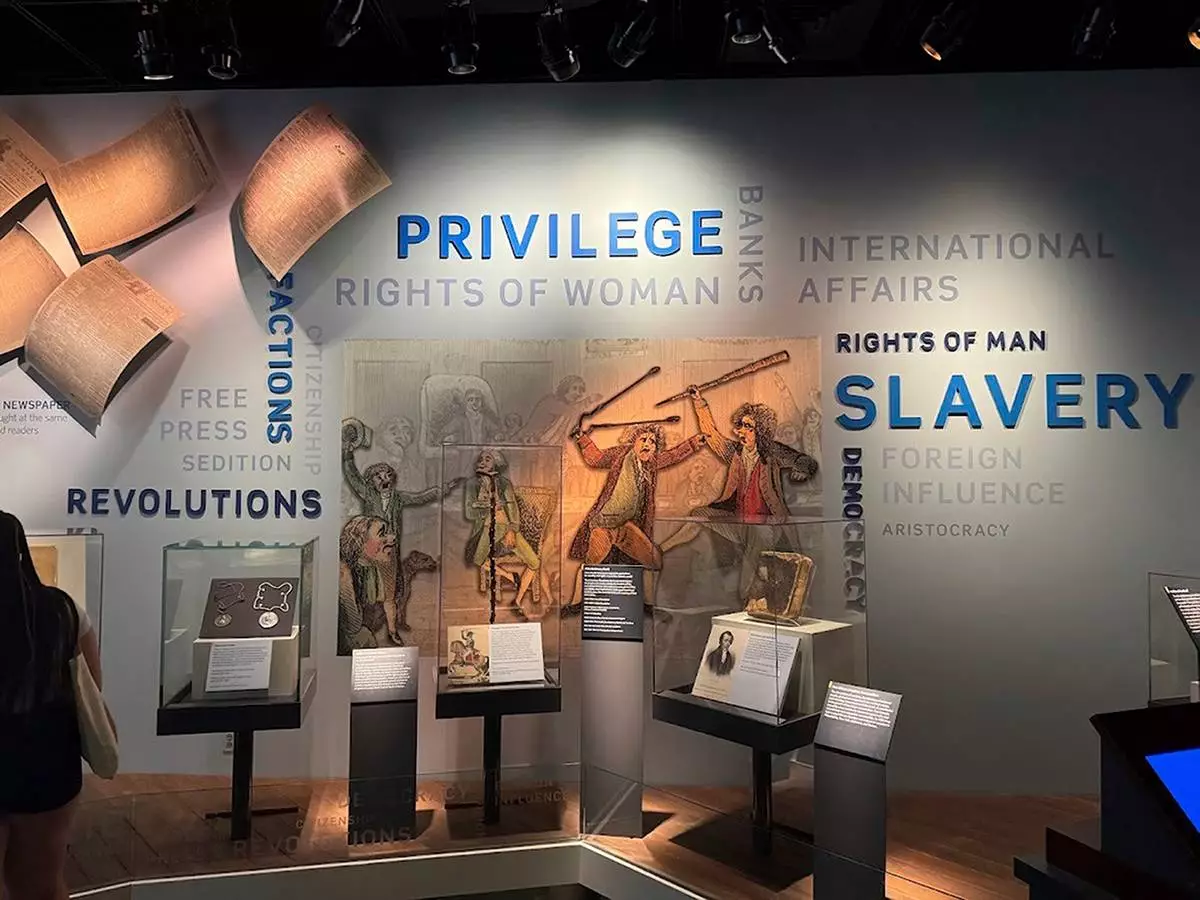
FILE - A display in the "Great Debate" section of a democracy exhibit at the National Museum of American History, seen Aug. 26, 2025, in Washington, reflects some of the issues the nation grapples with. (AP Photo/Calvin Woodward, File)

FILE - A display in the "Great Debate" section of a democracy exhibit at the National Museum of American History, seen Aug. 26, 2025, in Washington, reflects some of the issues the nation grapples with. (AP Photo/Calvin Woodward, File)

People react to a photograph of President Donald Trump on display at the Smithsonian's National Portrait Gallery's "American Presidents" exhibit on Sunday, Jan. 11, 2026 in Washington. (AP Photo/Rod Lamkey, Jr.)

People react to a photograph of President Donald Trump on display at the Smithsonian's National Portrait Gallery's "American Presidents" exhibit on Sunday, Jan. 11, 2026 in Washington. (AP Photo/Rod Lamkey, Jr.)

A visitor stops to look at a photograph of President Donald Trump and a short plaque next to it are on display at the Smithsonian's National Portrait Gallery's "American Presidents" exhibit on Sunday, Jan. 11, 2026 in Washington. (AP Photo/Rod Lamkey, Jr.)

A visitor stops to look at a photograph of President Donald Trump and a short plaque next to it are on display at the Smithsonian's National Portrait Gallery's "American Presidents" exhibit on Sunday, Jan. 11, 2026 in Washington. (AP Photo/Rod Lamkey, Jr.)

Recommended Articles