High-tech solutions are being deployed to help humans and elephants live in harmony around Zimbabwe's largest national park, mitigating years of troublesome conflicts while boosting conservation efforts.
Over the years, villagers living near Zimbabwe's Hwange National Park have often faced challenges as elephants have ventured further in search of food and water. Farmers in communal areas adjacent to the park have frequently had their crops damaged, while some people have even been maimed and killed by elephants that have strayed outside.
In an effort to address these longstanding issues, last year, 16 elephants in Hwange were carefully fitted with GPS tracking collars. These devices provide hourly updates on their movements, enabling conservationists to monitor the elephants and manage the pressures of a growing population.
"Sixteen is really a good number because if you fit one collar on a herd of ten, on average, which is ba sically the average herd size of elephants, so we are basically tracking the movements of probably 160 elephants plus. There is also a human-wildlife conflict-lens to it where we want to assist communities to detect possibilities of conflict early," said Henry Ndaimani, program manager for landscape conservation at the International Fund for Animal Welfare (IFAW).
The special 'EarthRanger' software tracking tool has a virtual geo-fence marking the boundary of the national park. With the information displayed on a dashboard, the monitoring team can observe when elephants are encroaching into human settlements and provide those communities with timely warnings to take the necessary precautions.
Simbarashe Chiseva, the IFAW's community development officer, said they have recruited more young people to help in this important protection work.
"We try to identify youths who are still very energetic, who are also literate, who can also perform some of the demanding roles of patrolling around the buffer zone areas where the boundaries of the protected areas [end] and where the communal areas start. And we've provided the basic equipment, the basic knowledge for them to understand and appreciate the behavior of probably more wildlife species like elephants, like lions," said Chiseva.
Mitigating human-wildlife conflicts has become a top priority given the overpopulation of elephants in Zimbabwe, with the Hwange National Park home to 45,000 elephants, three times more than its capacity
But in addition to the reducing conflicts, authorities say the special collars have given a big boost to the overall conservation efforts, with Zimbabwe also registering progress in its anti-poaching efforts.
"It also helps us even to detect things like poaching. If the elephant is no longer moving, it means our sensors can easily detect that it has stopped for quite a long period and it becomes a concern," said Tinashe Farawo, spokesperson for the Zimbabwe Parks and Wildlife Management Authority.
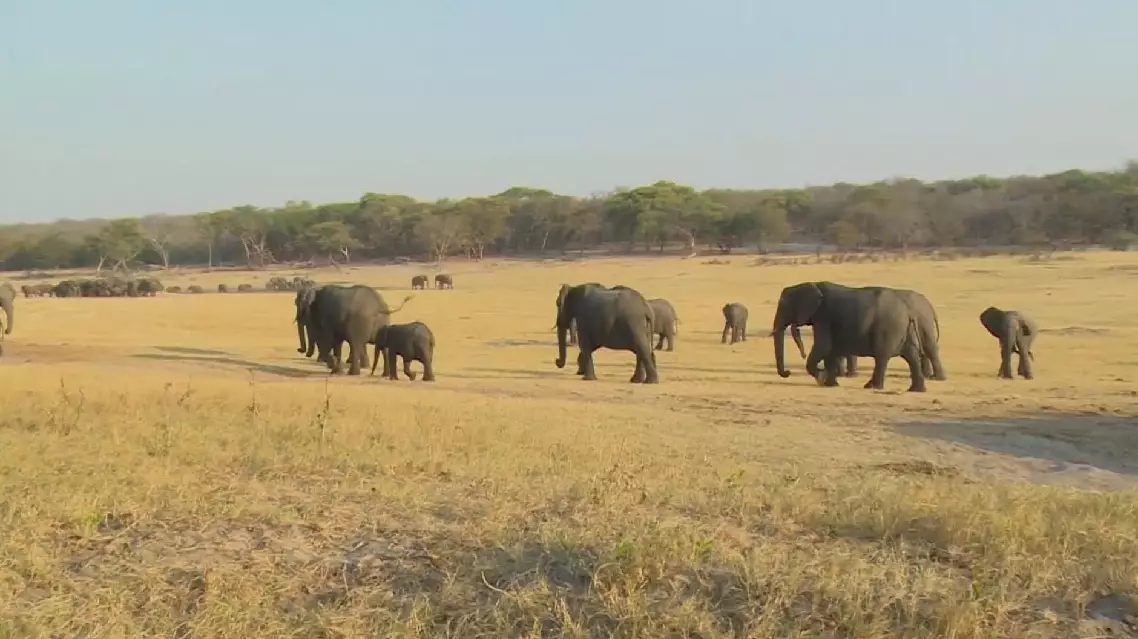
High-tech solutions help reduce human-elephant conflicts in Zimbabwe