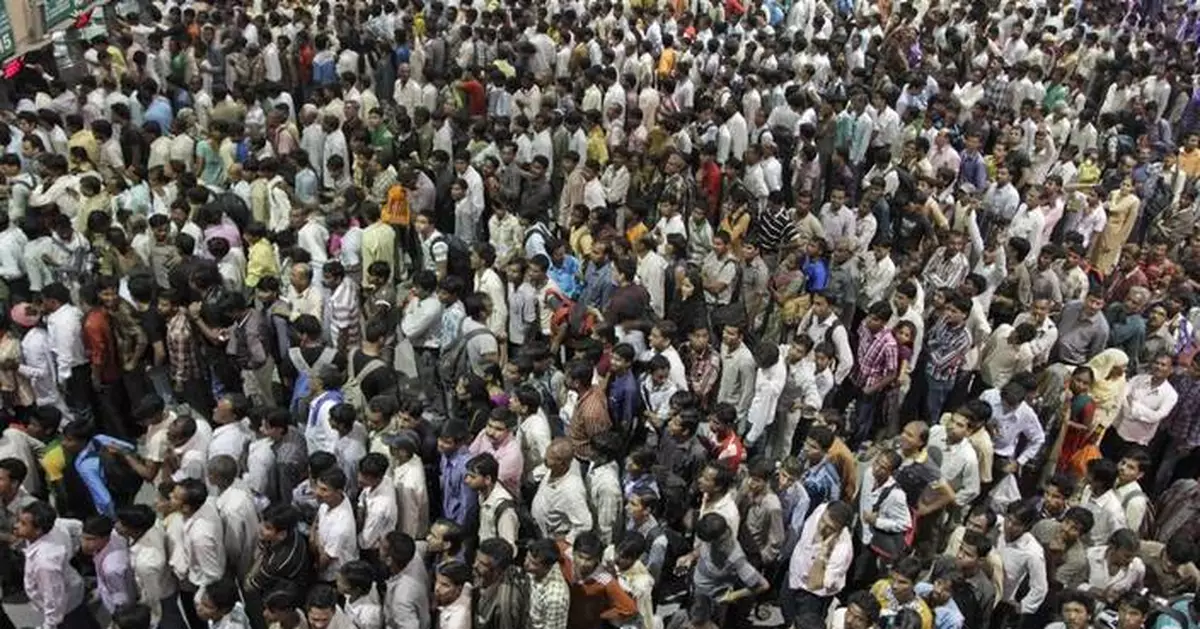
NEW DELHI (AP) — India will start counting its vast population in a mammoth exercise starting next year. The first census in 16 years will be conducted digitally and include controversial questions about caste for the first time since independence.
The Home Ministry announced plans to conduct a two-stage count ending March 1, 2027, in a statement Wednesday night.
India's last official census in 2011 counted 1.21 billion people. The country's population is now estimated to be well over 1.4 billion, making it the world's most populous country, according to the U.N.’s Department of Economic and Social Affairs.
The once-in-a-decade population survey was originally due in 2021 but was delayed by the COVID-19 pandemic and logistical hurdles.
Here's a look at what goes into India's census and why it matters.
The official count of the country’s people is used to allocate many of India's welfare programs and other policies.
It could also pave the way for redrawing the political landscape of India as seats are added to the lower house of Parliament and state legislatures to represent a larger population.
Under the 2023 Women's Reservation Bill, a third of those seats will be set aside for women.
The Indian census is said to be the largest peacetime mobilization in the world.
Almost 2.7 million people were hired to implement the 2011 census, visiting more than 240 million households.
The Home Ministry said the new census will be carried out in two phases and conclude by March 1, 2027. The government will spell out the details and schedule of the exercise later this month.
They'll collect information about houses and their occupants, such as sex, age, marital status, religion, mother tongue, language, literacy and economic activity — as well as caste.
The next census will be the first to consider the caste status of most Indians.
Caste is an ancient system of social hierarchy in India and is critical to Indian life and politics. There are hundreds of caste groups based on occupation and economic status across India, particularly among Hindus, but the country has limited, or outdated data on how many people belong to them.
Since independent India's first census in 1951, it counted only Dalits and Adivasis, members of marginalized groups known as scheduled castes and tribes.
But India also has quotas that reserve government jobs, college admissions and elected offices for a swathe of lower and intermediate castes that are recognized as Other Backward Classes. India’s current policy caps quotas at 50%, with 27% reserved for OBCs. A count of these groups will likely lead to calls to raise the quotas.
Successive Indian governments have resisted updating caste data, arguing that it could lead to social unrest.
The announcement on the census comes months ahead of a crucial election in India’s poorest state of Bihar, where caste is a key issue. Prime Minister Narendra Modi’s party runs a coalition government in Bihar.
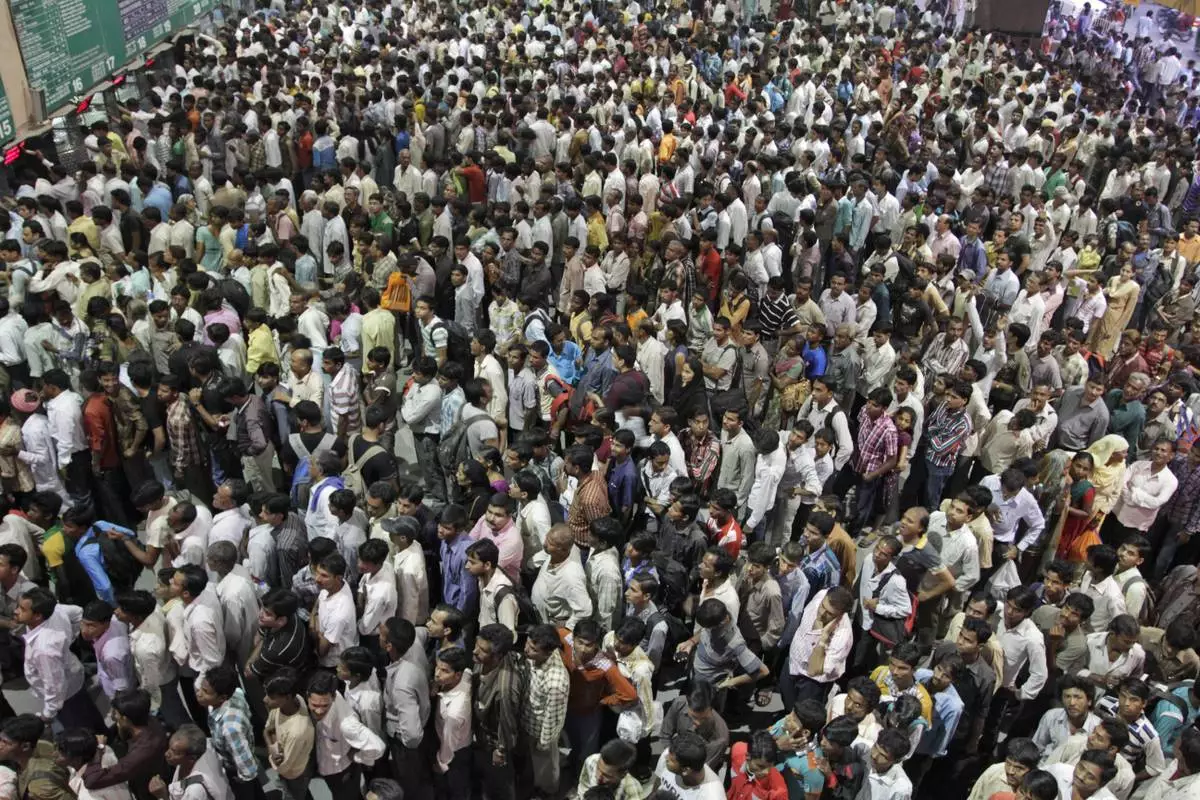
FILE - Indians crowd ticket counters at a railway station in Ahmadabad, India, Oct. 23, 2011. (AP Photo/Ajit Solanki, File)
NEW YORK (AP) — Stocks rose in morning trading on Wall Street Monday at the start of what’s expected to be a quiet holiday week.
The S&P 500 rose 0.5% and is just below the all-time high it set earlier this month. The Dow Jones Industrial Average rose 210 points, or 0.4%, as of 10:47 a.m. Eastern time. The Nasdaq composite climbed 0.4%.
The broader market eked out a slight gain last week in what has been a choppy month. Technology companies, especially those focused on artificial intelligence, have been the main force behind the market's oscillations. The direction of AI-related stocks will likely determine whether the market closes out December with gains or losses.
“If a Santa Claus rally does kick in this year, St. Nick’s gift bag will likely need to be full of positive tech sentiment,” wrote Chris Larkin, managing director of trading and investing at E-Trade from Morgan Stanley.
The gains on Monday were broad, with technology companies and banks leading the way. JPMorgan Chase rose 1% and Nvidia rose 1.3%.
Uber rose 2.8% and Lyft rose 4.2% after announcing plans to bring robotaxi services to London next year.
Gold and silver touched records and oil prices jumped after the U.S. Coast Guard said it was pursuing another sanctioned oil tanker in the Caribbean.
Gold prices rose 1.7% and are hovering around $4,460 per ounce, adding to their consistent gains throughout the year. Silver prices were up about 1.9%.
Crude oil prices in the U.S. rose 2.2% and prices for Brent crude oil, the international standard, rose 2.2%.
Treasury yields edged higher in the bond market. The yield on the 10-year Treasury rose to 4.17% from 4.15% late Friday.
Markets in Asia gained ground while markets in Europe slipped.
Markets in the U.S. will close early on Wednesday for Christmas Eve and remain closed on Thursday for Christmas. The short week for trading includes several economic reports that could shed more light on the condition and direction of the U.S. economy.
On Tuesday, the government releases the first of three estimates on gross domestic product, a reflection of how the broader U.S. economy fared in the third quarter. On Wednesday, the Labor Department will release its weekly data on applications for jobless benefits, which stands as a proxy for U.S. layoffs.
The Conference Board offers up results from its December consumer confidence survey on Tuesday as well.
The upcoming reports follow a mix of updates last week that show inflation remains elevated and consumer confidence has diminished over the last year. Overall, the job market has been slowing and retail sales have weakened.
The ongoing and wide-ranging U.S. trade war has been hanging over consumers and businesses already squeezed and worried by higher prices. The mix of stubbornly high inflation and a weaker jobs market has also put the Federal Reserve in a more difficult policy position moving forward.
The Fed has cut its benchmark interest rate at its last three meetings, despite inflation that has remained stubbornly above its 2% target. Fed officials have grown increasingly concerned about the slowing job market, pushing them to trim rates. Cutting interest rates to bolster the economy because of a weak job market could fuel inflation, however.
Wall Street is mostly betting that the Fed will hold steady on interest rates at its meeting in January.
Elaine Kurtenbach and Matt Ott contributed to this story.
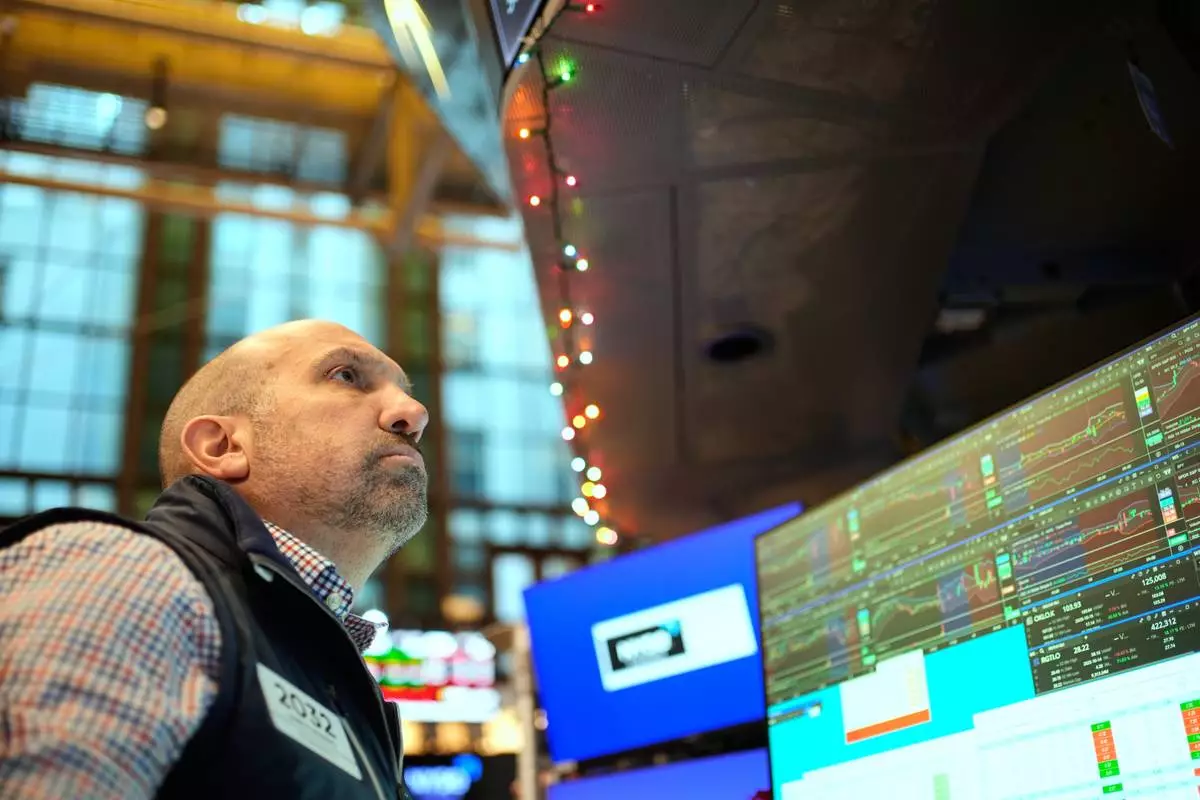
James Denaro works on the floor at the New York Stock Exchange in New York, Wednesday, Dec. 10, 2025. (AP Photo/Seth Wenig)

Trader Jonathan Mueller works on the floor of the New York Stock Exchange, Thursday, Dec. 11, 2025. (AP Photo/Richard Drew)
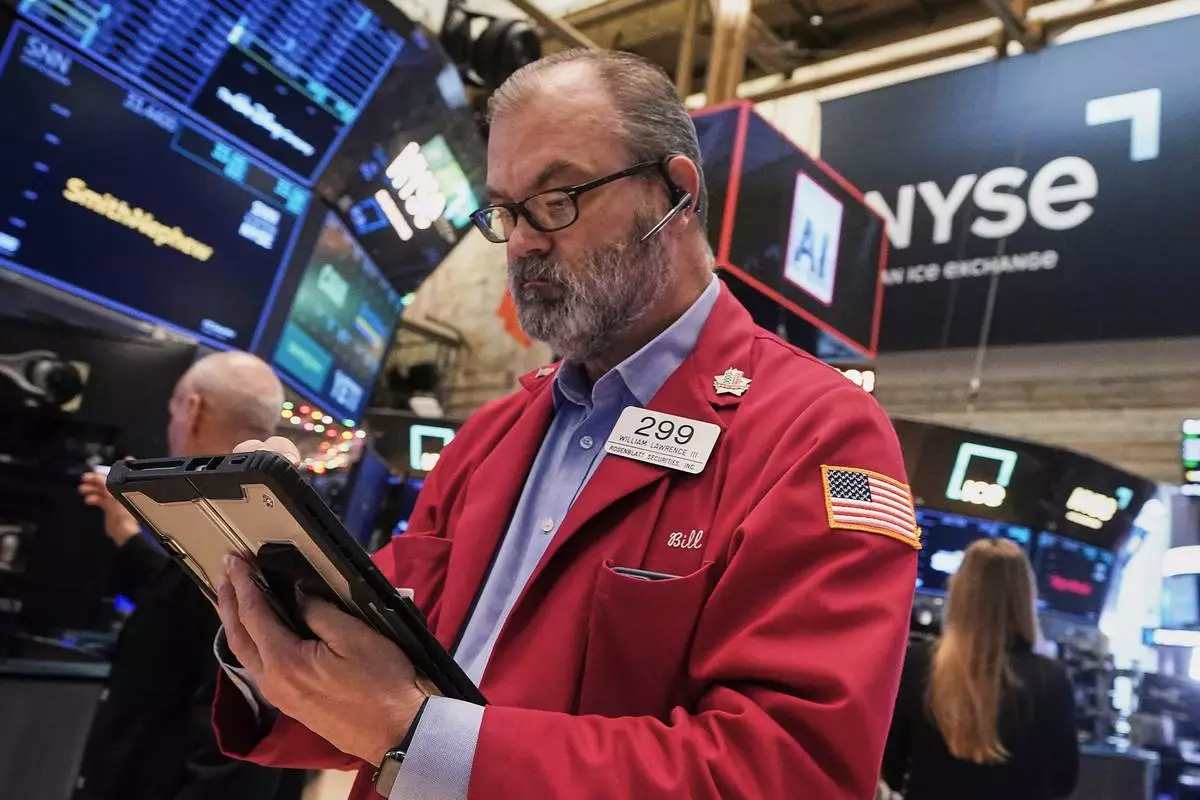
Trader William Lawrence works on the floor of the New York Stock Exchange, Thursday, Dec. 11, 2025. (AP Photo/Richard Drew)

A person looks at an electronic stock board showing Japan's Nikkei index at a securities firm Monday, Dec. 22, 2025, in Tokyo. (AP Photo/Eugene Hoshiko)
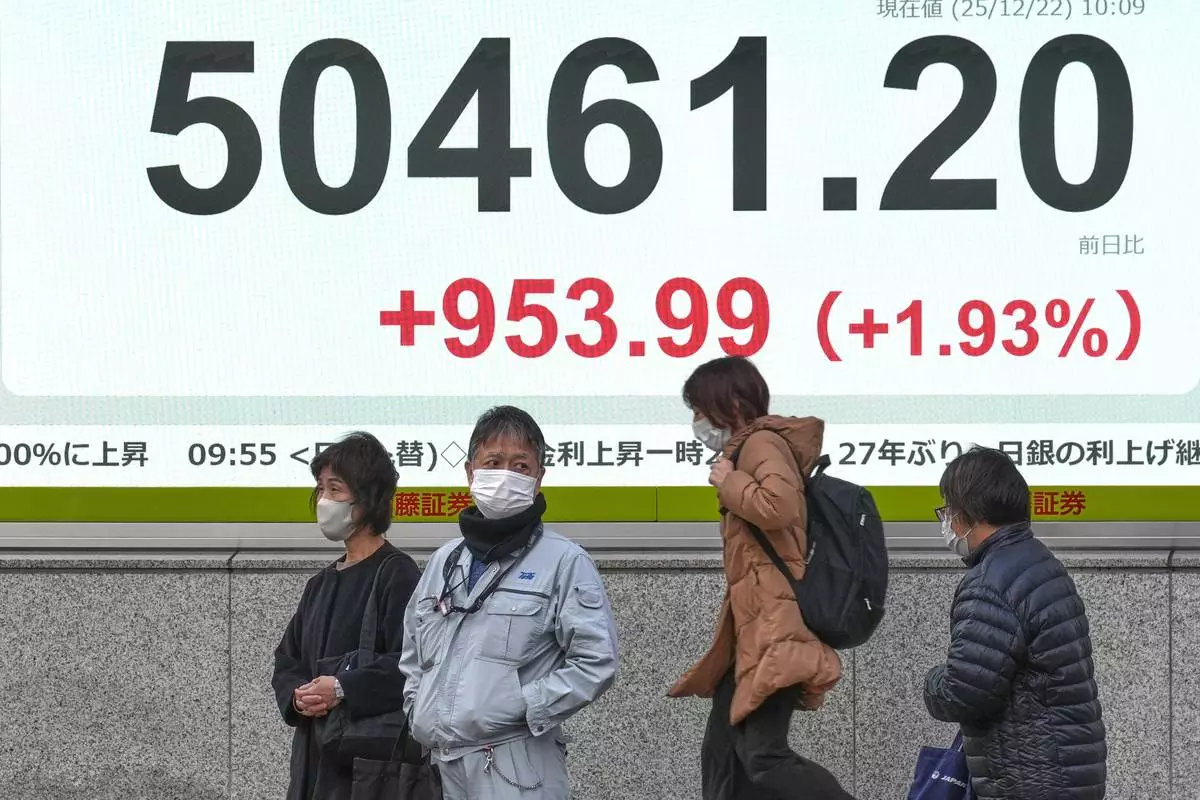
People stand in front of an electronic stock board showing Japan's Nikkei index at a securities firm Monday, Dec. 22, 2025, in Tokyo. (AP Photo/Eugene Hoshiko)
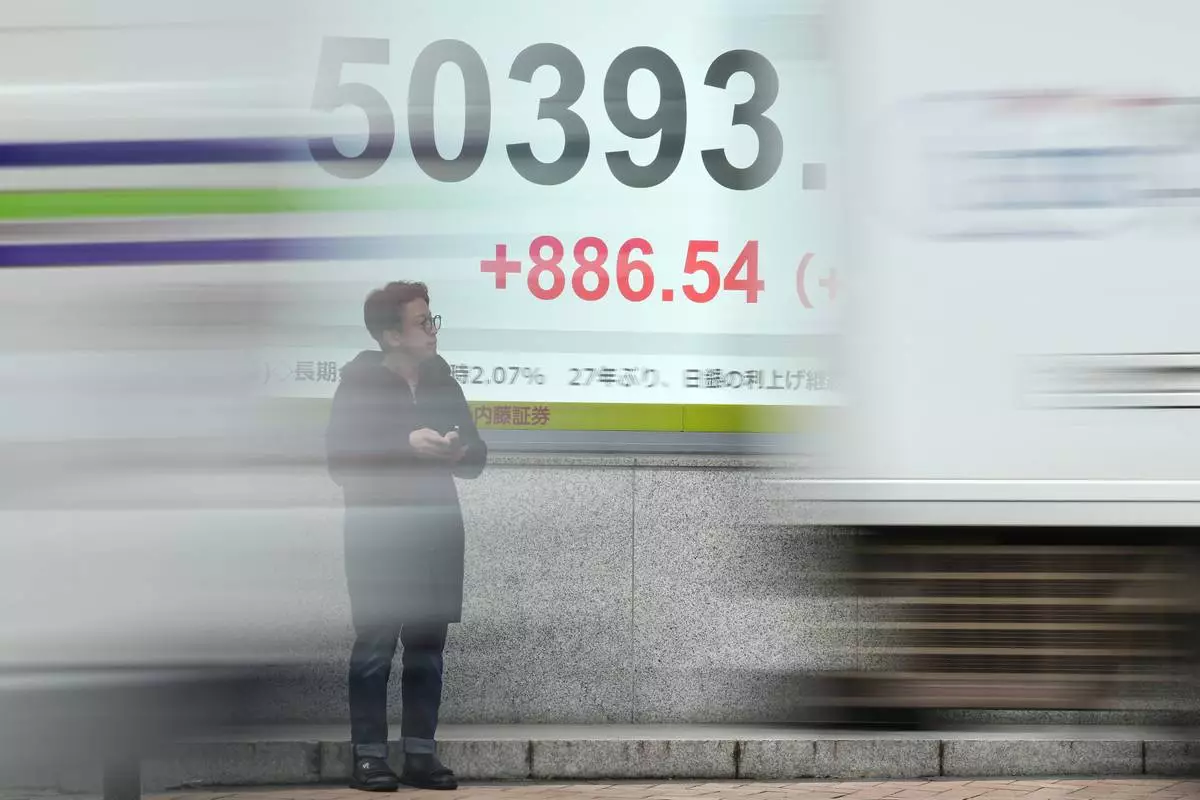
A person stands in front of an electronic stock board showing Japan's Nikkei index at a securities firm Monday, Dec. 22, 2025, in Tokyo. (AP Photo/Eugene Hoshiko)

A person walks in front of an electronic stock board showing Japan's Nikkei index at a securities firm Monday, Dec. 22, 2025, in Tokyo. (AP Photo/Eugene Hoshiko)