A Palestinian diplomat has called on every country to act and exert pressure on Israel to halt its war in Gaza after the United States on Wednesday vetoed a United Nations Security Council draft resolution calling for an immediate and permanent ceasefire in the war-torn enclave.
The text, which was co-sponsored by the ten elected non-permanent members of the Security Council, namely Algeria, Denmark, Greece, Guyana, Pakistan, Panama, the Republic of Korea, Sierra Leone, Slovenia, and Somalia -- who are collectively known as the E10 -- received 14 votes in favor, with the U.S. casting the lone vote against.
As one of the Security Council's five permanent members (P5), the U.S. holds veto power, a negative vote that automatically blocks any resolution from going forward.
Had it been adopted, the draft would have demanded "an immediate, unconditional and permanent ceasefire in Gaza" to be respected by all parties.
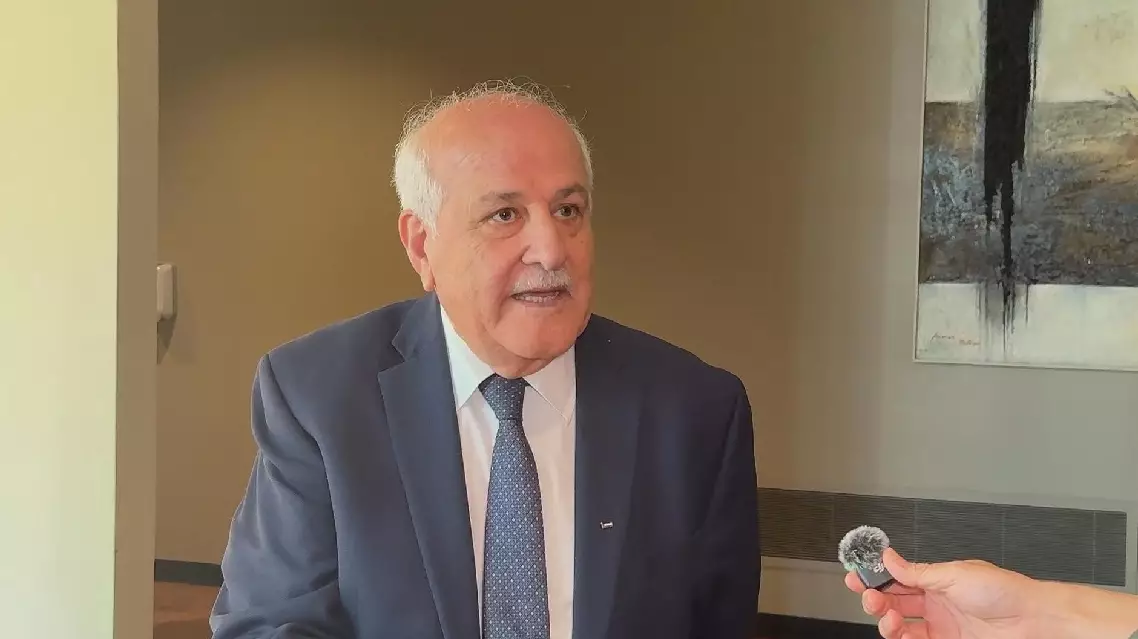
Giving his reaction following the vote, Riyad Mansour, permanent observer of the State of Palestine to the United Nations, was critical of the U.S. for not doing enough to stop the bloodshed.
"If you (the United States) send weapons to Israel, stop sending weapons to kill Palestinian children. If you did not recognize the State of Palestine, recognize the State of Palestine, as an investment in the two-state solution and peace. And if you have a relationship with settlements and settlers, stop them. Start squeezing those who are killing the Palestinian people, you can do it," said Mansour.
However, Danny Danon, Israel's permanent representative to the United Nations, said military pressure is necessary to secure the return of hostages held by Hamas militants.
"Ask yourself why we got the hostages back so far because of the military pressure. So if Hamas would release the hostages, lay the weapons down, then we can speak about a ceasefire. If they will not do it, we will force them. The hostages will come back home, either through negotiations or through military power," he said.
The challenges in finding a unanimous agreement were highlighted by Asim Iftikhar Ahmad, Pakistan's permanent representative to the UN, who said the 15-member Security Council which is charged with taking action, through resolutions and decisions, on any threats to international peace and security, faces multiple hurdles in adopting a draft into a legally binding document for the UN's 193 member states.
"At the moment, there is nothing. This process, it took some time for us to consider. There were consultations among the E10 and then with some of the P5, then with the entire P5. And then it was circulated and put into blue -- there were many proposals back and forth -- but this was the bare minimum. And as you saw, 14 members are supporting, so that means that there was a great deal of agreement on what needs to be done," he said.
More than 54,000 Palestinian people have been killed by Israel's bombing and ground campaign since the conflict with Hamas erupted on October 7, 2023, according to health authorities in Gaza.
Palestine calls for pressure on Israel to end Gaza war as US vetoes ceasefire resolution