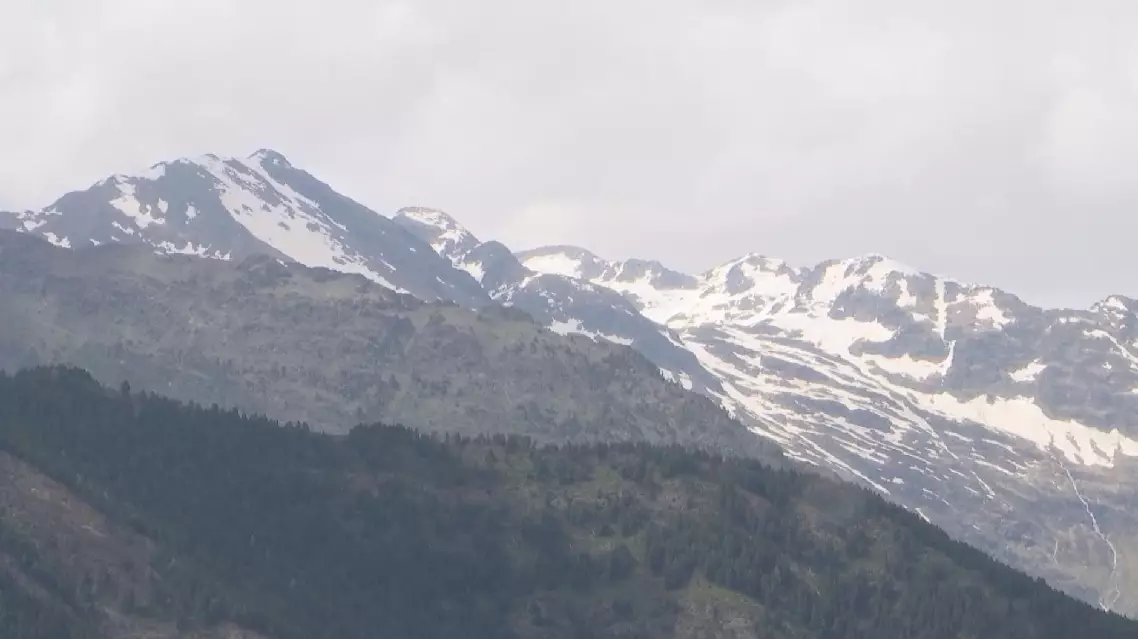
The tiny European mountain nation of Andorra is increasing efforts to protect its environment as the microstate aims for economic growth that is heavily reliant on tourism amid outsized climate change challenges.
With 90 percent of its territory covered by steep slopes, and tourism being its main source of income, Andorra has no space to waste and no room for error. If the snow melts too quickly, or the environment degrades, the country's economy could quickly unravel.
As the tiny country lacks the ability to battle a global challenge like climate change all on its own, currently, Andorra is launching more joint efforts to tackle the issue along with global partners.
"Andorra is not a member of the European Union, but the climate change policies are already aligned with the European Union as well. And we share the same long-term commitment, about the neutrality of carbon to 2050. So Andorra is an active member of the United Nations Framework Convention on Climate Change, the UNFCCC, since I think 2011. And we ratified the Paris Agreement in 2015," said David Forne Massoni, Andorran Secretary of State for Energy Transition, Transport and Mobility.
Since one of the real challenges facing Andorra is the sustainable use of space, the country has been making efforts to ensure its tourism can make most use of the country's resources and to build a sector that can receive tourists from across the world throughout the whole year.
"I think Andorra is doing a great job in promoting everything related to sports, especially nature sports like trail running, which has been developing a lot, and hiking. I've discovered this phenomenon. Even though I'm a French, I think Andorra is on the right path in communicating about its tourism, especially eco-tourism," said Jean Luc Dornic, a French tourist.
As Andorra chose to build a coherent and long-term system, rather than isolated fixes, to protect its environment, it has been building facilities to turn waste into energy as part of the country's efforts to pursue sustainable development.
"We export 70 percent of our rubbish into other countries of the EU. And after we manage all 30 percent of rubbish here in Andorra, we have a center of valorization of this rubbish -- and we create energy with this valorization," said Guillem Casal Font, Andorran Minister of Environment, Agriculture and Livestock.
Andorra increases environmental protection effort to boost tourism-driven economy
The Iranian government is focusing on public concerns and maintaining stable supplies of essential goods amid recent protests, Iranian President Masoud Pezeshkian said in a televised interview on Sunday.
In the city of Karaj, northwest of the capital Tehran, daily life has largely continued as normal. A video filmed by a local resident on Sunday shows food stores open and grocery shelves fully stocked.
"This is the block near my home, and there are some food stores here. Daily life continues here. Last night we did not see many protests in Karaj. Right now the city is very safe. This is a grocery store close to my home. All the food is available; nothing is in shortage. Here are noodles and different types of beans. Here are dairy products, cheese, and yogurt. I also checked other grocery stores and didn't see any shortages. Everything is available," said local resident Ali Reza.
Iranian officials have described recent disturbances as acts orchestrated by the "enemy," including some carried out by well-trained and armed "terrorists." The incidents have caused casualties among security personnel and civilians, as well as property damage.
The Secretary of Iran's Supreme National Security Council Ali Larijani has directed authorities to severely punish the "terrorists."
Meanwhile, Iran's police chief Ahmad-Reza Radan said on Sunday that the police had raised alert levels and arrested several leaders of the troublemakers during the operations on Saturday.
President Pezeshkian noted in the interview that the normal demands of the Iranian people are reasonable and justified, but they must realize that triggering riots and carrying out terrorist acts are the enemy's attempts to undermine the country. He urged the public to remain vigilant.
Also on Sunday, Iranian Parliament Speaker Mohammad Baqer Qalibaf warned that Tehran would regard U.S. and Israeli bases and facilities in the Middle East as "legitimate targets" if Washington takes military action against Iran. His remarks followed media reports saying U.S. President Donald Trump is "seriously considering authorizing a strike" against Iran.
Iranian state media reported that at least 109 members of Iran's security forces have been killed in clashes since the protests began 14 days ago. Meanwhile, human rights groups based outside the country said the number of protesters killed has exceeded 200, though the figure could not be independently verified.
The protests initially erupted over a sharp depreciation of the rial and sweeping subsidy reforms. Iranian authorities have blamed the unrest on foreign-linked agents and sanctions imposed by the United States.
Iranian president says government focusing on ensuring supplies amid protests