More than 300 students, scientists, and government officials gathered Friday at the Hungarian Academy of Sciences for a special space science question and answer session with Chinese astronauts aboard the Tiangong space station.
Dubbed the "Tiangong Classroom," the event was co-hosted by the China Manned Space Agency, the Chinese Embassy in Hungary, and the Hungarian Academy of Sciences in the Hungarian capital Budapest. It aimed to deepen growing cooperation between China and Hungary in the fields of aerospace, education, and innovation.
During the session, Shenzhou-20 crew members Chen Dong, Chen Zhongrui, and Wang Jie responded to questions submitted in advance by students representing over 100 Hungarian schools, touching on a wide range of space science topics including the space station operation and the life in orbit.
Many Hungarian students were thrilled to see their questions answered directly by astronauts in space. In a pre-recorded video, the astronauts also demonstrated zero-gravity science experiments, captivating the audience with examples from space.
"My first question is how the absence of a natural day-night rhythm affects the health and daily life of astronauts. They said it had no impact, and it's not a big issue for them. This event is awesome. In my opinion, it exceeded the national standards. I think the overall experience was excellent," said 15-year-old student Bence Kovacs who focused on the circadian cycle in space. "The astronauts came to explain in person, which completely satisfied my curiosity. I got the answer to my question." "I asked to what extent an astronaut's spinal column will grow in space when the compression on the intervertebral disc is relatively smaller than that on the earth, and their real feelings of this. I asked this question because I used to read an article in a contest about this. I'm very happy to be awarded and chosen to be involved in this event. I really can't wait to explore more. In the future, I definitely want to engage in astronomy work. I have been very interested in astronomy since I was a child. I have always loved it since then," said Sara Lovati, another student.
Kiss Áron Keve, the person in charge of Svábhegy Observatory in Hungary, one of the event organizers, highlighted the significance of the event. He said China's space industry has developed at an astonishing speed and is remarkable, adding that through this event, Hungarian students had the opportunity to personally participate in the space project, which was of great significance.
"I think apart from inspiring those students who raised specific questions, this activity itself is also of great significance. It provides each student with an excellent opportunity to think about how to participate in space projects and the aerospace industry. Even if they are not astronauts, they can contribute to this booming field from the perspective of researchers. I can see the future. It's very inspiring," he said.
The three-member crew aboard the Tiangong space station was sent into space on April 24 for a six-month mission.
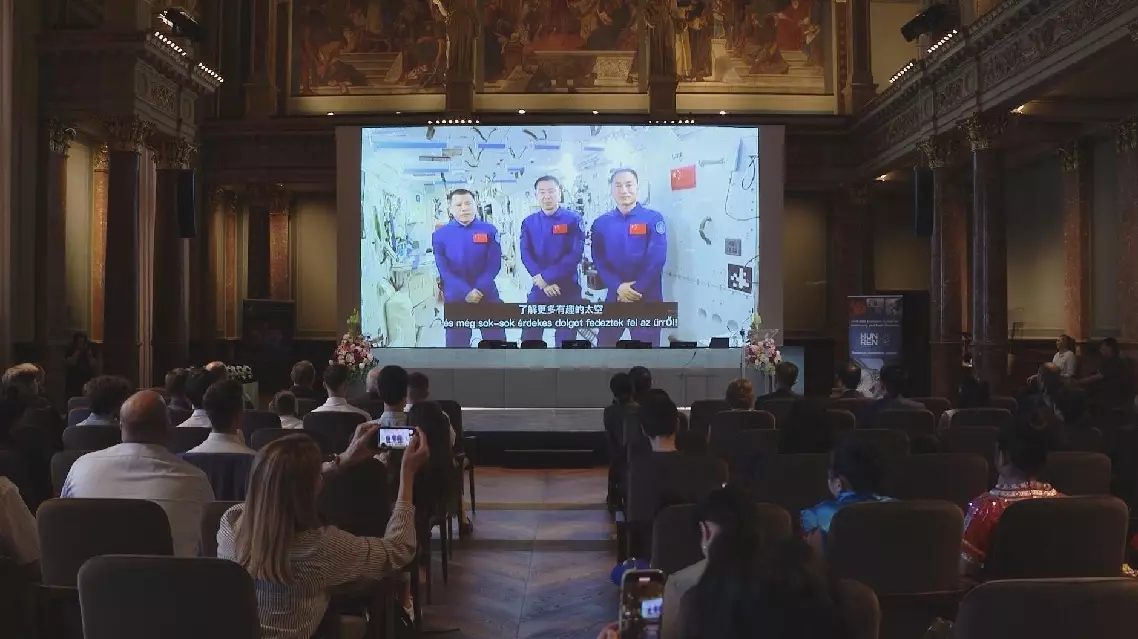
Hungarian students connect with Chinese astronauts in "Tiangong Classroom" event