In northwest China, a seriously injured snow leopard cub embarking on its remarkable journey of survival has caught much attention on the social media.
On March 5, the day of Jingzhe, or the Awakening of Insects in China's traditional solar terms, a wildlife rescue and breeding center in northwest China's Qinghai Province, also known as Xining Wildlife Park, received an emaciated six-month-old cub from Yushu Tibetan Autonomous Prefecture.
Severely malnourished, with a fractured spine, severe inflammation and critically low body temperature, the cub was barely clinging to life.
"When it first arrived, we were uncertain if it could survive the night and were very worried. After taking its temperature, we saw critically low readings. For warm-blooded animals like this, subnormal body temperature may trigger rapid heat loss, which can be fatal. So we immediately placed it in an incubator," said Zhao Hailong, a veterinarian at the Qinghai Wildlife Rescue and Breeding Center.
They named the cub Ling Xiaozhe, with Ling bearing the meaning of overcoming difficulties, Zhe referring to the solar term of Jingzhe when it was rescued, and Xiao, or small, relating to its figure and age -- the cub weighed just 9.7 kg -- far below the healthy range for its age.
Veterinarians believe that the cub might have fallen from a height, leaving it unable to move and starving before being discovered.
A joint team from the center and China Agricultural University sprang into action, providing oxygen, warmth, antibiotics and nutritional support.
"We placed it in a constant-temperature oxygen chamber and carried out emergency treatment. After nine days of care, its weight increased from the initial 9.7 kg to over 11 kg," said Qi Xinzhang, the center's deputy director.
By March 8, hope flickered as Ling Xiaozhe lifted its head for the first time.
On March 14, Ling Xiaozhe clumsily clambered out of its crate -- a sign of returning mobility.
By late March, Ling Xiaozhe was eating independently, attempting wobbly steps and even growling protectively over its food bowl.
"After over 20 days of treatment, one day it suddenly leaned against the wall and managed to stand up. Seeing it could fully support its entire body weight, I was very happy," said Zhao.
On April 28, an MRI scan confirmed its spine was healing, but challenges remained.
"The examination imaging shows its cervical fracture is recovering well, though minor nerve compression persists along with residual edema and inflammation," said Qi.
After over three months of dedicated treatment and care by the rescue team, Ling Xiaozhe had reached a healthy weight of 20 kg as of Friday. The animal is now showing strong recovery progress, with gradually improving motor skills, balance, and natural behavior—demonstrating the ability to run, jump, and regain its wild instincts.
The center's staff share daily rehabilitation updates on social media, attracting tens of thousands of engaged followers. To ensure uninterrupted recovery during this critical phase, the Xining Wildlife Park has postponed public exhibition to minimize external disturbances.
Addressing public interest, Zhao and his team creatively documented Ling Xiaozhe's progress through an illustrated picture series, offering netizens a virtual window into this unique conservation journey.
"Ling Xiaozhe has been under our care for over 60 days, and we made this illustration to record its progress. It clearly shows the distinct recovery stages in its rehabilitation," said Zhao.
These illustrations serve not merely as a chronicle of Ling Xiaozhe's rehabilitation journey, but also embody the collective dedication and hopeful vision of the entire rescue team at the center.
"Our greatest hope for this snow leopard cub is the full recovery of its mobility—to walk and jump like any healthy member of its species. We rescue numerous animals each year, and our biggest wish is that all the animals recovering after our rescue and treatment can return to the wild," said Zhao.
In China, the snow leopard is under top-level national protection, primarily found in regions such as Qinghai, Xizang, Gansu, Sichuan and Xinjiang. The latest data indicates that its population in China is steadily growing, with over 1,200 individuals now being monitored.
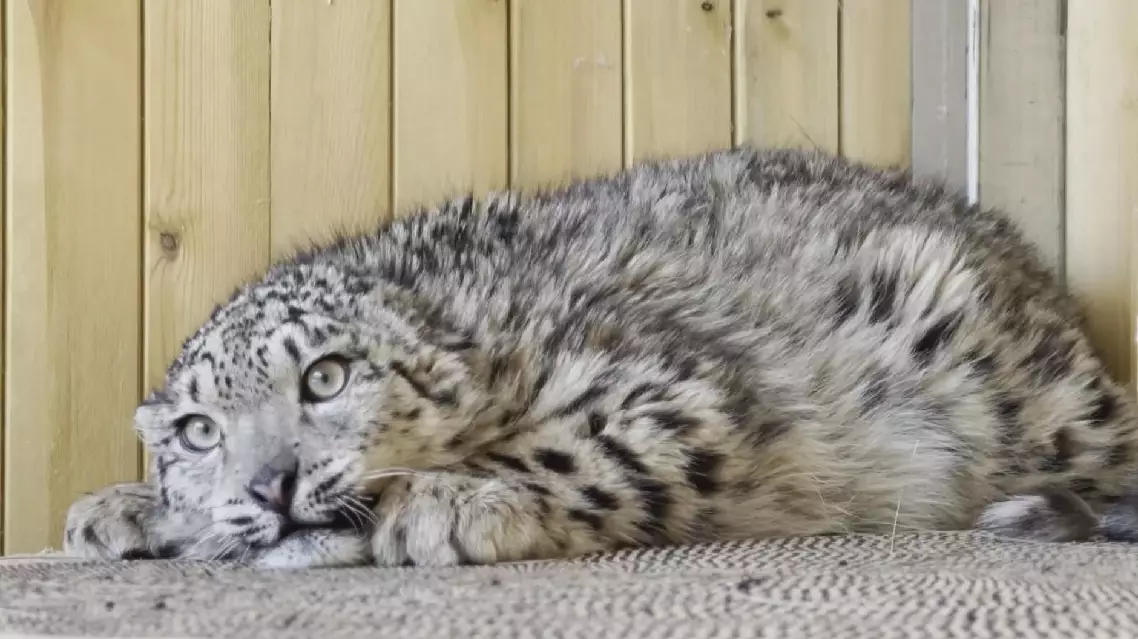
Seriously injured snow leopard cub remarkably recovering in northwest China