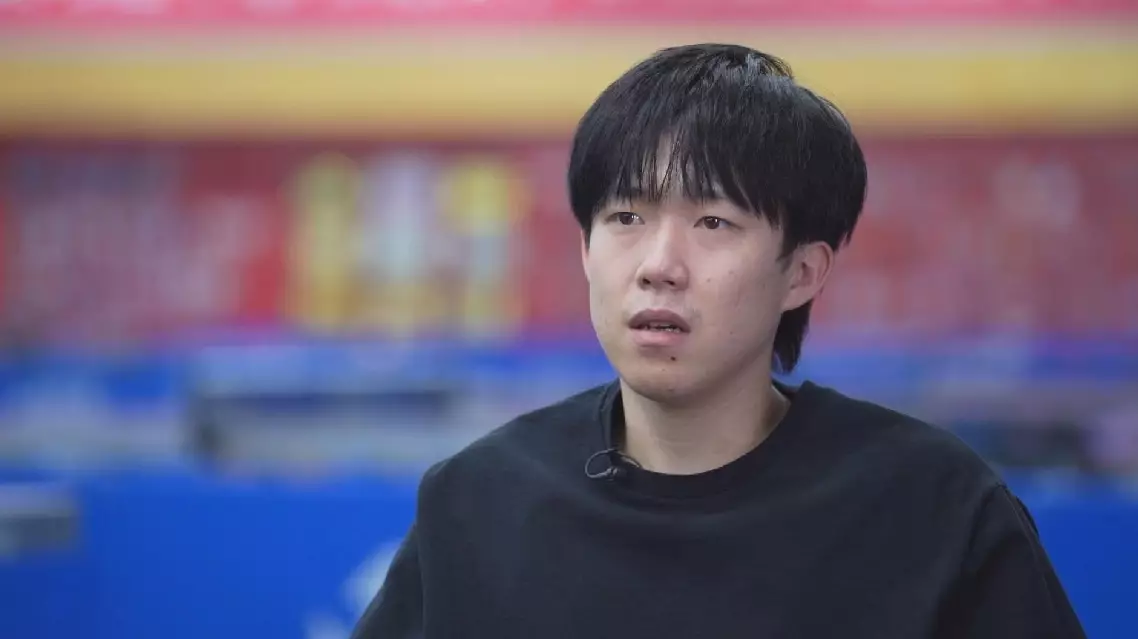
Wang Chuqin, the world's top-ranked table tennis player, has learned from setbacks and failures by adopting a growth mindset, acknowledging emotions, and concentrating on controllable factors.
The rising star on May 25 defeated Brazil's Hugo Calderano 4-1 as he won his first men's singles title at the World Table Tennis Championships in Doha, Qatar.
The victory caps a turbulent journey for the 25-year-old athlete.
On July 30, 2024, when Wang put his paddle aside on the floor in order to hold the national flag for celebration after the mixed doubles final of the Paris Olympics, a group of photographers rushed to the front to capture the moment and inadvertently stepped on his paddle. The table tennis player had to change his racket and lost 4-2 in the round of 32 to Sweden's Truls Moregard.
In October, Wang also suffered a shocking defeat to 14-year-old Iranian talented player, Benyamin Faraji, at the Asian Championships.
In a recent interview with China Central Television (CCTV), Wang opened up about his loss to Faraji and he attributed the loss to psychological rather than technical issues. Wang also emphasized the importance of resilience.
Reflecting on his experience at the WTT Finals Fukuoka, he acknowledged that he had reached a turning point where he understood the need to rescue himself from the disappointing loss.
He claimed the championship, defeating Japan's Tomokazu Harimoto 4-0 in the men's singles final.
"You can't just focus on external issues. I think a person shouldn't just blame external factors but should look inward," said Wang.
Realizing his overdependence on a single main paddle after an incident at the Paris Olympics, Wang Chuqin switched to training with his spare paddle almost obsessively. This change, though subtle, inadvertently averted a crisis in a subsequent match.
Fast forward to May 19, 2025, during the mixed doubles event at the Doha World Table Tennis Championships, Wang Chuqin discovered his paddle delaminating. He seamlessly transitioned to his spare paddle, already familiar with it from his previous experiences.
With unwavering determination, Wang Chuqin and his partner Sun Yingsha clinched the mixed doubles title, securing China's third consecutive victory in the event. Buoyed by this success, Wang Chuqin set his sights on the men's singles championship.
The road to victory was not without challenges. In the men's singles final on May 25, Wang Chuqin was against Brazilian player Hugo Calderano.
At the Macao Table Tennis World Cup just a month before, Wang Chuqin suffered a heartbreaking semifinal loss after seven grueling games to Calderano, missing the final of the men's bracket, by just two points.
"It's all about mentality. In fact, it's quite normal to blow a lead in competitive sports. Because once you take the lead, your mentality is definitely not the same as when you were behind. When you start thinking about winning, everything changes -- how you play, how you think, and where your focus goes. Are you still fully into the game, or are you worrying too much about the result? And when you're planning your moves, are you playing it safe, taking risks, or sticking to a plan that lets you go toe-to-toe with your opponent? All these things shift once you're in that leading position," he explained.
Despite his recent setback, Wang Chuqin's determination remained unshaken. In a rematch against Calderano at the Doha World Table Tennis Championships men's singles final, Wang Chuqin displayed a newfound confidence.
He overcame mid-game setbacks to beat the reigning World Cup champion 12-10, 11-3, 4-11, 11-2, 11-7 over 46 minutes.
He eventually realized his long-awaited dream of clinching his first men's singles title at a major championship.
"Except for true geniuses, especially in the China's table tennis team, no one can soar straight to the top. He must experience the bottom before he can bounce back," said Wang.
Wang Chuqin was born in 2000 in northeast China's Jilin Province. In 2015, he was selected to join the national table tennis team. In 2018, he competed in the Jakarta Asian Games, helping the Chinese team secure the men's team championship. That same year, he participated in the Youth Olympic Games and won the men's singles title, showcasing the strength of China's young table tennis talents.
During the interview, he described his growth as "difficult."
"In my understanding, I performed quite well in youth competitions. However, when transitioning from youth to adult levels, I struggled for a long time in this intermediate stage before breaking into the main team. Due to suspensions and the pandemic, I missed out on a lot. There were things I should have understood much earlier, because only through more games and experiences can you gradually figure out what you should do," said Wang.
Upon receiving the championship trophy, Wang Chuqin expressed his desire for unity within the Chinese table tennis team, attributing their success not to individual achievements but to the collective efforts of past and present players.
"I think after this win, what I hope for more is unity. The glory of the Chinese table tennis team is not achieved by any single individual, but by generations of predecessors. Therefore, I also hope to bring everyone together. We are united as one and stand together against the outside. I think this is what I hope for after this competition," said Wang.
China's table tennis star bounces back from setbacks