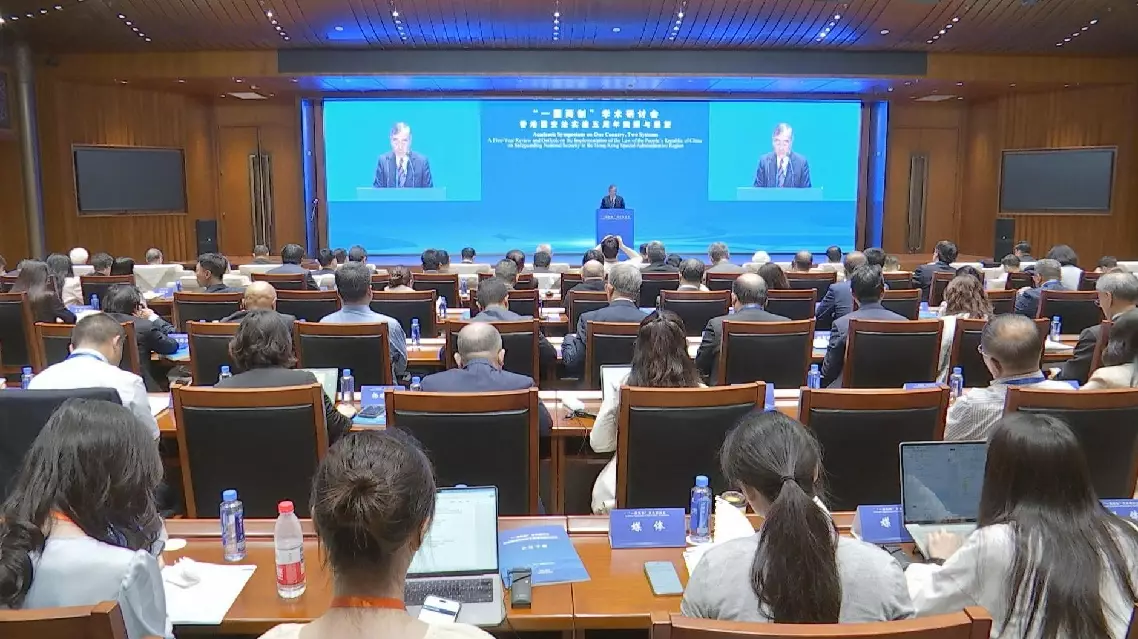
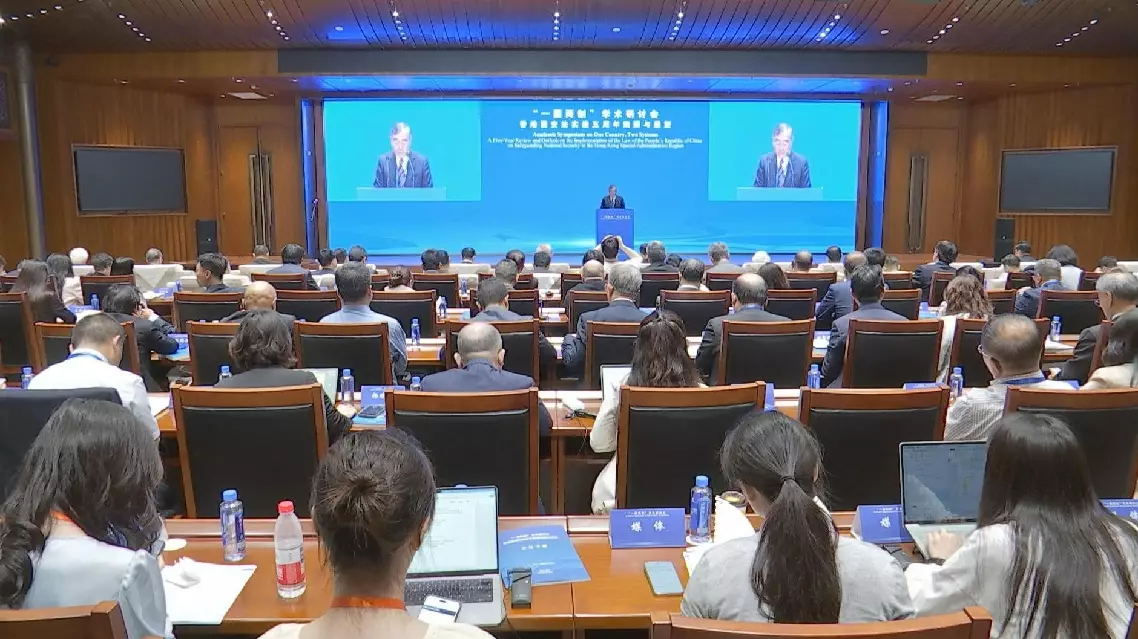
The Hong Kong national security law has played a crucial role in safeguarding the prosperity and stability of the Special Administrative Region (SAR), according to delegates at an academic symposium on "one country, two systems" held in Beijing on Monday.
The event was attended by nearly 100 guests and experts from the Chinese mainland, Hong Kong and Macao special administrative regions, and 11 countries including Britain, Portugal and Malaysia.
Hosted by the Chinese Academy of Social Sciences, the event featured parallel forums on topics including the theory and practice of national security legislation, national security and economic development, as well as national security and social governance.
The attending guests and scholars agreed that the Hong Kong national security law has played a comprehensive and fundamental role in resolving the chaos in Hong Kong, safeguarding the practice of "one country, two systems," as well as promoting Hong Kong's economic development and human rights protection.
The Hong Kong national security law stands as a model for upholding and improving the "one country, two systems" policy, they said, adding that the law has not only been crucial to restoring order and enabling prosperity in Hong Kong, but also provided valuable reference for other countries and regions in building their national security legal systems.
"At a ceremony held in Macao on Dec 20, 2024 to celebrate the 25th anniversary of its return to the motherland, President Xi Jinping said the values of peace, inclusiveness, openness and sharing embodied in 'one country, two systems' are not only meaningful for China but also have reference value for the whole world," said Elsie Leung Oi-sie, former deputy director of the Hong Kong Basic Law Committee under the Standing Committee of the National People's Congress.
"Hong Kong is a clear case in point. Being a British colony turned Special Administrative Region granted with high autonomy under the Chinese framework of 'one country, two systems' since 1997, it has every right to enact the necessary legislation in defense of its security and stability," said Ong Tee Keat, former deputy speaker of Malaysia's House of Representatives.
The "One country, two systems" principle offers an approach to achieving peaceful coexistence and win-win cooperation between different social systems, according to some delegates.
"The original aspiration of implementing the 'one country, two systems' is to maintain the national unity and territorial integrity, as well as to safeguard the prosperity and stability of Hong Kong. The idea of 'one country' is the root of 'two systems', as well as the foundation of the SAR," said Teresa Cheng Yeuk-wah, former secretary for Justice of the Hong Kong SAR.
"Associations in Macao, with love for both the motherland and the SAR, are transforming abstract concepts such as national security into actions to safeguard our homeland through community service networks covering the whole region," said Wu Zhiliang, president of the Board of Directors of the Macao Foundation.
Hong Kong national security law safeguards prosperity, stability: delegates
Hong Kong national security law safeguards prosperity, stability: delegates