The world on Tuesday celebrated the inaugural International Day for Dialogue among Civilizations, established by a UN resolution championed by China's Global Civilization Initiative (GCI).
Proposed by China in March 2023, the GCI has emerged as a cornerstone of contemporary global governance, advocating for civilizational diversity as humanity's shared heritage. The initiative's core principles, rejecting ideological confrontation while promoting mutual learning and common values, directly shaped the UN's historic decision to create this annual observance, with over 80 nations co-sponsoring the resolution.
In recent years, China has institutionalized the GCI through concrete multilateral and bilateral frameworks. The 20th Communist Party of China Central Committee formalized implementation mechanisms during its Third Plenary Session in July 2024, coinciding with the expansion of China's cultural diplomacy network.
This includes 16 multilateral platforms like BRICS cultural ministers' meetings and 25 bilateral mechanisms established through cultural years with Italy, Greece, Spain and other partners, building on earlier platforms such as the Conference on Dialogue of Asian Civilizations.
As part of China's efforts to contribute to global governance, the Global Civilization Initiative follows the Global Development Initiative, launched in 2021, and the Global Security Initiative, introduced in 2022.
Its growing international recognition, exemplified by the new UN observance day, reflects increasing consensus on intercultural dialogue as the foundation for shared human progress in an interconnected world.
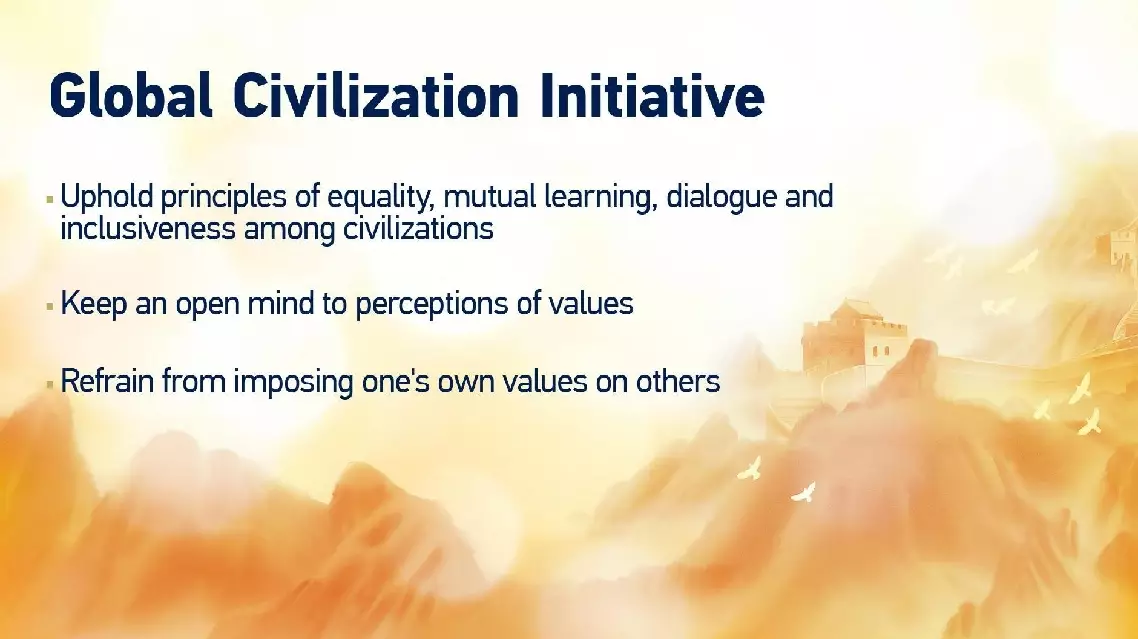
China's Global Civilization Initiative inspires 1st UN civilizations dialogue day
China's Global Civilization Initiative inspires 1st UN civilizations dialogue day
Marking China's 11th Space Day, the China National Space Administration (CNSA) introduced major space projects in the 15th Five-Year Plan period on Friday in Chengdu, the provincial capital of Sichuan in the southwest, the main venue of a series of events marking this day.
Jointly sponsored by the CNSA and the provincial government, the event revealed major sci-tech achievements and space industry updates, with Shan Zhongde, head of the CNSA, introducing China's major space projects to be implemented in the next five years.
"In the areas of entering space, utilizing space, exploring space, and governing space, we will intensify the efforts to carry out key projects including manned spaceflight, lunar probe, planetary probe, and the national satellite internet. We will pace up the demonstration and launch of a new generation of space-power initiatives such as heavy-lift rockets, reusable launch vehicles, and next-generation national space infrastructure. In the fields of lunar and planetary probe, asteroid defense, on-orbit service, and space debris mitigation, we will deepen international collaboration, build the International Lunar Research Station, have in-depth engagement in global space governance, and create an open and cooperative landscape for China's space industry to build a community with a shared future for mankind," Shan said.
The CNSA also released a series of updates marking the Space Day, including the latest lunar discoveries from the Chang'e-5 mission, two new minerals named magnesiochangesite-(Y) and changesite-(Ce), selected international partners for the Tianwen-3 Mars mission, announcement of international cooperation opportunities for the Xihe-2 mission, and the Version 1.0 of the Commercial Space Standards System.
On the same occasion, Xie Jun, deputy chief designer of the BeiDou system, Zhang Bing, member of the Chinese Academy of Sciences, and veteran astronaut Ye Guangfu, were appointed as the 2026 China Space Public Welfare Ambassadors.
More than 30 side events will take place across Chengdu during the Space Day period. Highlights include a space science exhibition at the Chengdu New International Convention and Exhibition Center, a VR sci-fi drama aimed at extending space knowledge, and the Space Wish Initiative launched by the China Media Group (CMG), inviting the public to share their stories related to space.
"We plan to put up over 30 activities in various forms with rich content for the Space Day to give people a feeling for the evolution and dynamism of China's space program. Aside from offering academic exchange platforms for professionals, we place more emphasis on engaging the public, particularly young people, in carrying forward the spirit and culture of space exploration," said Wang Cheng, secretary-general of the China Space Foundation.
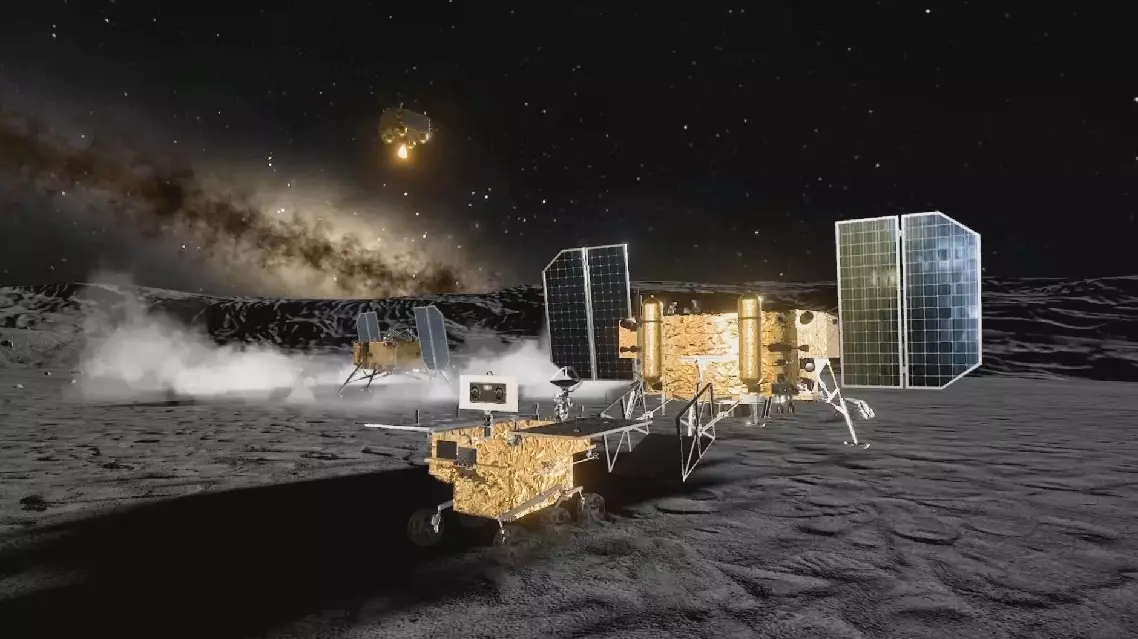
Officials introduces space projects in 15th 5-Year Plan period