MIAMI BEACH, Fla.--(BUSINESS WIRE)--Jun 10, 2025--
The American Black Film Festival (ABFF) is proud to announce a groundbreaking collaboration with the Art in Black Foundation to present The South African Collective —a debut curatorial art exhibition spotlighting five dynamic visual artists from South Africa. The exhibit, open exclusively to festival attendees, will be on view during ABFF, taking place June 12–14, 2025, at the New World Center in Miami Beach. The catalog of available artwork is HERE.
This press release features multimedia. View the full release here: https://www.businesswire.com/news/home/20250610277537/en/
Curated by Allana Foster Finley of Cur8Africa, The South African Collective is the inaugural fine art initiative of the Art in Black Foundation—founded by Ellis Friday, a visionary young creative committed to cultural connection, with support from his parents, Nicole and Jeff Friday. This curated experience marks an evolution in ABFF’s programming, expanding the festival’s cultural offerings to include global visual art in dialogue with Black film, media, and storytelling.
The idea for this collaboration was born during an immersive art tour through South Africa led by curator Allana Foster Finley and attended by Jeff Friday. Inspired by the depth of artistic talent and cultural expression, the journey laid the foundation for what would become this inaugural showcase.
“This exhibition is an exciting step forward in ABFF’s mission to uplift global Black creatives,” said Jeff Friday, founder of ABFF. “We are proud to provide a platform where African art and cinematic storytelling can exist in conversation, inspiring deeper cultural connection.”
Featured Artists:
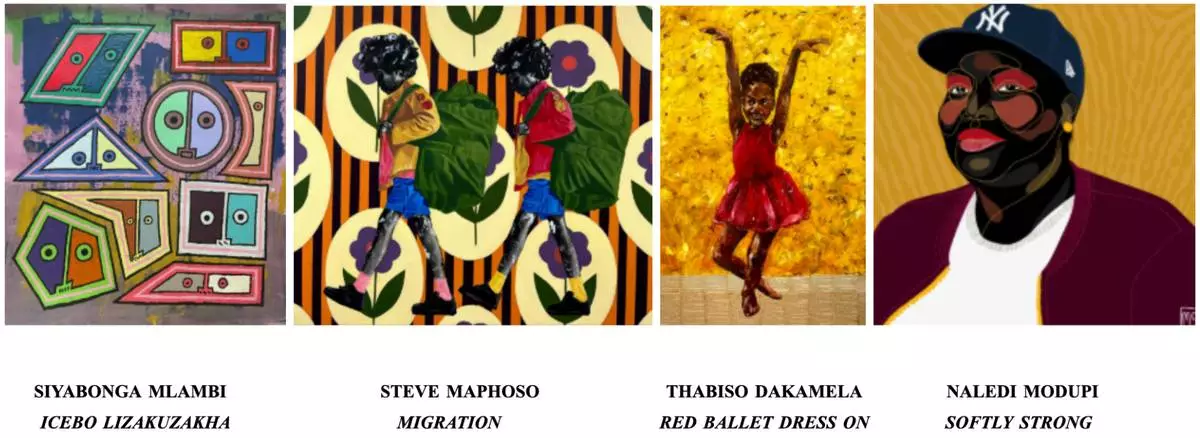
Steve Maphoso - A self-taught Angolan-born artist, Maphoso blends acrylic and charcoal to create emotionally resonant portraits. His current series centers on twin boys guided by ancestral intention, exploring themes of migration, ritual, and brotherhood through symbolic narrative and layered abstraction.
Thabiso Dakamela - With roots in Venda and Ndebele heritage, Dakamela’s Afrocentric work examines identity and emotion. His expressive style—often rendered in powerful blues—has earned national recognition, and his DKS Project House supports emerging artists in South Africa.
Assan Taylor - Known for textured portraits combining oil, charcoal, gold leaf, and found materials, Taylor’s work bridges tradition and innovation. His bold, multilayered pieces reflect the vibrancy of contemporary Southern African culture and human connection.
Siyabonga Mlambi - Originating from South Africa’s Eastern Cape, Mlambi’s art is deeply rooted in Nguni tradition and modern innovation. His unique style, Khanda-Art Superblur African Synthetic Cubism, employs fabric, stones, and mixed media to evoke unity, imagination, and spiritual energy.
Ayanda Moyo - A Zimbabwean artist whose work in charcoal and acrylic explores identity and culture, Moyo’s emotionally rich paintings invite deep reflection on the shared human experience through bold, expressive techniques.
Together, these artists bring their individual perspectives to a collective narrative that intersects visual art with the broader mission of ABFF—celebrating and amplifying Black stories worldwide.
About the Art in Black Foundation
Formerly the Film Life Foundation, the Art in Black Foundation is a 501(c)(3) nonprofit dedicated to uplifting works that reflect the richness and diversity of the Black experience. The organization aims to bridge communities through storytelling across all artistic mediums, highlighting the humanity and creativity of people of African descent.
About the American Black Film Festival (ABFF)
Founded in 1997, the American Black Film Festival is the leading festival dedicated to showcasing film and television content by and about people of African descent. Now in its 29th year, ABFF continues to serve as a vital platform for emerging and established Black artists, attracting attendees from around the world to celebrate the power of storytelling in all its forms.
For updates, visit abff.com and follow @ABFF on Twitter and @AmericanBlackFilmFestival on Instagram and Facebook.
Download Artists’ HeadshotsHERE
Catalog of ArtworkHERE
American Black Film Festival Partners With the Art in Black Foundation to Introduce The South African Collective
DUBAI, United Arab Emirates (AP) — U.S. President Donald Trump said Iran wants to negotiate with Washington after his threat to strike the Islamic Republic over its bloody crackdown on protesters, a move coming as activists said Monday the death toll in the nationwide demonstrations rose to at least 544.
Iran had no immediate reaction to the news, which came after the foreign minister of Oman — long an interlocutor between Washington and Tehran — traveled to Iran this weekend. It also remains unclear just what Iran could promise, particularly as Trump has set strict demands over its nuclear program and its ballistic missile arsenal, which Tehran insists is crucial for its national defense.
Meanwhile Monday, Iran called for pro-government demonstrators to head to the streets in support of the theocracy, a show of force after days of protests directly challenging the rule of 86-year-old Supreme Leader Ayatollah Ali Khamenei. Iranian state television aired chants from the crowd, who shouted “Death to America!” and “Death to Israel!”
Trump and his national security team have been weighing a range of potential responses against Iran including cyberattacks and direct strikes by the U.S. or Israel, according to two people familiar with internal White House discussions who were not authorized to comment publicly and spoke on condition of anonymity.
“The military is looking at it, and we’re looking at some very strong options,” Trump told reporters on Air Force One on Sunday night. Asked about Iran’s threats of retaliation, he said: “If they do that, we will hit them at levels that they’ve never been hit before.”
Trump said that his administration was in talks to set up a meeting with Tehran, but cautioned that he may have to act first as reports of the death toll in Iran mount and the government continues to arrest protesters.
“I think they’re tired of being beat up by the United States,” Trump said. “Iran wants to negotiate.”
He added: “The meeting is being set up, but we may have to act because of what’s happening before the meeting. But a meeting is being set up. Iran called, they want to negotiate.”
Iran through country's parliamentary speaker warned Sunday that the U.S. military and Israel would be “legitimate targets” if America uses force to protect demonstrators.
More than 10,600 people also have been detained over the two weeks of protests, said the U.S.-based Human Rights Activists News Agency, which has been accurate in previous unrest in recent years and gave the death toll. It relies on supporters in Iran crosschecking information. It said 496 of the dead were protesters and 48 were with security forces.
With the internet down in Iran and phone lines cut off, gauging the demonstrations from abroad has grown more difficult. The Associated Press has been unable to independently assess the toll. Iran’s government has not offered overall casualty figures.
Those abroad fear the information blackout is emboldening hard-liners within Iran’s security services to launch a bloody crackdown. Protesters flooded the streets in the country’s capital and its second-largest city on Saturday night into Sunday morning. Online videos purported to show more demonstrations Sunday night into Monday, with a Tehran official acknowledging them in state media.
In Tehran, a witness told the AP that the streets of the capital empty at the sunset call to prayers each night. By the Isha, or nighttime prayer, the streets are deserted.
Part of that stems from the fear of getting caught in the crackdown. Police sent the public a text message that warned: “Given the presence of terrorist groups and armed individuals in some gatherings last night and their plans to cause death, and the firm decision to not tolerate any appeasement and to deal decisively with the rioters, families are strongly advised to take care of their youth and teenagers.”
Another text, which claimed to come from the intelligence arm of the paramilitary Revolutionary Guard, also directly warned people not to take part in demonstrations.
“Dear parents, in view of the enemy’s plan to increase the level of naked violence and the decision to kill people, ... refrain from being on the streets and gathering in places involved in violence, and inform your children about the consequences of cooperating with terrorist mercenaries, which is an example of treason against the country,” the text warned.
The witness spoke to the AP on condition of anonymity due to the ongoing crackdown.
The demonstrations began Dec. 28 over the collapse of the Iranian rial currency, which trades at over 1.4 million to $1, as the country’s economy is squeezed by international sanctions in part levied over its nuclear program. The protests intensified and grew into calls directly challenging Iran’s theocracy.
Nikhinson reported from aboard Air Force One.
In this frame grab from video obtained by the AP outside Iran, a masked demonstrator holds a picture of Iran's Crown Prince Reza Pahlavi during a protest in Tehran, Iran, Friday, January. 9, 2026. (UGC via AP)
In this frame grab from footage circulating on social media from Iran shows protesters taking to the streets despite an intensifying crackdown as the Islamic Republic remains cut off from the rest of the world in Tehran, Iran, Friday, Jan. 9, 2026.(UGC via AP)
In this frame grab from footage circulating on social media from Iran showed protesters once again taking to the streets of Tehran despite an intensifying crackdown as the Islamic Republic remains cut off from the rest of the world in Tehran, Iran, Saturday Jan. 10, 2026. (UGC via AP)