The world's largest liquefied natural gas (LNG) carrier vessel, Offshore Oil 301, completed the largest-scale single refueling in Hong Kong on Tuesday. Offshore Oil 301, which is China's first and the world's largest LNG carrier and refueling ship, refueled 4,300 tons of LNG for the German large container ship Hanoi Express at a speed of over 1,600 cubic meters per hour in one go at Hong Kong's Kwai Tsing Container Terminals.
Hanoi Express departed from Madagascar, passed through Malaysia and Singapore, and then arrived at Hong Kong's Kwai Tsing Container Terminals. After staying there for 24 hours to load and unload cargo, the ship headed to its next destination.
"Through the intelligent monitoring system, we completed the LNG refueling in just eight and a half hours. The refueling would not only meet the fuel demand of the entire voyage of the vessel, but also significantly reduced the port turnover time, setting a new record for the single refueling volume and efficiency in Hong Kong. This is the first time for a Hong Kong terminal to witness LNG refueling for ship, and also the first time that refueling and cargo handling operations were carried out simultaneously," said Kang Huahua, CFO of CNOOC Gas and Power Group.
Hong Kong is the world's seventh largest maritime fuel bunkering port.
Located in the core area of the Asia-Pacific region, Hong Kong witnesses more than 5,000 ocean-going vessels to visit it every year.
In 2024, the Hong Kong Special Administrative Region Government issued the "Action Plan on Green Maritime Fuel Bunkering".
"This operation not only verifies the capabilities of Hong Kong terminals in cryogenic fuel operation, but also holds significant importance to consolidating and enhancing Hong Kong's status as an international shipping center. Next, we will continue to leverage CNOOC's advantages in the entire LNG industrial chain, accelerate the construction of a clean fuel supply network in Hong Kong, and carry out regular refueling services," said Kang.
Data show that the volume of LNG refueling for ships in the Greater Bay Area city cluster in south China, including Hong Kong, increased by 280 percent year on year in 2024.
It is expected that by 2025, the global demand for LNG refueling will exceed 10 million tons, and by 2030, it will grow to 30 to 45 million tons.
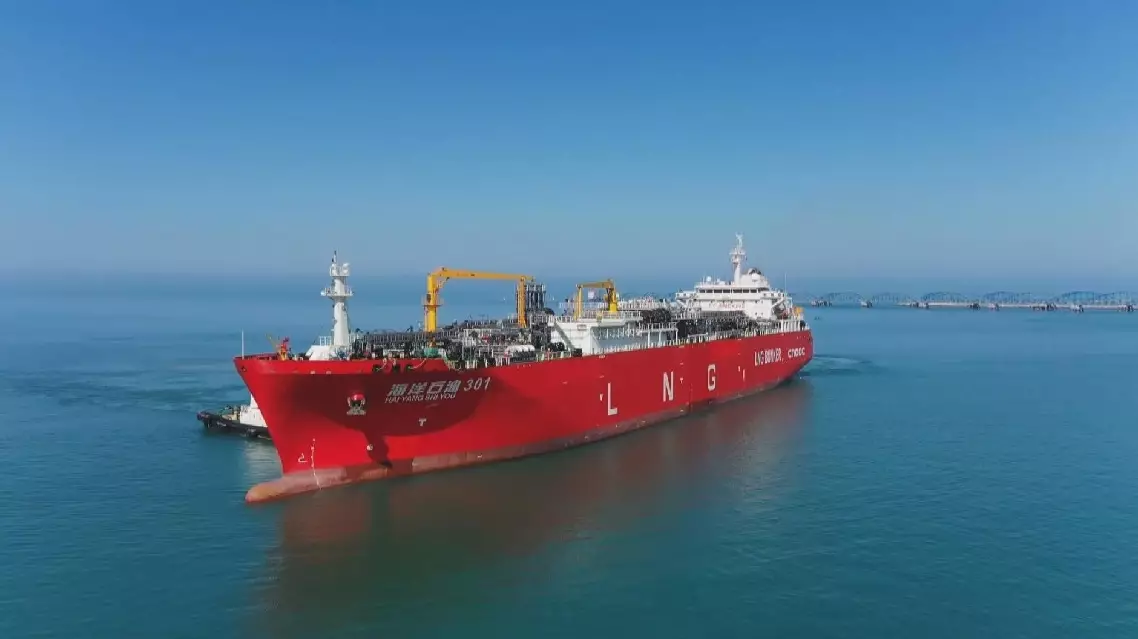
China's first LNG carrier vessel completes largest-scale single refueling in Hong Kong